
Diceratocephalid trilobites from the uppermost Changhia and Kushan formations (Guzhangian, Mialolingian, Cambrian) in North China Platform
JINLIANG YUAN, GUANGYING REN, JIAN GAO, XUEJIAN ZHU, HAIJING SUN, and YIFAN WANG
Yuan, J., Ren, G., Gao, J., Zhu, X., Sun H., and Wang, Y. 2026. Diceratocephalid trilobites from the uppermost Changhia and Kushan formations (Guzhangian, Mialolingian, Cambrian) in North China Platform. Acta Palaeontologica Polonica 71 (2): 297–322.
Examination of type material of the type species of Wongia, W. triangulata and new material from the uppermost Changhia Formation and Kushan Formation, in Shandong and Liaoning, necessitates transfer of the genus from Avoninidae to Diceratocephalidae. Many species, formerly assigned to Cyclolorenzella or Jiulongshania, are re-assigned to Wongia. Because Agraulos acalle the type species of Jiulongshania is assigned to Wongia, Jiulongshania is synonymized with Wongia. Jiulongshania was previously assigned to Inouyiidae but as a synonym of Wongia belongs to the Diceratocephalidae. Cyclolorenzella is also revised based on new material. Cyclolorenzella is distinguished from Wongia in having a relatively larger, subquadrate cranidium, with a shorter frontal area, longer occipital spine, and a transverse semi-ellipticalsemi-elliptical pygidium, without a narrow pygidial border, but with a weak posteromedian embayment. Three new species: Wongia nanzhaocunensis Yuan, Wongia laevigate Yuan, and Torifera intermedia Yuan, Ren & Gao are erected. Ranges of the constituent species of Wongia, Cyclolorenzella, and Torifera between the Damesella paronai–Ajacicrepida ajax Zone of the uppermost Changhia Formation to the Diceratocephalus armatus Zone of the uppermost Kushan Formation are detailed. This study facilitates the subdivision of pre-established fossil zones and the establishment of biozones based on the First Appearance Datum (FAD) of species, enabling the determination of the sequence of genera and species appearances in the stratigraphic record. It also contributes to the global correlation of the base of the Guzhangian and Paibian Stage in North China Platform.
Key words: Trilobita, Diceratocephalidae, Wongia, Cyclolorenzella, Torifera, Guzhangian, Miaolingian, Cambrian, North China Platform.
Jinliang Yuan [yuanjl403@126.com; ORCID: https://orcid.org/0009-0062-5110-8639 ], Institute of Geology and Palaeontology, Linyi University, Middle of Shuangling Road, Linyi, 276000, China; Nanjing Institute of Geology and Palaeontology, Chinese Academy of Sciences, 39 East Beijing Road, Nanjing, 210008, China; State Key Laboratory of Palaeontology and Stratigraphy, Nanjing Institute of Geology and Palaeontology, Chinese Academy of Sciences, 39 East Beijing Road, Nanjing, 210008, China.
Guangying Ren [gyren@lyu.edu.cn; ORCID: https://orcid.org/0009-0009-1030-0342 ] (corresponding author), Institute of Geology and Palaeontology, Linyi University, Middle of Shuangling Road, Linyi, 276000, China.
Jian Gao [gaoeuler@aliyun.com; ORCID: https://orcid.org/0000-0001-8817-8599 ], Xuejian Zhu [xjzhu@nigpas.ac.cn; ORCID: https://orcid.org/0000-0002-0524-3664 ], and Haijing Sun [hjsun@nigpas.ac.cn; ORCID: https://orcid.org/0000-0001-9647-0709 ], Nanjing Institute of Geology and Palaeontology, Chinese Academy of Sciences, 39 East Beijing Road, Nanjing, 210008, China; State Key Laboratory of Palaeontology and Stratigraphy, Nanjing Institute of Geology and Palaeontology, Chinese Academy of Sciences, 39 East Beijing Road, Nanjing, 210008, China.
Yifan Wang [wangyifan71@lyu.edu.cn; ORCID: https://orcid.org/0000-0003-3395-6407 ], Institute of Geology and Palaeontology, Linyi University, Middle of Shuangling Road, Linyi, 276000, China.
Received 9 September 2025, accepted 18 February 2026, published online 24 June 2026.
Copyright © 2026 J. Yuan et al. This is an open-access article distributed under the terms of the Creative Commons Attribution License (for details please see http://creativecommons.org/licenses/by/4.0/), which permits unrestricted use, distribution, and reproduction in any medium, provided the original author and source are credited.
Introduction
Wongia, with W. triangulata Sun, 1924, as its type species, was based on poorly preserved cranidia from the Cambrian (Guzhangian, Miaolingian) succession in North China and Korea. However, the supposed proparian course of the facial suture and the long spine thought to be metafixigenal, resulted in assignment to the Avoninidae Lochman, 1936 (Harrington et al. 1959; Lu et al. 1963, 1965; Jell and Adrain 2003; Zhu 2008). Sunʼs (1924) type material from the Blackwelderia Zone of the Kushan Formation, Lincheng County, Hebei, together with a large quantity of new material from the Kushan Formation and the uppermost Changhia Formation in Shandong, Hebei and eastern Liaoning, show this interpretation to have been in error. Cyclolorenzella, with Lorenzella quadrata Kobayashi, 1935, as its type species, was also based on a poorly preserved cranidium and also occurs in the Cambrian (Guzhangian, Miaolingian) succession in North China and Korea. Although emended and discussed in detail (Park et al. 2008), the relative rarity of specimens has hampered full understanding of the type species and reliable identification of members of the genus. Following Park et al. (2008), only Cyclolorenzella quadrata (Kobayashi, 1935), and C. convexa (Resser and Endo in Endo and Resser, 1937) remain in the genus, which is confined to a narrow stratigraphic interval within the Drepanura Zone (=Neodrepanura Zone) of the Kushan Formation, North China and the Sesong Formation, Korea. Examination of the types of Wongia triangulata and new collections from North China (Fig. 1) demonstrates that most of the species formerly assigned to Cyclolorenzella or Jiulongshania (considered herein as synonymous with Wongia) are re-assigned to Wongia. Cyclolorenzella sp. from the Lejopyge armata Zone of the Machari Formation, Yongwol Group, Korea (Hong et al. 2003), and Cyclolorenzella distincta Zhang, 1985, from the upper Hulusitai Formation, are assigned to Cyclolorenzella. Torifera Wolfart, 1974, with T. triangularis Wolfart, 1974, as its type species, known from Afghanistan, Himalaya (India), Iran, Oman, Vietnam, South China (northwestern Hunan, eastern Guizhou, western and southeastern Yunnan, southeastern Sichuan, western Guangxi and southern Jiangsu), is recorded in North China for the first time. The main aim of this study is to provide a thorough reassessment of Wongia, Jiulongshania, Cyclorenzella, and Torifera.
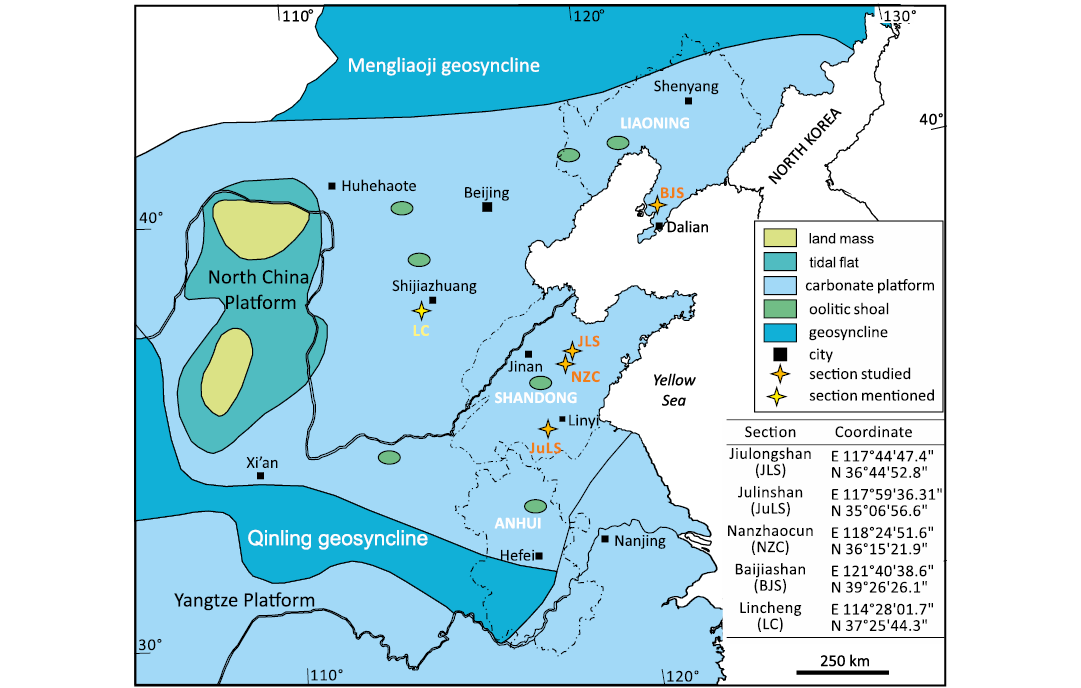
Fig. 1. Palaeogeographic map of the North China Platform in the middle to late Cambrian (Guzhangian–Paibian) with locations of the studied sections (modified after Feng et al. 2002; Wang et al. 2020).
Institutional abbreviation.—NIGP, Nanjing Institute of Geology and Palaeontology, Nanjing, China; USNM, United States National Museum, Washington, D.C., USA; SG, Shenyang Institute of Geology and Mineral Resources, Chinese Academy of Gelological Sciences, Shenyang, Liaoning, China.
Other abbreviations.—BAS, Baijiashan; exsag., exsagittal; jls, jiulongshan; ju, julinshan; NZC, Nanzhaocun; S1–S3, the first to third pair of lateral glabellar furrows; sag., sagittal; tr., transversal.
Nomenclatural acts.—This published work and the nomenclatural acts it contains, have been registered in Zoobank: urn:lsid:zoobank.org:pub:F3FCCD0A-6952-4504-A4EF-9F0ACBA613B5
Geological setting
The material used in the present paper were mainly collected from: (i) the Jiulongshan section (36°44’52.8’’ N, 117°44’47.4’’ E), Gangcheng District, Jinan City, Shandong; (ii) the Julinshan section (35°06’56.6’’ N, 117°59’36.31’’ E), at Renhezhuang Village, Feixian County, Linyi City, Shandong; (iii) the Nanzhaocun section (36°15’21.9’’ N, 118°24’51.6’’ E), Linqu County, Weifang City, Shandong; and (iv) from the Baijiashan section (39°26’26.1’’ N, 121°40’38.6’’ E), Dalian City, Liaoning (Fig. 1). The Cambrian succession of Shandong includes, in ascending order: the Liguan, Zhushadong, Manto, Changhia, Kushan, and Chaumitien formations (Zhang and Liu 1996), and in eastern Liaoning, the Cambrian succession consists of the Dalinzi, Getun, Jichang (= Changping), Sanqi (= lower Manto), Tangshih (= upper Manto), Taitzu (= Changhia), Kushan, Changshan and Fengshan (= Chaumitien) formations (Duan et al. 2005).
Wongia occurs in the uppermost part of the Changhia Formation and the Kushan Formation (Guzhangian) with the exception of Wongia acuta (Duan in Duan et al., 2005), which questionably occurs in the upper Manto Formation (upper Xuzhuagian Stage = ?upper Wuliuan), and Wongia humilis (Zhang in Qiu et al., 1983), which questionably occurs in the Changshanian Stage (the Chaumitien Formation, Furongian).
The uppermost Changhia Formation in Jiulongshan section (ca. 3–20 m thick) is mainly composed of light grey, thin- to medium-bedded limestone. The Kushan Formation in both the Jiulongshan and Julinshan sections is predominantly grey to yellowish-brown shale intercalated with grey to dark grey, thin-bedded limestone, and calcareous nodules or calcareous mudstone in the lower part (ca. 10–30 m thick). The middle part of the Kushan Formation (ca. 25–35 m thick) is mainly composed of grey to light grey thin-bedded to medium-bedded limestone and grey thin-bedded intraclastic rudstone, alternating with a few grey shale intervals. The upper part (ca. 30–40 m thick) chiefly consists of thin-bedded to medium-bedded bioclastic wackestones, grey slabby limestone, grey thin-bedded limestone-shale couplets, and occasionally intercalated with grey, thin- to medium-bedded oolitic limestone in the uppermost part.
Systematic palaeontology
The terminology and systematic classification follow that of the revised edition of the Treatise on Invertebrate Palaeontology (Whittington and Kelly 1997).
Class Trilobita Walch, 1771
Order Ptychopariida Swinnerton, 1915
Family Diceratocephalidae Lu, 1954
Genus Wongia Sun, 1924
Type species: Wongia triangulata Sun, 1924, from the Wongia triangulata Zone of the Kushan Formation, Lincheng County, Hebei, China.
Species included: Wongia acalle (Walcott, 1905), Wongia rotundata (Resser & Endo in Endo and Resser, 1937), Wongia triangulata Sun, 1924, Wongia subcylindrica (Chu, 1959), Wongia regularis regularis (Walcott, 1906), Wongia regularis pustulosa (Chu, 1959), Wongia acuta (Duan in Duan et al., 2005), Wongia humilis (Zhang in Qiu et al., 1983), Wongia magezhuangensis (Zhang & Wang, 1986), Wongia valida (Nan & Chang, 1985), Wongia longa (Park, Han, Bai & Choi, 2008), Wongia nanzhaocunensis Yuan sp. nov., and Wongia laevigate Yuan sp. nov.
Emended diagnosis.—Small diceratocephalid; cephalon with or without genal spine; axial furrow broad and deep; cranidium triangular to subtrapzoidal, with gently to strongly convex preglabellar boss defined by a pair of short, divergent furrows on frontal area, anterior margin more strongly bending forward; anterior border very narrow and low, anterior border furrow indistinct; glabella short, conical, subconical or subcylindrical, with 3 pairs of faintly impressed lateral glabellar furrows; occipital ring convex, semi-elliptical; opisthoparian facial suture, posterior branch of facial suture slanting outwards, bending near a small node located at the end of the posterior border furrow, then slightly to strongly slanting inwards, cutting the posterior border; posterior border narrower (tr.) than basal glabellar width, with obtuse intergenal angle, posterior border furrow shallow, slightly bending forwards distally; librigena narrow, sloping outwards; palpebral lobe short to moderately long, 1/3 size of the glabella. Thorax of 8 segments. Pygidium convex, rhombic, anterior margin bent strongly posteriorly at fulcrum, lateral margin long, strongly slanting backwards, acutely rounded laterally, posterior margin very broad, well rounded gently bending backwards; axial furrow very shallow, axis broad and long, tapering backwards, with 3–5 axial rings, axial ring furrows long and shallow, each pleural field as wide as axis, pleural lobe with or without terrace lines, pygidial border narrow and flat; surface finely granulose or smooth.
Remarks.—Wongia differs from Cyclolorenzella mainly in lacking a long occipital spine, in its subtriangular to subtrapezoidal cranidium with more strongly bending forward anterior margin, shorter (sag.) and slender (tr.) conical to subconical glabella, shorter (sag.) palpebral lobe located at anteriorly, posterior branches of facial sutures slanting outwards, bending near a small node located at the end of the posterior border furrow, then slightly to strongly slantng inwards, and its rhombic pygidium without posteromedian indentation. Wongia differs from Torifera Wolfart, 1974, chiefly in the latter having distinct anterior border furrow, a low baccula at the posteroproximal corner of the fixigena, broader fixigenae between palpebral lobes, and a shorter (sag.), wider (tr.) elliptical pygidium. In the general configuration of the cranidium and glabella, the type species of Jiulongshania, Agraulos acalle Walcott, 1905, is quite similar to the type species of Wongia, W. triangulata but differs from the latter mainly by its shorter genal spine directed at a different angle. Jiulongshania belongs in Wongia.
Stratigraphic and geographic range.—The uppermost Changhia Formation–uppermost Kushan Formation, Damesella paronai–Ajacicrepida ajax Zone to the Diceratocephalus armatus Zone, Guzhangian, Miaolignian, Cambrian; North-Northeast China and South Korea.
Wongia triangulata Sun, 1924
Fig. 2.
1924 Wongia triangulata Sun 1924: 85, pl. 5: 12a, b.
1956 Wongia triangularis Sun; Wang et al. 1956: 142, text–fig. 1.
1957 Wongia triangulata Sun; Lu 1957: 273, pl. 143: 17.
1959 Wongia triangulata Sun; Harrington et al. 1959: 283, text-fig. 209-3.
1960 Wongia triangulata Sun; Kobayashi 1960: 387: text-fig. 9h.
1965 Wongia triangulata Sun; Lu et al. 1965: 259, pl. 44: 2, 3.
1989 Cyclolorenzella longispina Wittke & Zhu; Zhu and Wittke 1989: 214, pl. 3: 13.
2008 Cyclolorenzella longispina Wittke & Zhu in Zhu and Wittke; Yang 2008: 107, pl. 13: 26–28; pl. 14: 1–3, 5–7, 9, 13, 18, 19 [not figs. 4, 8, 10–12, 14–17, 20, 21]; pl. 15: 1–13, 15–20, 22, 23, 25–32, 34, 35 [not figs. 14, 21, 24, 33].
2008 Jiulongshania longispina (Wittke & Zhu in Zhu and Wittke); Park et al. 2008: 260, fig. 7O–Q [non fig. 7A–K, L–N].
2013 Jiulongshania longispina (Wittke & Zhu in Zhu and Wittke); Park et al. 2013: 998, fig. 5.1–5.17.
2017 Wongia triangulata Sun; Ren 2017: 111, pl. 18: 12, 13, [non figs. 14, 15]; non pl. 42: 5.
2017 Wongia rotundata (Resser & Endo in Endo and Resser, 1937); Ren 2017: 114, pl. 18: 19, [non figs. 18, 20, 21].
2020 Jiulongshania longispina (Wittke & Zhu in Zhu and Wittke); Peng 2020: 458, pl. 203: 2, 6, [non figs. 1, 3–5, 7].
2023 Wongia triangulata Sun; Lei 2023: 9, 10, pl. 3: 11, ?12, 13, ?14, ?15.
Holotype: NIGP 628b, cranidium with partly librigena (Sun 1924: pl. 5: 12a; Fig. 2I).
Type locality: Lincheng County, Hebei Province, China.
Type horizon: Kushan Formation (Blackwelderia Zone), Guzhangian, Miaolingian, Cambrian.
Material.—Six cranidia and two pygidia (NIGP 205906–205913), all from Kushan Formation (Guangzhangia), Shandong Province, China.
Emended diagnosis.—Cephalon moderately vaulted, with moderately long genal spine directed posterolaterally at about 45° to the saggital line; cranidium triangular, glabella convex, subconical, with 3 pairs of shallow lateral furrows; librigena narrow, strongly sloping outwards; palbebral lobe moderately long, crescentic, located at opposite the anterior portion of the glabella, about 0.4 times as long as glabella. Pygidium short and convex, rhombic, acutely rounded laterally, axial furrow shallow; axis broad and long, distinctly tapering backwards, with 3–4 axial rings and a terminal piece, axial ring furrows very shallow, pleural field as wide as axis; surface smooth, or covered with 10–11 transverse teracelines; pygidial border very narrow and flat.
Description.—Cephalon moderately vaulted, with moderately long genal spine directed posterolaterally at about 45° an angle to the saggital line; axial furrow broad and deep; cranidium inflated, triangular, with distinct convex preglabellar boss defined by a pair of anteriorly divergent furrows on frontal area; glabella subconical, with 3 pairs of shallow lateral furrows; anterior branches of facial sutures parallel or slightly convergent forward, posterior branches divergent outwards, bending near a small node located at the end of the posterior border furrow, then slighty slantng inwards (Fig. 2G); eye ridge horizontal; palpebral lobe moderately long, crescentic, between middle and anterior of glabella, about 0.4 times as long as glabella; posterior border narrower (tr.), about 0.8 times as wide as basal glabellar width, with obtuse intergenal angle, posterior border furrow shallow, slightly bending forwards distally; librigena narrow, strongly sloping outwards; occipital ring semi-elliptical, with a small occipital node anteriorly; occipital furrow shallow. Pygidium rhombic, acutely rounded laterally; axial furrow very shallow; axis convex, broad and long, tapering backwards, with 3–4 axial rings and a terminal piece, axial ring furrows very shallow; pleural field as wide as axis, surface smooth or covered with terrace lines on pleural areas, pleural furrows very weakly impressed; pygidial border very narrow and flat.
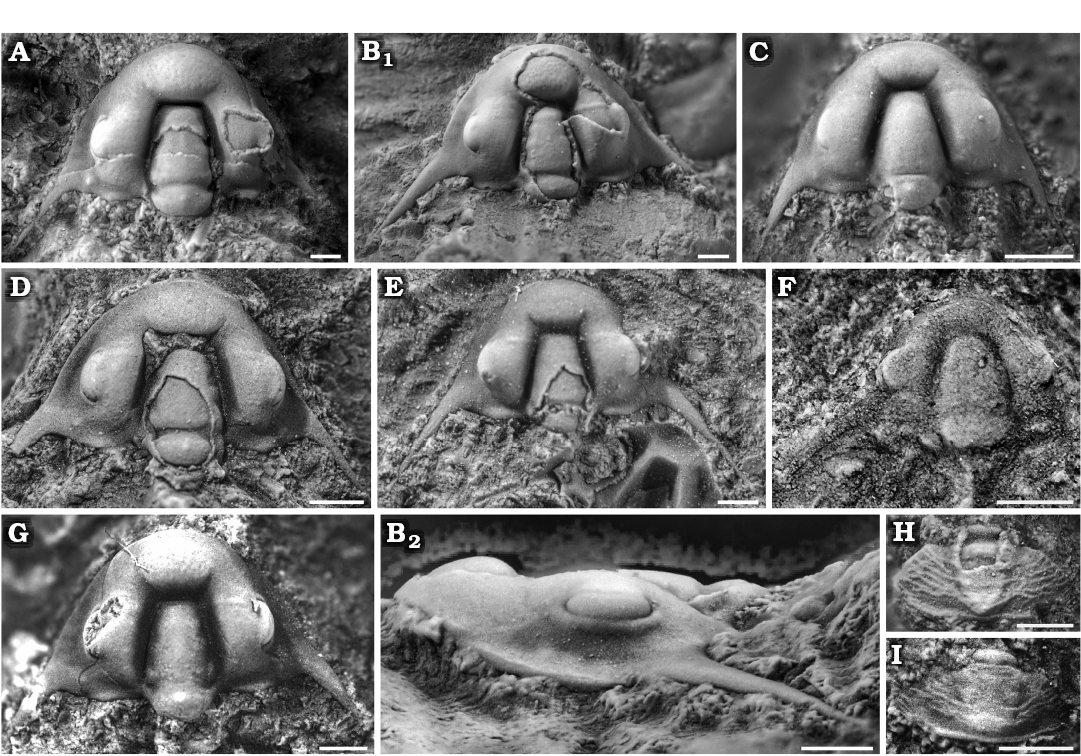
Fig. 2. Diceratocephalid trilobite Wongia triangulata Sun, 1924, from Guangzhangian, Miaolingian (Cambrian), the Kushan Formation of China, the Wongia triangulata Zone, Jiulongshan section, Shandong Pronvince (A–E; G–I), and Blackwelderia Zone (= Wongia triangulata Zone), Lincheng County, Hebei Pronvince (F). A. NIGP205906 (field no. jls 124), cephalon in dorsal view. B. NIGP205907 (field no. jls 126), cephalon in dorsal (B1) and lateral (B2) views. C. NIGP00205908 (field no. jls124), cephalonin dorsal view. D. NIGP00205909 (field no. jls124), cephalonin dorsal view. E. NIGP00205910 (field no. jls124), cephalonin dorsal view. F. Holotype NIGPG.S.Ch,6286, incomplete cephalonin dorsal view. G. NIGP 205911 (field no. jls316-2), cephalonin dorsal view. H. NIGP205912 (field no. jls124), pygidiumin dorsal view. I. NIGP205913 (field no. jls126), pygidium. Scale bars: A, B, D, E, G, 500 μm; C, F, H, I, 200 μm.
Remarks.—In the general configuration of the cephalon and pygidium, especially in having relatively long genal spine, W. triangulata is quite similar to W. subcylindrica (Chu, 1959). However, it differs from the latter in having a triangular cranidium with distinct convex preglabellar boss and a subconical glabella, and the genal spine being directed posterolaterally at about 45° to the saggital line, whereas the latter possessed a subquadrate cranidium with an indistinct convex preglabellar boss, and the genal spine is directed posterolaterally at about 60–80° to the saggital line.
Stratigraphic and geographic range.—Kushan Formation, Wongia triangulata Zone, Guzhangian, Miaolingian, Cambrian; Jiulongshan section, Gangcheng District, Jinan City, Shandong, China.
Wongia acalle (Walcott, 1905)
Fig. 3.
1905 Agraulos acalle; Walcott 1905: 43.
1913 Inouyia? acalle (Walcott); Walcott 1913: 150, pl. 14: 15.
1935 Lorenzella acalle (Walcott); Kobayashi 1935: 253.
1937 Lorenzella? ogurai Resser & Endo; Endo and Resser 1937: 232, pl. 51: 17–19.
1959 Lorenzella kushanensis; Chu 1959: 61, 99, pl. 2: 14, 15.
1960 Cyclolorenzella acalle (Walcott); Kobayashi 1960: 389.
1960 Cyclolorenzella ogurai (Resser & Endo); Kobayashi 1960: 389.
1965 Cyclolorenzella acalle; Lu et al. 1965: 251, pl. 42: 16, 17.
1965 Cyclolorenzella ogurai; Lu et al. 1965: 255, pl. 43: 16–18.
1965 Cyclolorenzella kushanensis (Chu); Lu et al. 1965: 252, pl. 42: 21, 22.
1980 Cyclolorenzella normalis Zhou; Zhou and Zheng 1980: 65, pl. 1: 3, 4.
1982 Cyclolorenzella normalis; Zhou et al. 1982: 248, pl. 62: 12, 13.
1986 Cyclolorenzella kushanensis (Chu); Zhang and Wang 1986: 405, pl. 122: 11, 12.
1985 Cyclolorenzella denotata; Nan and Chang 1985: 11, pl. 1: 22–25.
1987 Cyclolorenzella acalle (Walcott); Zhang and Jell 1987: 132, pl. 51: 1–4, [non figs. 5–7].
1989 Cyclolorenzella hebeiensis hebeiensis Wittke & Zhu; Zhu and Wittke 1989: 214, pl. 5: 6–8.
1989 Cyclolorenzella hebeiensis tangshanensis Wittke & Zhu; Zhu and Wittke 1989: 214, pl. 5: 9–12.
1989 Cyclolorenzella uniforma Wittke & Zhu; Zhu and Wittke 1989: 214, pl. 3: 11, 12; pl. 5: 13, 14.
1992 Cyclolorenzella acalle (Walcott); Zhu 1992: 345, pl. 117: 14.
non 1996 Cyclolorenzella acalle (Walcott); Guo et al. 1996: 114, pl. 59: 12–16.
non 2001 Cyclolorenzella acalle (Walcott); Luo 2001: 379, pl. 4: 11b, c, 17.
2008 Cyclolorenzella acalle (Walcott); Yang 2008: 100, pl. 13: 1–9, 11–14, 16–25, 27, 29, 30; pl. 16: 18–21, 24, 27; text fig. 17.1–17.3).
2008 Jiulongshania acalle (Walcott); Park et al. 2008: 256, fig. 5A–C, F–N, P–W, [non fig. 5D, E, O].
part 2008 Cyclolorenzella magezhangensis; Zhang & Wang 2008: 1986, fig. 22B, C (right cranidium and librigenae), pl. 13: 10, 15, 26 [not fig. 22A (left cranidium)].
2010 Jiulongshania acalle (Walcott); Chough et al. 2010: 266, fig. 15a.
2012 Jiulongshania acalle (Walcott); Yuan et al. 2012: 371, pl. 223: 1–15; pl. 224: 10, 12–14; pl. 225: 14, 15.
2017 Wongia acalle (Walcott); Ren 2017: 112–114, pl. 18: 9–11, [non fig. 8]; pl. 41: 20; pl. 42: 1–4.
2020 Jiulongshania acalle (Walcott); Peng 2020: 456, pl: 8–14.
Holotype: USNM 58023, cranidium (Walcott 1913: pl. 14: 15; Zhang and Jell 1987: pl. 51: 1).
Type locality: Southwest of Yanzhuag Town, Laiwu District, Jinan City, Shandong Province, China.
Type horizon: Kushan Formation Guzhangian (Damesella paronai–Teinistion typicalis Zone), Miaolingian, Guzhangian, Cambrian.
Material.—Two cephala, eleven cranidia, two pygidia, and one hypostome (NIGP 205914–205929), all from Kushan Formation (Guangzhangia), Shandong Province, China.
Emended diagnosis.—Cephalon with moderately long genal spine directed posteriorly to posterolaterally at approximately 15–30° to sagittal line; cranidium inflated, triangular, with moderately convex preglabellar boss defined by a pair of short, distinctly divergent furrows on frontal area; glabella conical, 3 pairs of glabellar furrows short and shallow; anterior branches of facial sutures slightly convergent anteriorly, posterior branches slanting outwards, gently bending backwards near proximal end of posterior border furrow (Fig. 3P); posterior border gently convex, about 0.6–0.7 times as wide as glabella at the base, without intergenal angle; palpebral lobe short, crescentic, located between middle and anterior of glabella; pygidium rhombic, acutely rounded laterally; axial furrow very shallow; axis convex, broad and long, tapering backwards, with 3–4 axial rings and a terminal piece.
Description.—Cephalon with moderately long genal spine directed posteriorly to posterolaterally at approximately 15–30° to sagittal line; axial furrow broad and deep; cranidium inflated, triangular, with moderately convex preglabellar boss defined by a pair of short strongly divergent furrows on frontal area; glabella conical to subconical, with 3 pairs of short and shallow lateral furrows; anterior branches of facial sutures slightly convergent forward, posterior branches slanting outwards, gently bending backwards near proximal end of posterior border furrow (Fig. 3P); palpebral lobe short, crescentic, located between middle and anterior of glabella; eye ridge faint, transverse; posterior border gently convex, about 0.6–0.7 times as wide as glabella at the base, without intergenal angle; librigena narrow, strongly sloping outwards; occipital ring broad (sag.), semi-elliptical, with a small occipital node in the centre, and with a few terrace lines on the posterior part; occipital furrow shallow. Hypostome very small, subovate, and divided into an ovoid central body and a crescentic posterior lobe, with a pair of small suboval maculae behind the very shallow middle furrow. Pygidium rhombic, acutely rounded laterally; axial furrow very shallow; axis convex, broad and long, tapering backwards, with 3–4 axial rings and a terminal piece, axial ring furrows very shallow, but on exfoliated specimens axial ring furrows broad and deep, disconnected with axial furrow; pleural field as wide as axis, surface smooth or with weakly impressed terrace lines on pleural areas. Pleural furrows very weakly impressed; pygidial border very narrow and flat.
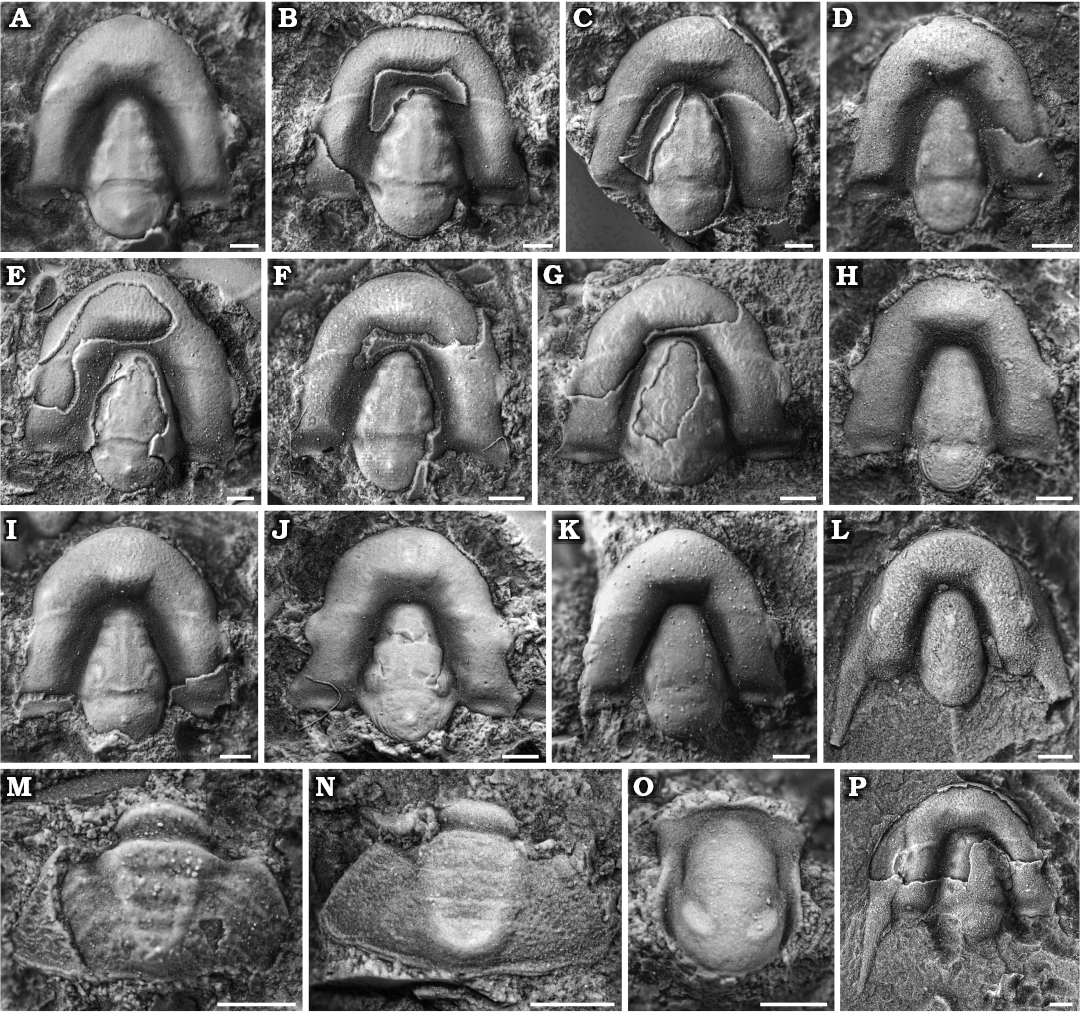
Fig. 3. Diceratocephalid trilobite Wongia acalle (Walcott, 1905) from Guangzhangian, Miaolingian (Cambrian), the Kushan Formation of China, the Damesella paronai–Teinistion typicalis Zone, Jiulongshan (D, H, J, N, O), Julinshan (A–C, E–G, I, K, M) and Helilu (L, P) sections, Shandong Pronvince. A. NIGP205914 (field no. Ju-2-R6-2), cranidium. B. NIGP205915 (field no. Ju-2-R6-2), cranidium. C. NIGP205916 (field no. Ju-2-RBD), cranidium. D. NIGP205923 (field no. jls102), cranidium. E. NIGP205917 (field no. Ju-2-R6-2), cranidium. F. NIGP205918 (field no. Ju-2-R6-2), cranidium. G. NIGP205919 (field no. Ju-2-R7-2), cranidium. H. NIGP205924 (field no. jls102), cranidium. I. NIGP205920 (field no. Ju-2-R6-2), cranidium. J. NIGP205925 (field no. jls102), cranidium. K. NIGP205921 (field no. Ju-2-R6-2), cranidium. L. NIGP205928 (field no. hl-16), cephalon. M. NIGP205922 (field no. Ju-2-R6-2), pygidium. N. NIGP205926 (field no. jls102), pygidium. O. NIGP205927 (field no. jls102), hypostome. P. NIGP205929 (field no. hl-16), cephalon. All in dorsal view. Scale bars: A–N, 500 μm; O, 200 μm; P, 1 mm.
Remarks.—This species is characterized by a pair of strongly divergent, short furrows on the frontal area, with a moderately convex preglabellar boss, librigenae with a moderately long genal spine directed posteriorly to posterolaterally at about 15–30° to the sagittal line, conical glabella with short, faint glabellar furrows, and a rhombic pygidium, with a relatively broad longer axis. In the general configuration of the cranidium and glabella, this species is quite similar to the type species, Wongia triangulata but differs from the latter mainly by its shorter genal spine directed at a different angle. The cranidium has a less convex preglabellar boss, defined by a pair of shorter strongly divergent furrows on the frontal area; it also shows a conical to subconical glabella, shorter palpebral lobes located between the middle and anterior portion of glabella, and the posterior branches of the facial sutures gently bending backwards near proximal end of posterior border furrow, posterior border gently convex, about 0.6–0.7 times as wide as glabella at the base, without intergenal angle.
Stratigraphic and geographic range.—Damesella paronai–Teinistion typicalis Zone of the Kushan Formation, Guzhangian, Miaolignian, Cambrian; Jiulongshan and Julinshan sections, Shandong, China.
Wongia subcylindrica (Chu, 1959)
Fig. 4.
1959 Lorenzella subcylindriica; Chu 1959: 60, 98, pl. 2: 11–13.
1960 Cyclolorenzella subcylindrica (Chu); Kobayashi 1960: 389.
1965 Cyclolorenzella subcylindrica (Chu); Lu et al. 1965: 254, pl. 43: 8, 9.
2008 Jiulongshania subcylindrica (Chu), Park et al. 2008: 256.
2008 Cyclolorenzella longispina (Wittke & Zhu in Zhu and Wittke); Yang 2008: 107–109, [non pl.13: 26–28], pl. 14: 4, 8, 10, 11, 12, 14–17, 20, 21, [non figs. 1–3, 5–7, 9, 13, 18, 19], pl. 15: 14, 21, 24, 33, [non figs. 1–13, 15–20, 22, 23, 25–32, 34, 35].
2008 Jiulongshania longispina (Wittke & Zhu in Zhu and Wittke); Park et al. 2008: 260, fig. 7A–K, L–N, [non fig. 7O–Q].
2012 Jiulongshania subcylindrica (Chu); Yuan et al. 2012: 369.
2017 Wongia triangulata Sun; Ren 2017: 111–112, pl. 18: 14, 15, [non figs. 12, 13]; pl. 42: 5.
2020 Jiulongshania longispina (Wittke & Zhu in Zhu and Wittke); Peng 2020: 458, pl. 203: 1, 3–5, 7, [non figs. 2, 6].
Holotype: NIGP 9456, a pygidium (Chu 1959: pl. 2: 13).
Type locality: Jiulongshan and Julinshan sections, [Yaopu (=Yaobao), Dongsanli, Tienshihfu, Penchi (=Benxi) district of Liaoning], Shandong Province, China.
Type horizon: Kushan Formation (Blackwelderia Zone), Guzhangian, Miaolingian, Cambrian
Material.—Five cephala, one cranidium, and three pygidia (NIGP 205930–205938), all from the type locality and horizon.
Emended diagnosis.—Cephalon with long genal spine directed laterally and slightly posteriorly, lies anterior to the genal angle, at approximately 70–80° angle to the sagittal line; cranidium inflated, trapezoidal to subquadrate, with very narrow anterior border, and with a small, weakly convex preglabellar boss, weakly defined by a pair of very short divergent furrows on frontal area, which is strongly sloping outwards; glabella convex, subcylindrical to truncated conical, with 3 pairs of very shallow lateral furrows; librigena steeply sloping outwards; palpebral lobe short, located at a level with middle of glabella. Pygidium short, broad and convex, subfusiform, axis broad and long, tapering backwards, with 5–6 axial rings, axial ring furrows very shallow; pleural field as wide as axis, with or without trasverse terrace lines, pygidial border very narrow and gently convex.
Description.—Cephalon with very long genal spine projecting laterally and slightly posteriorly at about 70–80° to the saggital line; axial furrow broad and deep; cranidium inflated, trapezoidal to subquadrate, with smaller weakly convex preglabellar boss defined by a pair of short, indistinct divergent furrows on frontal area; glabella convex, truncated conical to subcylindrical, with 3 pairs of shallow lateral furrows; anterior branches of facial sutures parallel forward or slightly divergent forward, posterior branches distinctly divergent outwards, bending inwards near a small node located at the end of the posterior border furrow, then cutting the posterior border; posterior border narrow (tr.), about 0.9 times as wide as basal glabellar width,with an obtuse intergenal angle; palbebral lobe moderately long, crescentic, located opposite to anterior potion of glabella; eye ridge faint; librigena narrow, steeply sloping outwards; occipital ring narrow (sag.) and gently convex, semi-elliptical semi-elliptical, with a small occipital node medially; occipital furrow narrow and shallow. Pygidium broad (tr.), subfusiform, acutely rounded laterally; axial furrow very shallow; axis convex, broad and long, tapering backwards, with 4–5 axial rings and a terminal piece, axial ring furrows very shallow; pleural field as wide as axis, surface smooth or covered with terrace lines on pleural areas, pleural furrows very weakly impressed; pygidial border very narrow and gently convex.
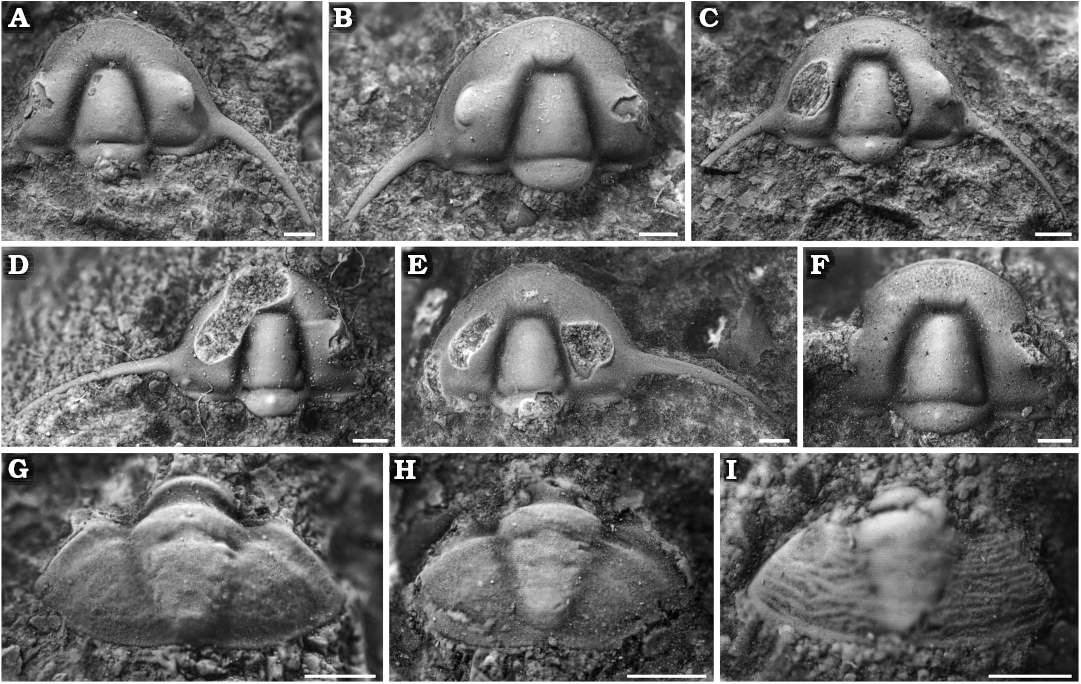
Fig. 4. Diceratocephalid trilobite Wongia subcylindrica (Chu, 1959) from Guangzhangian, Miaolingian (Cambrian), the Kushan Formation of China, the Wongia subcylindrica Zone, Jiulongshan (D, E, H) and Julinshan (A–C, F, G, I) sections, Shandong Pronvince. A. NIGP205930 (field no. ju-4-E11), incomplete cephalon. B. NIGP205931 (field no. ju-4-E6), incomplete cephalon. C. NIGP205932 (field no. ju-4-E9), cephalon. D. NIGP205936 (field no. jls-134), incomplete cephalon. E. NIGP2059307 (field no. jls-136), incomplete cephalon. F. NIGP205933 (field no. ju-4-E7), cranidium. G. NIGP205934 (field no. ju-4-E3), pygidium. H. NIGP205938 (field no. jls.136), pygidium. I. NIGP205935 (field no. ju-4-E5), pygidium. All in dorsal view. Scale bars: A, C–H, 500 μm; B, 1 mm; I, 200 μm.
Remarks.—In the general configuration of the cranidium and glabella, and especially the cranidium with its indistinct convex preglabellar boss (defined by a pair of short, indistinct divergent furrows on the frontal area), and the course of facial suture, this species is quite similar to Wongia magezhuangensis (Zhang & Wang, 1986) from the Changhia Formation at Magezhuang, Hebei, China (Zhang and Wang 1986: 406, pl. 122: 15–18). However, the latter has a narrower preglabellar field (sag.), wider anterior border, narrower fixigenae between the palpebral lobes, broader semicircular occipital ring, and a horizontal, convex eye ridge. This species can also be distinguished from Wongia triangulata Sun, 1924, mainly from its very faint convex preglabellar boss, the longer genal spine that projects laterally at about 70–80° to the sagittal line, and the longer, subcylindrical glabella. The strongly curved genal spine of Park’s et al. (2008; Fig. 7J) cephalon is comparable to some of the specimens assigned to W. subcyclindrica (e.g., Fig. 4A, C). The specimen with distinct lateral glabellar furrows (e.g., Fig. 4D) matches the furrows of some specimens figured by Park et al. 2008 (e.g., Fig. 7E). The weak anterior border (e.g., Fig. 4B) is also comparable to some of Park’s et al. (2008) specimens (e.g., Fig. 7M).
Stratigraphic and geographic range.—Wongia subcylindrica Zone of the Kushan Formation, Guzhangian, Miaolingian, Cambrian; Jiulongshan and Julinshan sections, Shandong, China.
Wongia rotundata (Resser & Endo in Endo and Resser, 1937)
Fig. 5.
1937 Lorenzella rotundata Resser & Endo; Endo and Resser 1937: 232, pl. 46: 4–6; pl. 61: 9, 10 (only cranidia), [non fig. 11].
1957 Lorenzella parabola; Lu 1957: 272, pl. 142: 14.
1959 Lorenzella parabola Lu; Chu 1959: pl. 1: 35; pl. 2: 1–5.
1959 Lorenzella yentaiensis; Chu 1959: 60, 61, pl. 2: 9, 10.
1960 Cyclolorenzella rotundata (Resser & Endo); Kobayashi 1960: 389.
1960 Cyclolorenzella parabola (Lu); Kobayashi 1960: 389.
1963 Cyclolorenzella parabola (Lu); Lu et al. 1963: 91, pl. 11: 11.
1965 Cyclolorenzella rotundata (Resser & Endo); Lu et al. 1965: 253, 254, pl. 43: 5 (only cranidium), 7, [non. fig. 6].
1965 Cyclolorenzella parabola; Lu et al. 1965: 252, 253, pl. 43: 1–4.
1965 Cyclolorenzella yentaiensis (Chu); Lu et al. 1965: 254, pl. 43: 10, 11.
1976 Cyclolorenzella parabola; Nan 1976: 336, pl. 196: 9–11.
1983 Cyclolorenzella parabola; Qiu et al. 1983: 126, pl. 41: 1.
1986 Cyclolorenzella parabola; Zhang and Wang 1986: 405, pl. 122: 7–9.
1986 Cyclolorenzella matoshanensis; Zhang and Wang 1986: 406, pl. 122: 10.
1986 Cyclolorenzella parabola; Zhang and Wang 1986: 671, pl. 1: 11–14.
1987 Cyclolorenzella acalle (Walcott); Zhang and Jell 1987: 132, 133, pl. 51: 5–7, [non figs. 1–4].
1989 Cyclolorenzella parabola; Zhu and Wittke 1989: 213, pl. 5: 1–5.
non 1991 Cyclolorenzella parabola; Zhang and Liu 1991: 96, pl. 1: 6–9.
?1993 Cyclolorenzella parabola; Zhang and Zhou 1993: 741, pl. 1: 9.
non 1995 Cyclolorenzella yentaiensis (Chu); Zhang et al. 1995: 78, pl. 34: 12–14.
1996 Cyclolorenzella parabola; Guo et al. 1996: 114, pl. 53: 1–16.
2007. Cyclolorenzella rotundata; Kang and Choi 2007: 291: fig. 7m–o.
2008 Jiulongshania rotundata (Resser & Endo in Endo and Resser); Park et al. 2008: 258–260, figs. 6A–I.
2012 Cyclolorenzella rotundata; Yuan et al. 2012: 369, 370, pl. 224: 11, pl. 225: 1–13, pl. 238: 8–10.
2016 Jiulongshania rotundata (Resser & Endo in Endo and Resser, 1937); Yuan et al. 2016: 236, 237, pl. 2: 1, 2.
2017 Wongia rotundata (Resser & Endo in Endo and Resser, 1937); Ren 2017: 114, 115, pl. 18: 18, 20, 21, [non fig. 19].
2020 Jiulongshania rotundata (Resser & Endo in Endo and Resser, 1937); Peng 2020: 456, pl. 202: 15–20.
Lectotype: USNM 86842b, cranidium (Endo and Resser 1937: pl. 46: 5; Zhang and Jell 1987: pl. 51: 6), selected as the lectotype by Park et al. (2008) from the of the Kushan Formation, at the Shuangmiaozi, 12.5 km east of Liaoyang, Liaoning Province, China.
Type locality: Shuangmiaozi section, 12.5 km east of Liaoyang, Liaoning Province, China.
Type horizon: Kushan Formation (Blackwelderia Zone), Guzhangian, Miaolingian, Cambrian.
Material.—Six cephala and three pygidia (NIGP 205939–205947), all from Kushan Formation (Guangzhangia), Shandong Province, China..
Emended diagnosis.—Cephalon moderately vaulted, with short genal spine projecting laterally and slightly posteriorly, at approximately 70° angle to the sagittal line; cranidium inflated, subtrapezoidal, with broad well-rounded anterior margin, with larger convex elliptical preglabellar boss distinctly defined by a pair of divergent furrows on broader frontal area; glabella wide, convex, truncated conical, with 3 pairs of very shallow lateral furrows; palpebral lobe moderately long, about 0.5 times as long as glabella; anterior branches of facial suture gently convergent forward from palpebral lobes, posterior branches short, slightly slanting outwards, then bending inwards near a small node at the end of posterior border furrow; librigena flat, gently sloping outwards, with 3–5 tubercles on lateral border posteriorly. Pygidium short and convex, fusiform, axis tapering backwards, with 4 axial rings and a terminal piece, surface covered with transverse terrace lines on pleural field, pygidial border very narrow and flat.
Description.—Cephalon moderately vaulted, with very short genal spine projecting laterally and slightly posteriorly at approximately 70° single to the sagittal line; axial furrow broad and deep; cranidium inflated, subtrapezoidal, with broad well-rounded anterior margin, with larger convex elliptical preglabellar boss distinctly defined by a pair of divergent furrows on broader frontal area; glabella wide, convex, truncated conical, with 3 pairs of very shallow lateral furrows; palpebral lobe moderately long, about 0.5 times as long as glabella; anterior branches of facial suture gently convergent forward from palpebral lobes, posterior branches short, slightly slanting outwards, then bending inwards near a small node at the end of posterior border furrow; posterior border gently convex, about 0.8 times as wide as basal glabellar width, with an obtuse intergenal angle; posterior border furrow shallow, slightly bending forward distally; librigena flat, gently sloping outwards, with 3–5 tubercles on lateral border posteriorly; occipital ring semi-elliptical, with a small occipital node anteriorly; occipital furrow very shallow medially, slghtly deeper laterally. Pygidium rhombic, acutely rounded laterally; axial furrow very shallow; axis convex, broad and long, tapering backwards, with 4 axial rings and a terminal piece, axial ring furrows very shallow, disconnected from axial furrow; pleural field as wide as axis, surface covered with strongly impressed transverse terrace lines; pleural furrows very weakly impressed; pygidial border very narrow and gently convex.
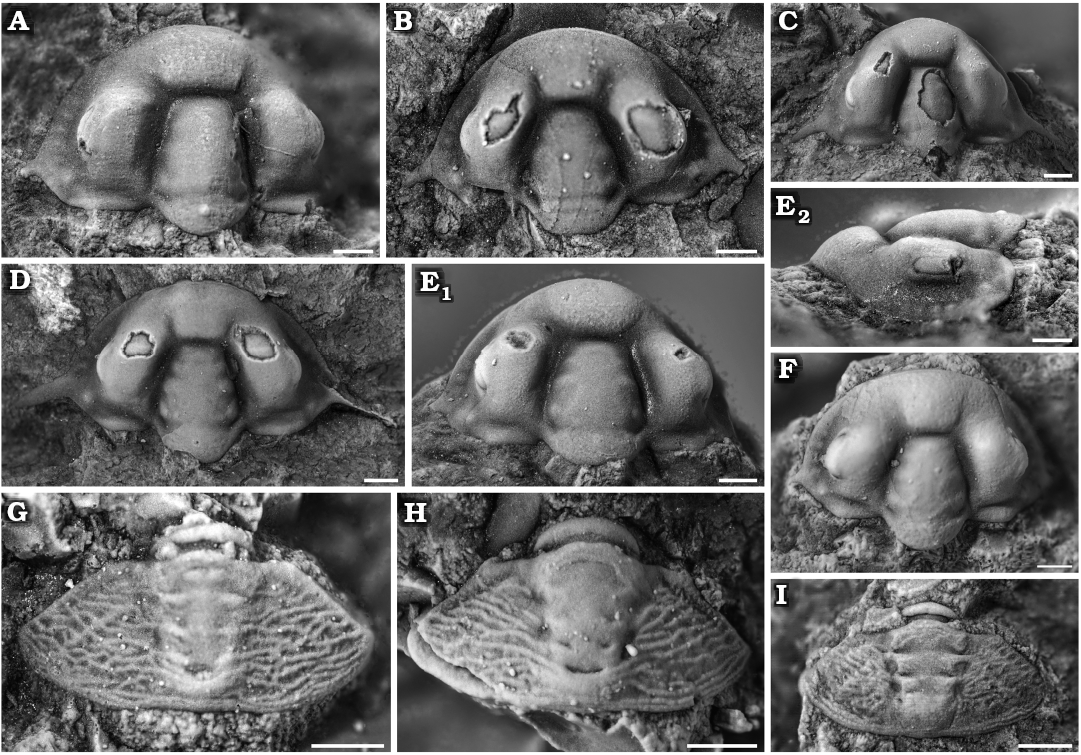
Fig. 5. Diceratocephalid trilobite Wongia rotundata (Resser & Endo in Endo and Resser, 1937) from Guangzhangian, Miaolingian (Cambrian), the Kushan Formation of China, the Wongia rotundata Zone, Julinshan section, Shandong Pronvince (B–D, G, H) and Baijiashan section, Dalian, Liaoning Pronvince (A, E, F, I). A. NIGP205939 (field no. BJS-C21), cephalon in dorsal view. B. NIGP205943 (field no. Ju-2-1.6m), cephalon in dorsal view. C. NIGP205944 (field no. Ju-2-1.6m), cephalon in dorsal view. D. NIGP205945 (field no. Ju-2-1.6m), cephalon in dorsal view. E. NIGP205940 (field no. BJS-C25), cephalon in dorsal (E1) and lateral (E2) views. F. NIGP205941 (field no. BJS-C27), cephalon in dorsal view. G. NIGP205946 (field no. Ju-2-1.6m), pygidium in dorsal view. H. NIGP205947 (field no. Ju-2-1.6m), pygidium in dorsal view. I. NIGP205942 (field no. BJS C37), pygidium in dorsal view. Scale bars: A–C, E–I, 500 μm; D, 1 mm.
Remarks.—The narrow anterior border, and the course of the facial suture make this species most similar to Wongia regularis regularis (Walcott, 1906); however, the latter has a wider and more vaulted cranidium, with broader fixigenae; a shorter palpebral lobe located anteriorly; more distinct, nearly horizontal eye ridges; libigenae without a genal spine and without 3–5 tubercles on lateral border posteriorly, and an occipital ring with a larger tubercule or a short occipital spine.
Stratigraphic and geographic range.—Wongia rotundata Zone of the Kushan Formation, Guzhangian, Miaolingian, Cambrian; Julinshan section, Shandong; Baijiashan section, Liaoning, China.
Wongia regularis (Walcott, 1906)
Remarks.—Wongia regularis and Wongia pustulosa (Chu, 1959) share characteristics that include a strongly vaulted cephalon without a genal spine, a very short palpebral lobe located at anteriorly, and a nearly horizontal eye ridge. Consequently, W. pustulosa has been suppressed as a synonym of W. regularis by both Park et al. (2008) and Peng (2020). Park et al. (2008) assumed that these two species have the same granulose ornament on cranidium. However, the holotype cranidium of W. regularis has smooth surface (e.g., Zhang and Jell 1987: pl. 51: 8). Therefore, two subspecies are recognized, with Wongia regularis pustulosa differing in having a semicircular cephalon with an obtuse genal angle, a wider (tr.), less convex palpebral lobe, a wider (tr.) pygidium and distinct granules on the surface of the cephalon. This subspecies is a little younger than Wongia regularis regularis.
Stratigraphic and geographic range.—Wongia rotundata Zone of the Kushan Formation, Guzhangian, Miaolingian, Cambrian; Julinshan section, Shandong; Baijiashan section, Liaoning, China.
Wongia regularis regularis (Walcott, 1906)
Fig. 6.
1906 Agraulos regularis Walcott 1906: 578.
1913 Inouyia? regularis (Walcott); Walcott 1913: 154, pl. 14: 18.
1960 Latilorenzella regularis (Walcott); Kobayashi 1960: 390.
1965 Cyclolorenzella regularis (Walcott); Lu et al. 1965: p. 253, pl. 42: 25, 26.
1986a Cyclolorenzella sp.; Zhang and Liu 1986: 14, pl. 1: 3, 4.
1987 Cyclolorenzella regularis (Walcott); Zhang and Jell 1987: 133, pl. 51: 8, 9.
1991 Cyclolorenzella parabola (Lu); Zhang and Liu 1991: 96, pl. 1: 6–9.
1995 Cyclolorenzella yentaiensis (Chu); Zhang et al. 1995: 78, pl. 34: 12–14.
2008 Cyclolorenzella regularis (Walcott); Yang 2008: 103, 104, pl. 17: 2–6, [non figs. 1, 7–25].
non 2008 Jiulongshania regularis (Walcott, 1906); Park et al. 2008: 260–263, fig. 9A?, B–H.
Holotype: USNM 58028, cranidium (Walcott 1913: pl. 14: 18; Zhang and Jell 1987: pl. 51: 8).
Type locality: 6.4 km east of Fanglanzhen, Shanxi Province, China.
Type horizon: Kushan Formation (Blackwelderia Zone), Guzhangian, Miaolingian, Cambrian.
Material.—Four cephala and three pygidia (NIGP 205948–205954), all from Kushan Formation (Guangzhangia), Shandong Province, China.
Emended diagnosis.—Cephalon strongly vaulted, semi-elliptical, without genal spines, genal angle well rounded; cranidium wide, subquadrate, slightly wider than long, with a gently convex preglabellar boss defined by a pair of short distinct divergent furrows on frontal area, anterior border narrow, strongly sloping outwards; glabella short and convex, truncated conical; occipital ring with a large occipital node or very short occipital spine; fixigenae slightly wider than glabella between palpebral lobes; palpebral lobe short, crescentic, located opposite to anterior glabella, about 0.25–0.3 times as long as glabella; eye ridge slightly curved forwads; anterior branches of facial suture parallel or gently convergent forward from palpebral lobe, posterior branches slanting backwards, bending inwards near a node (metafixigenal node) at the end of the posterior border furrow, then slanting inwards; posterior border gently convex, sharply narrowing and bending forwards distally, 0.8 times as wide as basal glabellar width, with an obtuse intergenal angle; posterior border furrow distinct, shallowing and bending forward distally; surface smooth; relatively short subfusiform to rhombic pygidium acutely rounded laterally, with dense trasverse terrace lines.
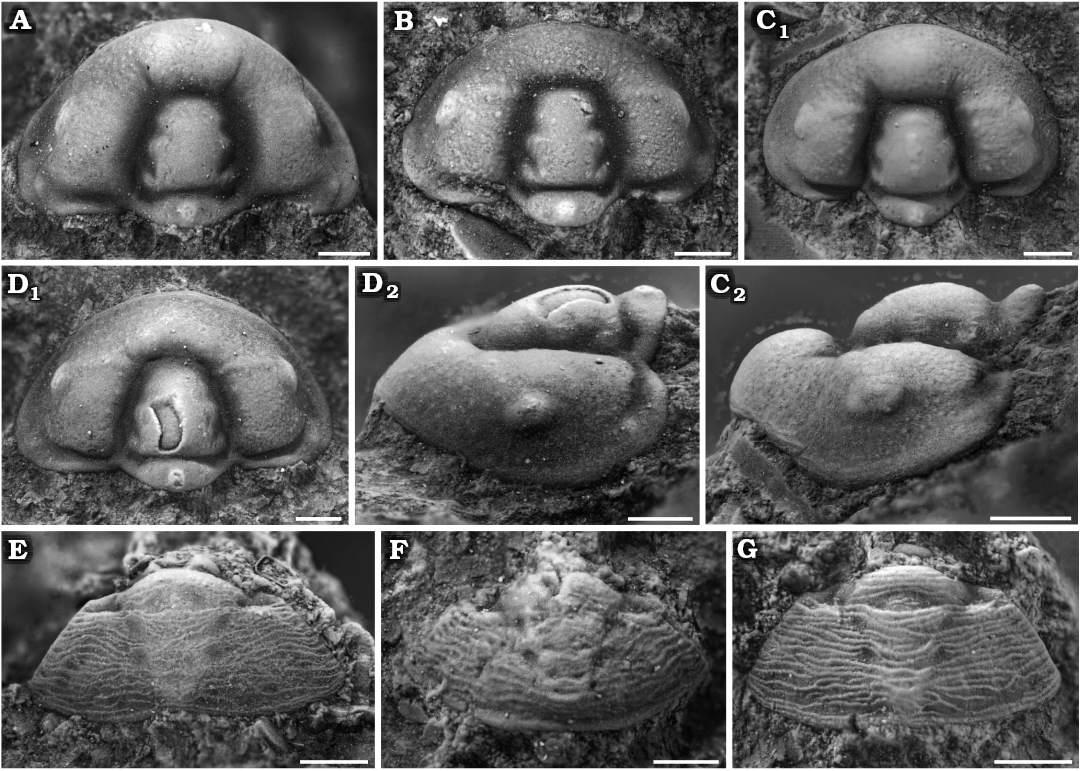
Fig. 6. Diceratocephalid trilobite Wongia regularis regularis (Walcott, 1906) from Guangzhangian, Miaolingian (Cambrian), the Kushan Formation of China, the Wongia regularis Zone, Julinshan (A–G, I) and Jiulongshan (H) sections, Shandong Pronvince. A. NIGP205948 (field no. Ju-4-F6-1), cephalon in dorsal view. B. NIGP205949 (field no. Ju-4-F6-1), cephalon in dorsal view. C. NIGP205950 (field no. Ju-4-F6-1), cephalon in dorsal (C1) and lateral (C2) views. D. NIGP205951 (field no. Ju-4-F6-1), cephalon in dorsal (D1) and lateral (D2) views. E. NIGP205952 (field no. Ju-4-F6-1), pygidium in dorsal view. F. NIGP205952 (field no. Ju-4-F6-1), pygidium in dorsal view. G. NIGP205953 (field no. Ju-4-F6-1), pygidium in dorsal view. All in dorsal view. Scale bars 500 μm.
Description.—Cephalon strongly vaulted, semi-elliptical in outline, without genal spine, genal angle well rounded; cranidium wide, subquadrate, slightly wider than long, with a gently convex preglabellar boss defined by a pair of short distinct divergent furrows on frontal area; anterior border narrow, strongly sloping outwards, covered with 3–6 terrace lines; glabella short and convex, truncated conical, with 3 pairs of very shallow lateral furrows, of which S1 is incised; palpebral lobe short and convex, crescentic, located at anteriorly, about 0.25–0.3 times as long as glabella; eye ridge slightly curved forwads; occipital ring with a large occipital node or very short occipital spine; cranidium wide and convex, subquadrate, slightly wider than long, with a gently convex preglabellar boss defined by a pair of short divergent furrows on the frontal area, and with a narrow, strongly sloping outwards anterior border covered with 3–6 terrace lines; glabella short and convex, truncated conical, with 3 pairs of very shallow lateral furrows, of which S1 is incised; occipital ring with a large occipital node or very short occipital spine; occipital fuurow wider and deep; fixigenae slightly wider than glabella between palpebral lobes; palpebral lobe short, crescentic, located opposite to anterior glabella, about 0.25–0.3 times as long as glabella; eye ridge slightly curved forwads; anterior branches of facial suture parallel or gently convergent forward from palpebral lobe, posterior branches slanting backwards, bending inwards near a node (metafixigenal node) at the end of the posterior border furrow, then slanting inwards; posterior border gently convex, sharply narrowing and bending forwards distally, 0.8 times as wide as basal glabellar width, with an obtuse intergenal angle; posterior border furrow distinct, shallowing and bending forward distally; librigena very narrow, sloping outwards. Pygidium short and convex, subfusiform to rhombic, acutely rounded laterally, axis broad and long, tapering backwards, with 3–5 axial rings; pleural field as wide as axis, surface covered with denser transverse terrace lines; pygidial border very narrow and flat.
Stratigraphic and geographic range.—Wongia regularis Zone of the Kushan Formation, Guzhangian, Miaolignian, Cambrian; Jiulongshan and Julinshan sections, Shandong, China.
Wongia regularis pustulosa (Chu, 1959)
Fig. 7.
1959 Lorenzella pustulosa; Chu 1959: 98, pl. 2: 6–8.
1960 Cyclolorenzella pustulosa (Chu); Kobayashi 1960: 389.
1960 Latilorenzella regularis (Walcott); Kobayashi 1960: 390.
1965 Cyclolorenzella pustulosa (Chu); Lu et al. 1965: 253, pl. 42: 23, 24.
1965 Cyclolorenzella regularis (Walcott); Lu et al. 1965: 253, pl. 42: 25, 26.
1986a Cyclolorenzella sp.; Zhang and Liu 1986: 14, pl. 1: 3, 4.
1987 Cyclolorenzella regularis (Walcott); Zhang and Jell 1987: 133, pl. 51: 8, 9.
1991 Cyclolorenzella parabola (Lu); Zhang and Liu 1991: 96, pl. 1: 6–9.
1995 Cyclolorenzella yentaiensis (Chu); Zhang et al. 1995: 78, pl. 34: 12–14.
non1996 Cyclolorenzella regularis (Walcott); Guo et al. 1996: 115, pl. 59: 17, 18.
2003 Cyclolorenzella regularis (Walcott); Hong et al. 2003: 901.
2008 Cyclolorenzella regularis (Walcott); Yang 2008: 103, pl. 17: 1, 7–25, [non figs. 2–6].
2008 Jiulongshania regularis (Walcott); Park et al. 2008: 260–263, fig. 9A?, B–H.
2009 Jiulongshania regularis (Walcott), Park et al. 2009: 121, fig. 3.1–3.10.
2010 Jiulongshania regularis (Walcott); Park et al. 2010: 176, fig. 3.6–3.8.
2013 Jiulongshania regularis (Walcott); Park et al. 2013: 998, 999, fig. 5.18–5.32.
2017 Wongia regularis (Walcott); Ren 2017: 115, 116, pl. 18: 16, 17; pl. 42: 6–13.
2020 Jiulongshania regularis (Walcott); Peng 2020: 458, pl. 203: 8–12.
Holotype: NIGP9451, cranidium (Chu, 1959: pl. 2: 8).
Type locality: Tangshiling village, Liaoyang County, Laioning Province, China.
Type horizon: Kushan Formation Blackwelderia Zone Guzhangian, Miaolingian, Cambrian.
Material.—Four cephala, one cranidium, and one pygidium (NIGP205955–205960), all from Kushan Formation (Guangzhangia), Shandong Province, China.
Diagnosis.—Cephalon strongly convex, with acutal rounded genal angle; cranidium subtrapezoidal in outline, slightly wider than long, with a gently convex preglabellar swelling boss defined by a pair of more or less short divergent furrows on frontal area; short and convex, truncated conical glabella; occipital ring with a larger occipital node; surface with tuberculate ornament; wider (tr.) and shorter (sag.) subfusiformis pygidium acutely rounded laterally, with dense trasversal terrace lines.
Description.—Cephalon strongly vaulted, semicircular in outline, librigena very narrow, sloping outwards, absence of genal spines, with acutal rounded genal angle; cranidium wide and vaulted, subtrapezoidal, slightly wider than long, with a moderately convex preglabellar boss defined by a pair of short divergent furrows on frontal area, and with a narrow, strongly outward-sloping anterior border; axial furrow deep and broad; glabella short, truncated conical, with 3 pairs of shallow lateral furrows, of which S1 is incised, S2 and S3 short and faint; occipital ring short (sag.), with a large occipital node; occipital furrow deep, bending forward distally; fixigenae wider, about 1.1–1.2 times as wide as glabella between palpebral lobes; palpebral lobe short, about 0.25–0.3 times as long as glabella, crescentic, located anteriorly; eye ridge low, nearly horizontal; anterior branches of facial sutures short, slightly convergent forwards, posterior branches long, gently divergent outwards, bending near a node located at the end of posterior border furrow, then slanting inwards, posterior border narrow (sag.), gently convex, slightly widening outwards, sharply narrowing and bending forwards diatally, with an obtuse intergenal angle; posterior border furrow deep, bending forward distally; surface with fine dense granules or postulose. Pygidium wider (tr.) and shorter (sag.), subfusiform to rhombic, acutely rounded laterally, axis broad and long, tapering backwards, with 3–5 axial rings; axial furrow very shallow; pleural field as wide as axis, surface covered with denser transverse terrace lines and fine granules; pygidial border very narrow and flat.
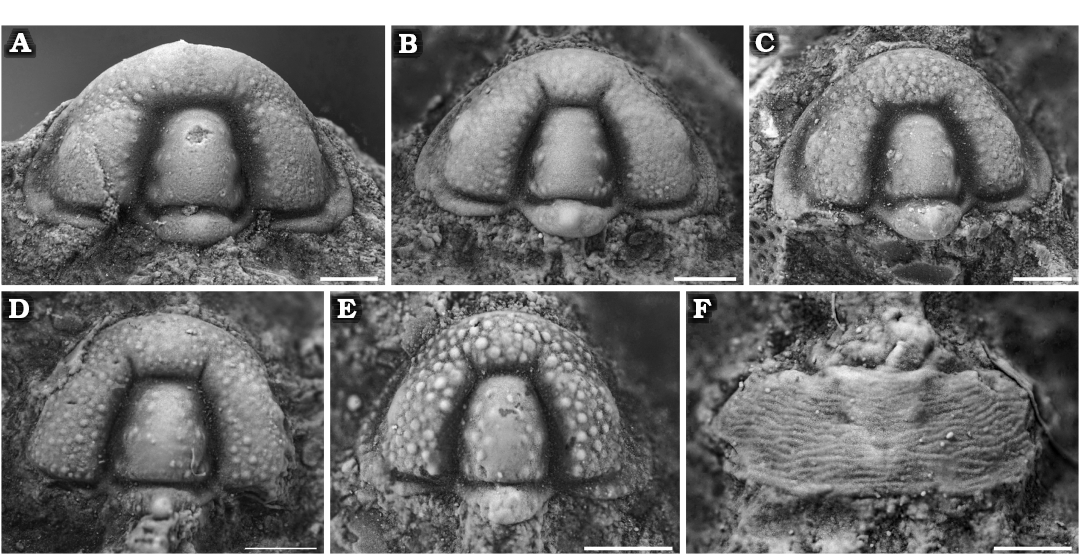
Fig. 7. Diceratocephalid trilobite Wongia regularis pustulosa (Chu, 1959) from Guangzhangian, Miaolingian (Cambrian), the Kushan Formation of China, the Wongia regularis Zone, Julinshan (A–C, E, F) and Jiulongshan (D) sections, Shandong Pronvince. A. NIGP205955 (field no. Ju-3-R19), cephalon. B. NIGP205956 (field no. Ju-3-R24), cephalon. C. NIGP205957 (field no. Ju-3-R19), cephalon. D. NIGP205960 (field no. Jls-140), cephalon. E. NIGP205955 (field no. Ju-4-F6-1), cephalon. F., NIGP205959 (field no. Ju-3-R19), pygidium. All in dorsal view. Scale bars: A–D, F, 500 μm; E, 200 μm.
Stratigraphic and geographic range.—Wongia regularis Zone of the Kushan Formation, Guzhangian, Miaolingian, Cambrian; Jiulongshan and Julinshan sections, Shandong, China.
Wongia valida (Nan & Chang, 1985)
Fig. 8A–I.
1985 Cyclolorenzella valida; Nan and Chang 1985: 12, pl. 1: 20, 21.
1996 Cyclolorenzella acalle (Walcott); Guo et al. 1996: 114, pl. 59: 12–15, [non. fig. 16].
Holotype: SG030200 (Xn7), cranidium (Nan and Chang 1985: pl. 1: 21).
Type locality: Xishan, Fuzhouwan, Dalian, Liaoning Province, China.
Type horizon: Changhia Formation (Damesella Zone), Guzhangian, Miaolingian, Cambrian.
Material.—An incomplete cephalon, seven cranidia, and one pygidium (NIGP 205961–205969), all from Kushan Formation (Guangzhangia), Shandong Province, China.
Emended diagnosis.—Cephalon gently vaulted, long semi-elliptical in outline with short and broad genal spine directed posterolaterally at approximately 45–50° to the sagittal line; cranidium short and broad, subquadrate, with wide well rounded anterior margin; preglabellar field broad (sag.), preglabellar boss indistinct; glabella short, conical, subconical, glabellar length the same as the width as the base; occipital ring wide and long, semi-circular to semi-elliptical, slightly shorter than glabellar length, with a smaller occipital node medially; occipital furrow shallow; fixigenae slightly wider than glabella between palpebral lobes; posterior border (tr.) as wide as glabella at the base. Pygidium rhombic, anterior margin short, transverse, lateral margin long, strongly slanting backwards, acutely rounded laterally; prosopon of fine irregular wrinkles on the surface of preglabellar field and occipital ring.
Description.—Cephalon gently vaulted, broad (tr.), with short genal spine directed laterally and slightly posteriorly, at about 45–50° to the sagittal line; axial furrow deep and broad; cranidium subquadrate, with wide well rounded anterior margin, anterior border and border furrow indistinct, preglabellar field broad (sag.), as long as glabella, gently convex, with indistinct preglabellar boss, without a pair of divergent furrows on frontal area; glabella relatively short, conical, subconical, lateral glabellar furrows obscure or absent; occipital ring wide and long, semicircular to semi-elliptical, slightly shorter than glabellar length; occipital furrow very shallow and narrow; fixigenae slightly wider than glabella between palpebral lobes; palpebral lobe short, about 0.3 times as long as glabella, located at a level in front of middle point of glabella; eye ridge faint, transverse; opisthoparian facial suture, anterior branch of facial sutures parallel or slightly divergent forward from palpebral lobe, posterior branch of facial suture strongly divergent backwards from palpebral lobe, then gently bending outside of posterior border furrow, then slanting inward; posterior border gently convex, as wide as glabella at the base, with an obtuse intergenal angle; posterir border furrow shallow. Pygidium wide (tr.) and short (sag.), rhombic; anterior margin short, transverse; lateral margin long, strongly slanting backwards, acutely rounded laterally; posterior margin very broad; pygidial border very narrow; pygidial axis long, strongly tapering backwards, almost reaching posterior margin, with 4 axial rings, axial ring furrows very shallow; prosopon of fine irregular wrinkles on the surface of preglabellar field and occipital ring.
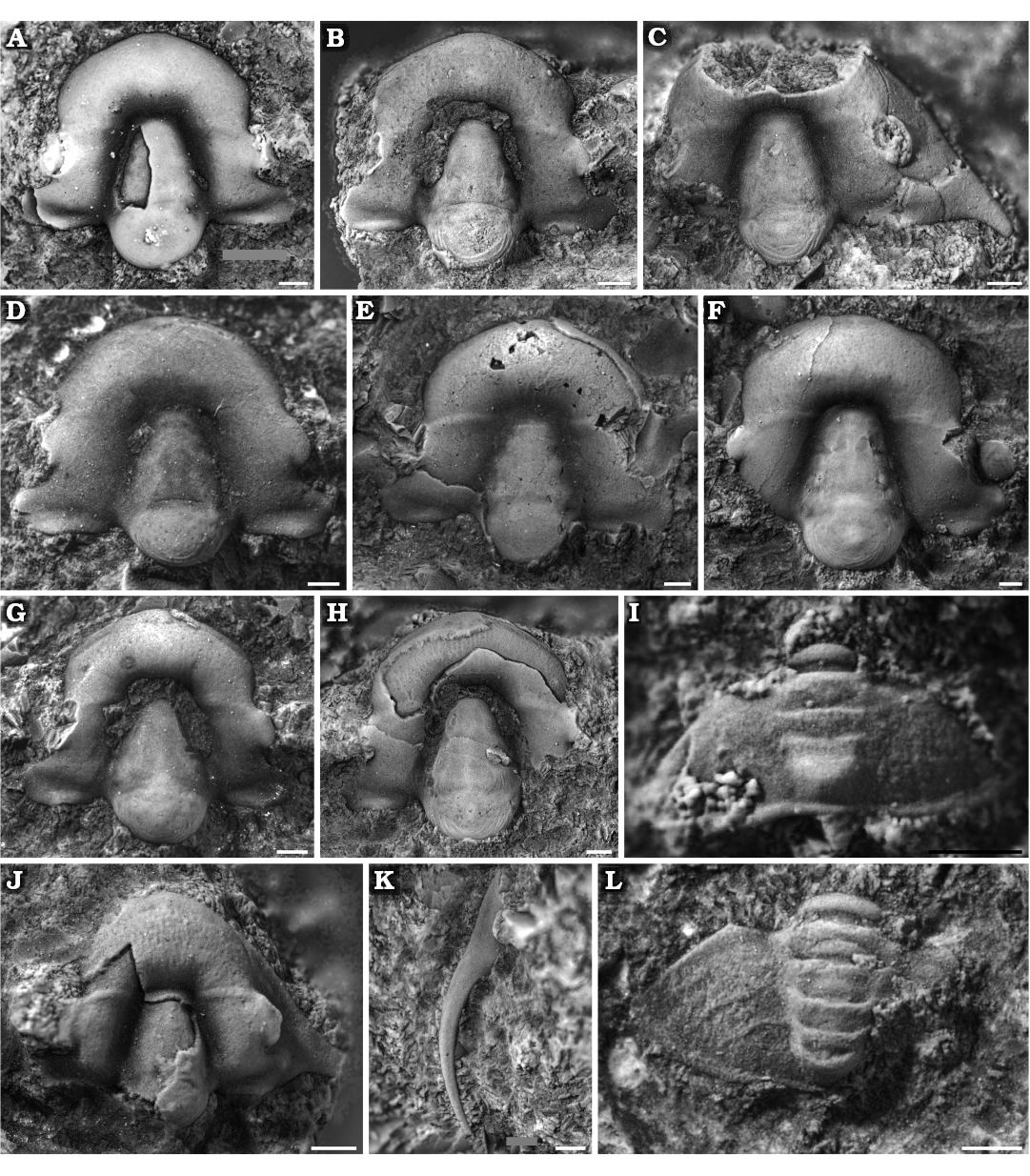
Fig. 8. Diceratocephalid trilobites Wongia valida (Nan & Chang, 1985) (A–I) and Wongia sp. (J–L) from Guangzhangian, Miaolingian (Cambrian), the Changhia Formation of China, the Damesella paronai–Ajacicrepida ajax Zone, southern Nanzhaocun (A, D–G, I, J, L) and Julinshan (B, C, H, K) sections, Shandong Pronvince. A. NIGP205961 (field no. NZC-S1-2-1), cranidium. B. NIGP205967 (field no. Ju-2-A2-3), cranidium. C. NIGP205968 (field no. Ju-2-A2-3), incomplete cephalon. D. NIGP205962 (field no. NZC-S1-2-1), cranidium. E. NIGP205963 (field no. NZC-S1-2-1), cranidium. F. NIGP205964 (field no. NZCS1-2-1), cranidium. G. NIGP205965 (field no. NZC-S1-2-1), cranidium. H. NIGP205969 (field no. Ju-2-A2-3), cranidium. I. NIGP205966 (field no. NZC-S1-2-1), pygidium. J. NIGP205970 (field no. NZCS1-2-1), cranidium. K. NIGP205972 (field no. Ju-2-A2-3), librigena. L. NIGP205971 (field no. NZCS1-2-1), pygidium. All in dorsal view. Scale bars 500 μm.
Remarks.—In general configuration of cranidium, especially with indistinct preglabellar boss on frontal area, this species is quite similar to Wongia subcylindrica. However, it differs from the latter mainly in having a shorter conical glabella, much longer (sag.) occipital ring, shallower occipital furrow, wider gently convex librigena with very short and wider genal spine, much shorter (sag.), wider (tr.) pygidium.
Stratigraphic and geographic range.—Damesella paronai–Ajacicrepida ajax Zone of the Changhia Formation; Guzhangian, Miaoligian, Cambrian; Julinshan and southern Nanzhaocun section, Shandong, China.
Wongia sp.
Fig. 8J–L.
Material.—An incomplete cephalon, one librigena, and one pygidium (NIGP 205970–2059972) from Damesella paronai–Ajacicrepida ajax Zone, Changhia Fomation, Guzhangian, Miaoligian, Cambrian, Nanzhaocun section, Shandong Province, China.
Description.—Cephalon moderately vaulted, with moderately long genal spine; axial furrow deep; cranidium inflated, triangular; preglabellar field broad (sag.), strongly bending forward, slightly wider than glabellar length; anterior border narrow, sloping outwards; glabella short, truncated conical; posterior border slightly narrower (tr.) than the basal glabellar width, with an obtuse intergenal angle; posterior border furrow shallow; palbebral lobe longer, about 0.5–0.6 times as long as glabellar length, crescentic; eye ridge convex, horizontal; occipital ring semi-elliptical; occipital furrow very shallow; librigena narrow, strongly sloping outwards. Pygidium rhombic, acutely rounded laterally; axial furrow very shallow; axis convex, broad and long, tapering backwards, with 4 axial rings and a terminal piece, axial ring furrows distinct, disconnected with axial furrow; pleural field as wide as axis, surface smooth, pleural furrows very weakly impressed; pygidial border very narrow and flat.
Remarks.—The cephalon of specimens has a relatively long genal spine directed laterally, Wongia sp. is quite similar to W. subcylindrica; however, it differs from the latter mainly in having a triangular cranidium with longer pregalbellar area, a shorter, more slender glabella, a broader (sag.) occipital ring, a longer palpebral lobe and convex eye ridges. In general configuration of the cranidium, notably the longer frontal area, Wongia sp. bears the closest resemblance to W. longa (Park, Han, Bai & Choi, 2008) (Park et al. 2008: 263–265, fig. 10A–K), from the lowermost Kushan Formation at Jiulongshan, Shandong; however, it can be distinguished from the latter mainly by its shorter, truncated conical glabella, triangular cranidium with longer frontal area (sag.), and the longer palpebral lobe.
Wongia nanzhaocunensis Yuan sp. nov.
Fig. 9.
Zoobank LSID: urn:lsid:zoobank.org:act:F3FCCD0A-6952-4504-A4 EF-9F0ACBA613B5
Etymology: After Nanzhaocun, a village of Linqu County, Shandong, where the new species occurs.
Type material: Holotype: NIGP205979, cephalon (Fig. 9G). Paratypes: two cephala (NIGP 205973, 205974), Fig. 9A, B; 4 cranidia (NIGP 205975–205978), Fig. 9C–F; one pygidium (NIGP 205980) Fig. 9H.
Type locality: Northern Nanzhaocun village, 0.5 km east of Sitou Town, Linqu County, Shandong Province, China.
Type horizon: Changhia Formation (Damesella paronai–Ajacicrepida ajax Zone), Miaolingian, Guzhangian, Cambrian.
Material.—Type material only.
Diagnosis.—Cephalon weakly vaulted, semi-elliptical in outline, without genal spine, genal angle well rounded; preglabellar field wider (sag.), nearly as long as glabella, without a preglabellar swelling boss on preglabellar field; glabella short, conical to subconical, strongly tapering forward; occipital ring wide (tr.), semi-elliptical, with a faint occipital node posterally; fixigenae as wide as glabella between palpebral lobes; palpebral lobes short; librigena narrow and flat, with 3–5 tubercles on posterior part of lateral border. Pygidium rhombic, well-rounded laterally, axis broad and long, tapering backwards, with 3–4 axial rings; surface smooth.
Description.—Cephalon weakly vaulted, semi-elliptical, anterior margin strongly bending forward, without genal spine, genal angle well rounded; preglabellar field wide (sag.), nearly as long as glabella, without a preglabellar swelling boss on preglabellar field, with a pair of very short faint furrows that are slightly divergent forwards on preglabellar field; anterior border narrow, slightly sloping outwards; anterior border furrow shallow; glabella short, conical to subconical, strongly tapering forward, with 3 pairs of faint lateral glabellar furrows; palpebral lobes short, about 0.3 times as long as glabellar length, located at a level opposite anterior portion of glabella; occipital ring wide (tr.) and long, semi-elliptical, with a faint occipital node posterally; occipital furrow shallow medially, slightly bending forward laterally; fixigenae as wide as glabella between palpebral lobes; eye ridges nearly transverse; librigena narrow, gently sloping outwards, with 3–5 tubercles on posterior part of lateral border; lateral border narrow, gently convex; opisthoparian facial suture, anterior branch of facial suture running parallel forward or slightly convergent, posterior branch strongly slanting outwards, bending inwards near a small node (metafixigenal node) located at the end of the posterior border furrow, then strongly slantng inwards, cutting the posterior border; posterior border gently convex, slightly broadening outwards, sharply narrowing and bending forwards distally, about 0.8 times as wide as glabella at the base (tr.); posterior border with an obtuse intergenal angle; posterior border furrow shallow, bending forward distally. Pygidium rhombic, well-rounded laterally, axis broad and long, tapering backwards, with 3–4 axial rings, surface smooth.
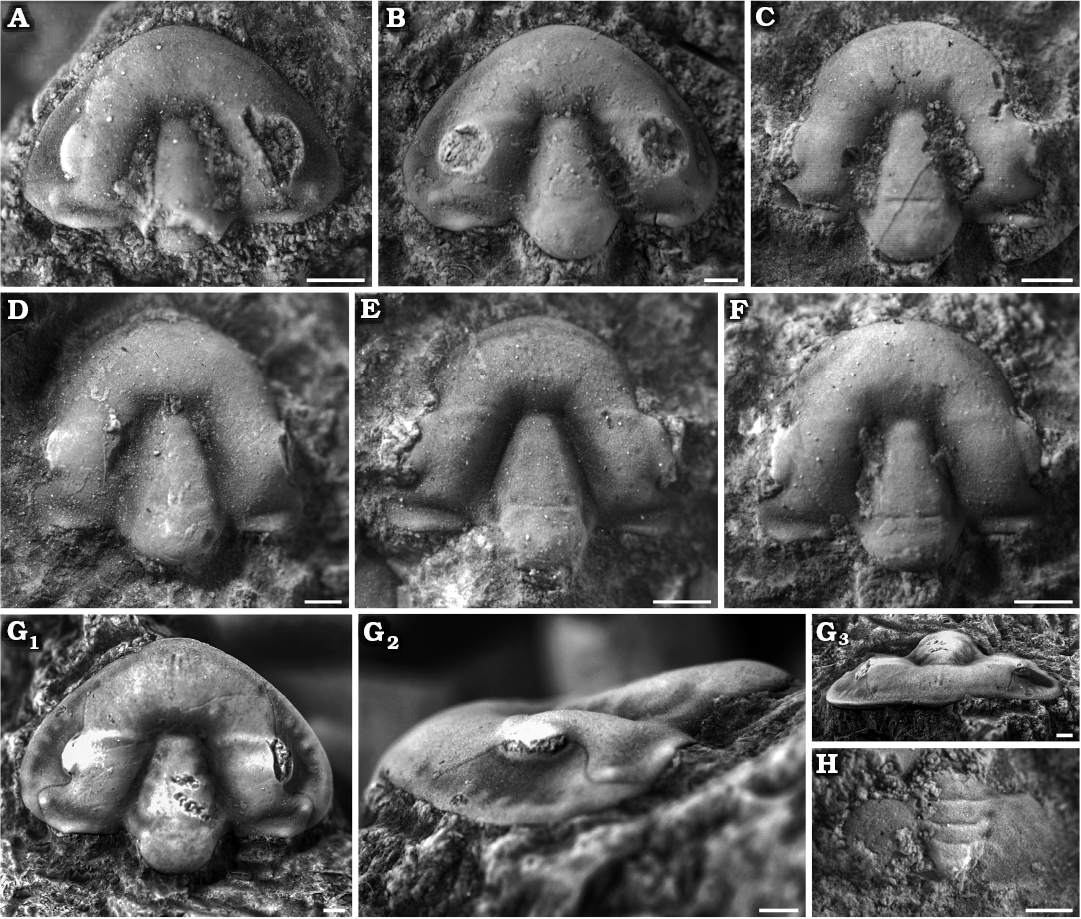
Fig. 9. Diceratocephalid trilobite Wongia nanzhaocunensis Yuan sp. nov. from Guangzhangian, Miaolingian (Cambrian), the Changhia Formation of China, the Damesella paronai–Ajacicrepida ajax Zone, northern Nanzhaocun section, Shandong Pronvince. A. NIGP205973 (field no. NZC-NA2), cephalon in dorsal view. B. NIGP205974 (field no. NZC-NA4), cephalon in dorsal view. C. NIGP205975 (field no. NZC-NA3), cranidium in dorsal view. D. NIGP205976 (field no. NZC-NA3), cranidium in dorsal view. E. NIGP205977 (field no. NZC-NA5), cranidium in dorsal view. F. NIGP205978 (field no. NZC-NA7), cranidium in dorsal view. G. Holotype, NIGP205979 (field no. NZC-NA1), cephalon in dorsal (G1), lateral (G2), and anterior (G3) views. H. NIGP205980 (field no. NZC-NA8), pygidium in dorsal view. Scale bars: A, C–F, H, 500 μm; B, G, 1 mm.
Remarks.—In general configuration of the cephalon, especially the librigena with 3–5 tubercles on posterior part of lateral border, the new species bears some resembles to Wongia rotundata (Resser & Endo in Endo and Resser, 1937), however, it differs from the latter mainly in having less vaulted cephalon with well rounded genal angle, no strongly convex swelling boss on preglabellar field, shorter conical to subconical glabella, wider fixigenae between palpebral lobes, longer and wider occipital ring and narrower (sag.) and wider (tr.) pygidium. In general configuration of cephalon and cranidium, especially the librigenae with its rounded genal angle, the presence of a narrow anterior border, and the course of the facial suture, the new species bears the closest resembles to Wongia regularis regularis (Walcott, 1906), however, it differs from Wongia regularis regularis chiefly in having a weakly vaulted cephalon, slender conical to subconical glabella, a broader occipital ring (sag.) without prominent occipital node or spine, no preglabellar swelling boss on the wider preglabellar field, broader fixigenae between the palpebral lobes, and librigena with 3–5 tubercles on the lateral border, and its pygidium covered without denser transverse terrace lines.
Stratigraphic and geographic range.—Damesella paronai–Ajacicrepida ajax Zone of the Changhia Formation, Guzhangian, Miaolingian, Cambrian; Northern Nanzhaocun section, Shandong, China.
Wongia laevigata Yuan sp. nov.
Fig. 10.
Zoobank LSID: urn:lsid:zoobank.org:act:A1155397-7127-4677-8E3E- 40E15E517D5C
Etymology: From Latin laevigata, smooth, glossy; because of the smooth surface on cephalon of the new species.
Type material: Holotype: NIGP 205983, cephalon (Fig. 10C). Paratypes: four cephala (NIGP 205981, 205982, 205984, 205985), Fig. 10A, B, D, E; one pygidium (NIGP 205986), Fig. 10F.
Type locality: Baijiashan section, Dalian City, Liaoning Province, China
Type horizon: Kushan Formation (the lower part of Wongia rotundata Zone), Guzhangian, Mialingian, Cambrian.
Material.—Type material only.
Diagnosis.—Cephalon semicircular, moderately vaulted, without genal spines, genal angle obtuse to well-rounded; axial furrow very shallow; preglabellar field relatively short (sag.), nearly 0.35–0.4 times as long as glabella, a lower swelling boss visible on the exfoliated specimen (Fig. 10D); anterior border furrow, lateral border furrow and posterior border furrow indistinct; glabella long and pronounced, subconical to truncated conical, gently tapering forward, lateral glabellar furrows very faint, only on the exfoliated specimen (Fig. 10D) can be observed; occipital ring narrow (sag.) and wide (tr.), without occipital node; occipital furrow very faint; fixigenae slightly narrower (tr.) than glabella between palpebral lobes; palpebral lobes indistinct or moderately long on exfoliated specimen; eye ridge indistinct, surface smooth.
Description.—Cephalon semicircular in outline, moderately vaulted, with obtusely to well-rounded genal angle; genal spines absent; axial furrow very shallow; preglabellar field relatively short (sag.), nearly 0.35–0.4 times as long as glabella, a very gently convex preglabellar boss and a pair of very faint short furrows divergent forward on preglabellar field can be observed only on the exfoliated specimen (Fig. 10D); anterior border narrow; anterior border furrow, lateral border furrow and posterior border furrow indistinct or very narrow and shallow on exfoliated specimen; glabella long and robust, subconical to truncated conical, gently tapering forward, lateral glabellar furrows very faint, only on the exfoliated specimen (Fig. 10D) can be observed; occipital ring narrow (sag.) and wide (tr.), without occipital node; fixigenae slightly narrower (tr.) than glabella between palpebral lobes; palpebral lobes moderately long, about 0.4 times as long as glabellar length, located at a level opposite to anterior portion of glabella on the exfoliated specimen (Fig. 10D); occipital ring wide (tr.) and short (sag.), semi-elliptical, without occipital node; eye ridges obscure; anterior branches of facial suture slightly convergent forward from palpebral lobe, posterior branches divergent backwards, then bending inwards, posterior border gently convex, narrower (tr.) than basal glabellar width, with an obtuse intergenal angle; librigena narrow and flat, gently sloping outwards. Pygidium rhombic, acutely rounded laterally, axis broad and long, tapering backwards, with 4–5 axial rings; axial ring furrows very shallow, pleural ribs gently convex, pleural furrows and interpleural furrows obscure, and surface smooth.
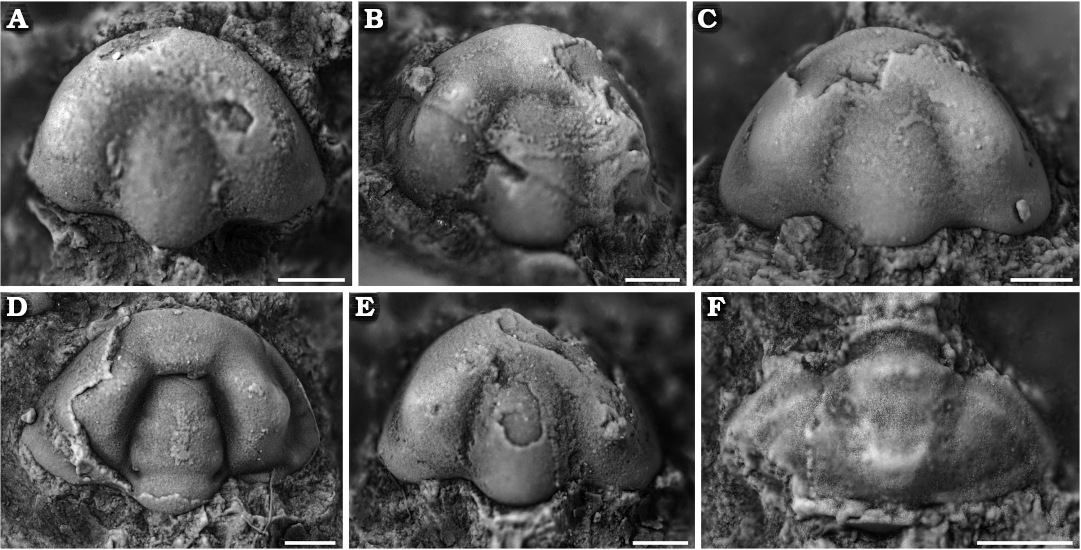
Fig. 10. Diceratocephalid trilobite Wongia laevigata Yuan sp. nov. from Guangzhangian, Miaolingian (Cambrian), the Kushan Formation of China, the lower Wongia rotundata Zone, Baijiashan section, Liaoning Pronvince. A. NIGP205981 (field no. BJS-C39), cephalon. B. NIGP205982 (field no. BJS-C38a), cephalon. C. Holotype, NIGP205983 (field no. BJS-C38b), cephalon. D. NIGP205984 (field no. BJS-C40), cephalon. E. NIGP205985 (field no. BJS-C41), cephalon. F. NIGP205986 (field no. BJS-C37), pygidium. All in dorsal view. Scale bars: A–E, 500 μm; F, 200 μm.
Remarks.—The new species shows some characteristics of the librigena with the rounded genal angle; the new specimens (Fig. 10A–F) bears the closest resemblance to Wongia regularis regularis (Walcott, 1906) and Wongia nanzhaocunensis Yuan sp. nov. It can be distinguished from Wongia regularis regularis (Walcott, 1906) mainly by its less vaulted cephalon with shorter preglabellar field without distinct swelling preglabellar boss, its very shallow axial furrow, anterior border furrow, lateral border furrow, posterior border furrow, occipital furrow, indistinct palpebral lobe and eye ridge, longer and wider glabella without distinct glabellar furrows, the occipital ring lacking an occipital node. It differs also from W. nanzhaocunensis Yuan sp. nov. chiefly in having a very shallow axial furrow, longer and wider truncated conical glabella without glabellar furrows, a narrower preglabellar field, relatively narrower fixigenae between paalpebral lobes (tr.), librigena without 3–5 tubercles on the lateral border, and obscure eye ridges.
Stratigraphic and geographic range.—The lower part of the Wongia rotundata Zone, Kushan Formation, Guzhangian, Miaolingian, Cambrian; Baijiashan section, Liaoning, China.
Genus Cyclolorenzella Kobayashi, 1960
Type species: Lorenzella quadrata Kobayashi, 1935; Neodrepanura Zone Guzhangian, Miaolignian, Cambrian; Sesong Formation, Jikdong, Taebaeksan Basin, Korea.
Species included: Cyclorenzella convexa (Resser & Endo in Endo and Resser, 1937), Cyclorenzella distincta Zhang, 1985, Cyclorenzella jishanensis Zhang & Wang, 1986, Cyclorenzella sp. reported herein.
Emended diagnosis.—Cranidium subquadrate, slightly wider than long; frontal area moderately long, with a distinct, low convex preglabellar boss outlined by long or short parallel-sided to slightly divergent furrows emerging from antero-lateral corners of glabella; preglabellar area moderately long, preglabellar field and anterior border not differentiated; glabella truncated conical, with 3 pairs of very faint glabellar furrows; occipital ring narrow (sag.), extending backward into a long occipital spine medially; occipital furrow shallow; palpebral lobes short, located opposite glabellar mid-point; eye ridge very faint or obscure. Pygidium semi-elliptical, with a posteromedian indentation; axis long, tapering backwards, with 3–6 axial rings; pleural area with very faint pleural and interpleural furrows; pygidial border very narrow or not differentiated; prosopon of fine granules, or smooth.
Remarks.—Cyclolorenzella Kobayashi, 1960, with type species Lorenzella quadrata Kobayashi, 1935, from the Neodrepanura Zone (upper Guzhangian, Miaolingian) of the Sesong Formation, Jikdong, Taebaeksan Basin, Korea, has had more than 30 species referred to it from the uppermost Drumian to Guzhangian (Miaolingian; Park et al. 2008) emended the generic concept of Cyclolorenzella and retained only C. quadrata (Kobayashi, 1935) and C. convexa (Resser & Endo in Endo and Resser, 1937) in the genus. They transferred most of the thirty species formerly assigned to Cyclolorenzella to Jiulongshania (Park et al. 2008). However, Jiulongshania is herein a junior subjective synonym of Wongia Sun, 1924. In the general configuration of the cranidium, Cyclolorenzella granulata (Lazarenko 1965: 15, pl. 1: 3–10; Egorova et al. 1982: 82, pl. 49: 11) from the Lejopyge laevigata Zone of the north-central Siberian Platform is quite similar to Sachia Rozova, 1964, with Sachia perexigua Rozova, 1964, as the type species, and therefore is better assigned to Sachia rather than to Cyclolorenzella. The revised list of species is provided in Table 1.
Table 1. Correlation Chart between taxa of Cyclolorenzella and their replacement names.
|
Number |
Taxa of Cyclolorenzella |
New assignments |
|
1. |
Cyclolorenzella acalle (Walcott, 1905) |
Wongia acalle |
|
2. |
Cyclolorenzella acuta Duan in Duan et al., 2005 |
Wongia acuta |
|
3. |
Cyclolorenzella armata (Walcott, 1906) |
Lonchinouyia armata |
|
4. |
Cyclolorenzella caijiapingensis Yang, 1978 |
Torifera caijiapingensis |
|
5. |
Cyclolorenzella convexa (Resser & Endo in Endo and Resser, 1937) |
Cyclolorenzella convexa |
|
6. |
Cyclolorenzella denotata Nan & Chang, 1985 |
Wongia acalle |
|
7. |
Cyclolorenzella distincta Zhang, 1985 |
Cyclolorenzella distincta |
|
8. |
Cyclolorenzella divi (Walcott, 1905) |
Latilorenzella divi |
|
9. |
Cyclolorenzella granulata Lazarenko, 1965 |
Sachia granulata Lazarenko, 1965 |
|
10. |
Cyclolorenzella hebeiensis hebeiensis Wittke & Zhu in Zhu and Wittke, 1989 |
Wongia acalle |
|
11. |
Cyclolorenzella hebeiensis tangshanensis Wittke & Zhu in Zhu and Wittke, 1989 |
Wongia acalle |
|
12. |
Cyclolorenzella humilis Zhang in Qiu et al., 1983 |
Wongia humilis |
|
13. |
Cyclolorenzella jishanensis Zhang & Wang, 1986 |
Cyclolorenzella jishanensis |
|
14. |
Cyclolorenzella kushanensis (Chu, 1959) |
Wongia acalle |
|
15. |
Cyclolorenzella latisulcata Zhang in Qiu et al., 1983 |
Torifera latisulcata |
|
16. |
Cyclolorenzella longispina Wittke & Zhu in Zhu and Wittke, 1989 |
Wongia triangulata |
|
17. |
Cyclolorenzella magezhuangensis Zhang & Wang, 1986 |
Wongia magezhuangensis |
|
18. |
Cyclolorenzella matoshanensis Zhang & Wang, 1986 |
Wongia rotundata |
|
19. |
Cyclolorenzella normalis Zhou in Zhou & Zheng, 1980 |
Wongia acalle |
|
20. |
Cyclolorenzella ogurai (Resser & Endo in Endo and Resser, 1937) |
Wongia acalle |
|
21. |
Cyclolorenzella parabola (Lu, 1957) |
Wongia rotundata |
|
22. |
Cyclolorenzella paraconvexa Yang, 1978 |
Torifera? paraconvexa |
|
23. |
Cyclolorenzella pustulosa (Chu, 1959) |
Wongia regularis pustulosa |
|
24. |
Cyclolorenzella quadrata (Kobayashi, 1935) |
Cyclolorenzella quadrata |
|
25. |
Cyclolorenzella regularis (Walcott, 1906) |
Wongia regularis regularis |
|
26. |
Cyclolorenzella rotundata (Resser & Endo in Endo and Resser, 1937) |
Wongia rotundata |
|
27. |
Cyclolorenzella spinosa Ergaliev & Ergaliev, 2008 (nomen nudum) |
|
|
28. |
Cyclolorenzella subcylindrica (Chu, 1959) |
Wongia subcylindrica |
|
29. |
Cyclolorenzella tonkinensis (Mansuy, 1915) |
Torifera tonkinensis |
|
30. |
Cyclolorenzella tuma Yang in Zhou et al., 1977 |
Torifera tuma |
|
31. |
Cyclolorenzella uniforma Wittke & Zhu in Zhu and Wittke, 1989 |
Wongia acalle |
|
32. |
Cyclolorenzella valida Nan & Chang, 1985 |
Wongia valida |
|
33. |
Cyclolorenzella yentaiensis (Chu, 1959) |
Wongia rotundata |
|
34. |
Cyclolorenzella sp. Xiang & Zhang, 1985 |
Eurostina sp. |
|
35. |
Jiulongshania shandongensis Yuan in Yuan et al., 2012: 372, pl. 224: 1–9 |
Torifera latisulcata |
|
36. |
Jiulongshania longa Park et al., 2008: 263–265, fig. 10A–K |
Wongia longa |
|
37. |
Cyclolorenzella sp. Hong et al., 2003 |
Cyclolorenzella sp |
|
38. |
Cyclolorenzella sp. Wang & Zhang, 1994: 146, pl. 9: 17 |
Torifera latisulcata |
Stratigraphic and geographic range.—Guzhangian, Miaolignian, Cambrian; North China and Korea.
Cyclorenzella convexa (Resser & Endo in Endo and Resser, 1937)
Fig. 11A–C.
1937 Lorenzella (?) convexa Resser & Endo; Endo and Resser 1937: 233, pl. 55: 18, 19; pl. 65: 26, 27.
1959 Lorenzella (?) convexa Resser & Endo; Endo and Resser; Chu 1959: 61, pl. 2: 16.
1960 Cyclolorenzella convexa (Resser & Endo in Endo and Resser); Kobayashi 1960: 389.
1965? Cyclolorenzella convexa (Resser & Endo in Endo and Resser); Lu et al. 1965: 254, pl. 43: 12–15.
1987 Cyclolorenzella convexa (Resser & Endo in Endo and Resser); Zhang and Jell 1987: 133, pl. 51: 10.
1996 Cyclolorenzella convexa (Resser & Endo in Endo and Resser); Guo et al. 1996: 114, pl. 59: 11.
2008 Cyclolorenzella convexa (Resser & Endo in Endo and Resser); Park et al. 2008: 253–255, fig. 4A–S.
2008 Cyclolorenzella convexa (Resser & Endo in Endo and Resser); Yang 2008: 102–103, text-fig. 18B, [non text-fig. 18A, pl. 15: 36].
2010 Cyclolorenzella convexa; Park and Choi 2010: 77–79, figs. 4A–O, 5A–K.
2017 Cyclolorenzella convexa; Choi and Park 2017: 903, fig. 8: lower row.
2020 Cyclolorenzella convexa (Resser & Endo in Endo and Resser, 1937); Peng 2020: 454, pl. 201: 11–14.
2020 Cyclolorenzella convexa (Resser & Endo in Endo and Resser, 1937), Wang et al. 2020: 5, fig. 4B.
Holotype: USNM86844, cranidium (Zhang and Jell 1987: pl. 51: 10).
Type locality: Baijiashan section, Dalian, Liaoning Province, China.
Type horizon: Kushan Formation (Diceratocephalus armatus Zone), Guzhangian, Miaolingian, Cambrian.
Material.—Three cranidia (NIGP 205987–2059989), all from the type locality and horizon.
Emended diagnosis.—Cranidium subtrapezoidal, frontal area moderately long, with a moderately preglabellar boss that is circular to subquadrate and outlined by long or short parallel-sided or slightly divergent furrows emerging from antero-lateral corners of glabella; glabella truncated conical, with indistinct glabellar furrow S1; occipital ring narrow laterally, extending backward into a long occipital spine medially; occipital furrow shallow; palpebral lobes short, located behind glabellar mid-point; anterior branches of facial sutures slightly convergent forward from palpebral lobe; prosopon of finer and courser granules.
Stratigraphic and geographic range.—Diceratocephalus armatus Zone of the Kushan Formation, Guzhangian, Miaolingian, Cambrian; Baijiashan section, Liaoning, China.
Cyclolorenzella sp.
Fig. 11D, E.
Material.—A cranidium and one pygidium (NIGP 205990, 2059991), from Wongia rotundata Zone, Kushan Formation, Guzhangian, Miaolingian, Cambrian; Julinshan section, Feixian, Shandong Province, China.
Description.—Cranidium subquadrate, moderately convex, with broadly rounded anterior margin; axial furrow shallow; preglabellar field relatively long (sag.), nearly 0.7–0.8 times as long as glabella, with an indistinct preglabellar boss (slightly convex and circular) demarcated by very short parallel or slightly divergent furrows emerging from antero-lateral corners of glabella; glabella long, prominent, truncated conical to subcylindrical and tapering gently forwards, with 3 pairs of shallow lateral glabellar furrows, of which S1 is bifurcated; palpebral lobes short, about 0.3 times as long as glabella, located opposite the middle portion of glabella; occipital ring broad (sag.), narrow laterally, with a short and slender occipital spine; fixigenae are gently convex, narrow (tr.), about 0.4 times as wide as glabella between palpebral lobes; anterior branch of facial suture slightly divergent from palpebral lobe, posterior branch short, gently slanting backwards. Pygidium semi-elliptical, with a distinct posteromedian indentation; axis long, tapering backwards, with 5–6 axial rings, the axial ring furrows being straight; pleural area with 2–3 pairs of very faint pleural furrows; pygidial border absent; surface smooth.
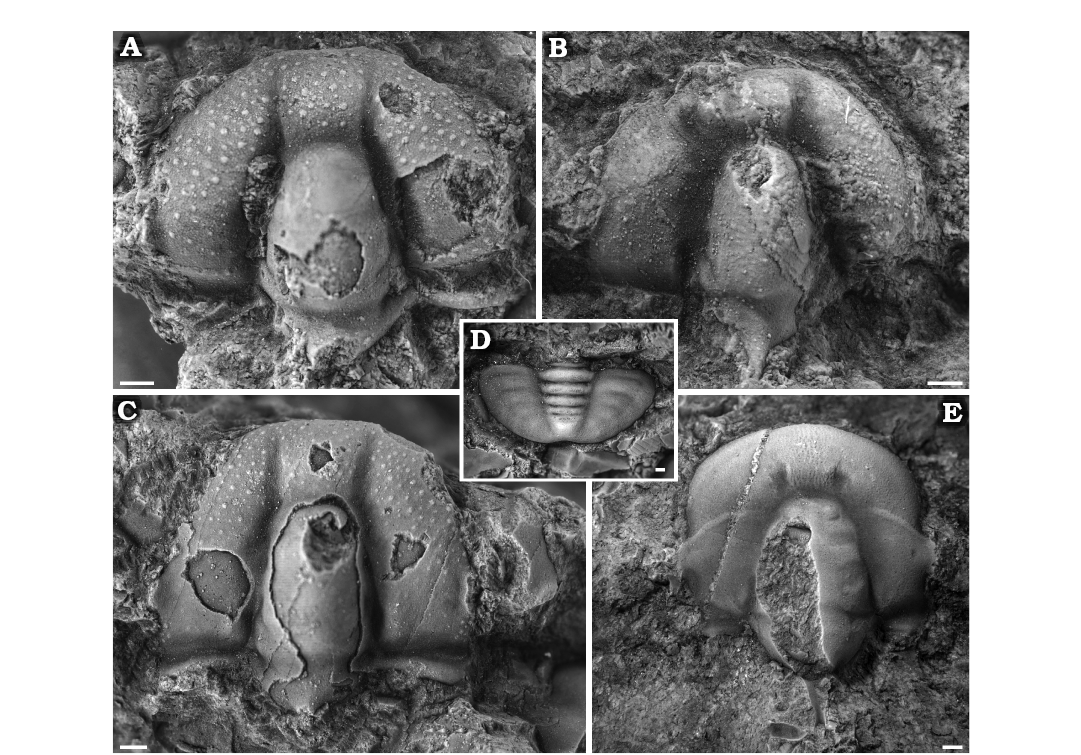
Fig. 11. Diceratocephalid trilobites from Guzhangian, Miaolingian (Cambrian), the Kushan Formation of China. Cyclolorenzella convexa (Resser & Endo in Endo and Resser, 1937), the Diceratocephalus armatus Zone, Baijiashan section, Liaoning Pronvince (A–C) and Cyclolorenzella sp., the Wongia rotundata Zone, Julinshan section, Shandong Province (D, E). A. NIGP205987 (field no. BJS-A3.3m), cranidium. B. NIGP205988 (field no. BJS-A3.3m), cranidium. C. NIGP205989 (BJS-A3.3m), cranidium. D. Holotype, NIGP205990 (field no. Ju-2-1.6m), pygidium. E. NIGP205991 (field no. Ju-2-1.6m), cranidium. All in dorsal view. Scale bars: A–C, 500 μm; D, E, 1 mm.
Remarks.—In the general configuration of the cranidium, Cyclolorenzella sp. is quite similar to Cyclolorenzella distincta (Zhang 1985: 113, pl. 1: 17, 17a; Yuan et al. 2016: 235, 236, pl. 2: 3–9) and Cyclolorenzella jishanensis (Zhang and Wang 1986: 406, pl. 122: 13, 14) from the lower part of the Kushan Formation, Shanxi Province. However, it differs from Cyclolorenzella distincta in having a subquadrate cranidium with a broad, well-rounded anterior margin, subcylindrial glabella, shorter palpebral lobe, and a slightly divergent anterior branch of the facial suture. It can also be distinguished from C. jishanensis chiefly by its subquadrate cranidium with broad, well-rounded anterior margin, shorter palpebral lobe, and the slightly divergent anterior branch of the facial suture.
Genus Torifera Wolfart, 1974
Type species: Torifera triangularis Wolfart, 1974; from the Blackwelderia–Torifera–Crepicephalus Assemblage Zone, Guzhangian, Miaolignian, Cambrian; Central Afghanistan.
Species included: Torifera youyangensis Zhu in Zhang et al., 1980, Torifera abrupta Peng, Babcock and Lin, 2004, Torifera jelli Peng et al., 2009, Torifera tonkinensis (Mansuy, 1915), Torifera mera (Romanenko in Goncharova et al., 1972), Torifera tuma (Yang in Zhou et al., 1977), Torifera taoyuanensis (Peng, 1987), Torifera? paracovexa (Yang in Yin and Lee, 1978), Torifera? latisulcata (Zhang in Qiu et al., 1983), Torifera sp., Torifera intermedia Yuan, Ren & Gao sp. nov.
Emended diagnosis.—Small diceratocephalid trilobites; cephalon with genal spine; axial furrow broad and deep; cranidium convex, subtrapezoidal, with or without gently convex preglabellar boss defined by a pair of short, distinctly divergent furrows on preglabellar field; preglabellar field wide (sag.), convex; anterior border gently convex; anterior border furrow shallow but distinct; glabella convex, conical to truncated conical, with faintly impressed lateral glabellar furrows; fixigenae wider (tr.), vaulted near the palpebral lobe, sloping down towards axial furrow, with a pair of low baccula at posteroproximal corner of fixigenae; eye ridge distinct, transverse; palpebral lobe short to moderately long; gonatoparian facial suture; occipital ring extending backwards, forming triangular, semicircular to semi-elliptical in outline or moderately long occipital spine; occipital furrow shallow and narrow medially, bending forward laterally. Thorax of 8 segments. Pygidium wide (tr.) and narrow (sag.), transverse, semi-elliptical, bluntly rounded laterally; axial furrow very shallow; axis broad and long, reaching posterior border, tapering backwards, with 3–5 axial rings; axial ring furrows broad and shallow; pleural field as wide as axis, pygidial border narrow and flat; prosopon of closely pitted cranidium, or with fine granulation, irregular wrinkles or terrace lines on the surface of cranidium and pygidium.
Remarks.—In the general outline of the cranidium and glabella, and the course of the facial suture, Torifera most closely resembles Wongia Sun, 1924. However, it differs from the latter mainly in having its occipital ring expanding strongly backwards, a more distinct anterior border and border furrow, bacculae at the posteroproximal corner of fixigenae, broader fixigenae between the palpebral lobes, and a broader (tr.) and narrower (sag.) elliptical pygidium. Torifera has been assigned to the Aulacodigmatidae Öpik, 1967 (Wolfart 1974; Zhang et al. 1980; Wittke 1984), but the Aulacodigmatidae Öpik, 1967, is considered to be synonymous with Diceratocephalidae Lu, 1954 (Zhang and Jell 1987; Jell and Hughes 1997). Subsequently, Torifera has been assigned to the Diceratocephalidae (Zhang and Jell 1987; Jell and Hughes 1997; Jell and Adrain 2002; Yuan and Li 2008; Zhu 2008; Luo et al. 2009). The Alsataspididae Turner, 1940, is characterized by its cephalon having a long frontal axial spine, subcircular glabella with a deep anterior median longitudinal glabellar furrow, an absence of palpebral lobes and eye ridges, and a larger pygidium. Torifera is therefore quite different from any genera of Alsataspididae, and we do not think that Torifera can be placed in Alsataspididae (Peng et al. 2004, 2009; Peng 2008, 2020).
Stratigraphic and geographic range.—Miaolingian, Guzhangian, Cambrian of southern Asia (Afghanistan, India, Iran, Oman, Vietnam), south and southwestern China (western northwestern Hunan, eastern Guizhou, western and southeastern Yunnan, southeastern Sichuan, western Guangxi and southern Jiangsu), and North China (Shandong).
Torifera sp.
Fig. 12A–C.
Material.—Two cranidia and one pygidium (NIGP 205992–205994), from Damesella paronai–Ajacicrepida ajax Zone, Changhia Formation, Shandong Province, China.
Description.—Cranidium subtrapezoidal, anterior margin more strongly bending forwards; preglabellar field broad, moderately convex, anterior border furrow distinct, anterior border narrow and convex; glabella short and convex, truncated conical, with faintly impressed lateral glabellar furrow S1; fixigenae gently convex, wider than glabellar width between palpebral lobes, a pair of distinct low bacculae at posteroproximal corner of fixigenae; eye ridge distinct, transverse; occipital ring prominent, extending backwards to form a triangle, slightly shorter than glabellar length; anterior branch of facial suture slightly divergent forward, crossing anterior border furrow and then bending inward. Pygidium wide (tr.), transverse, semi-elliptical, sharply rounded laterally; axial furrows very shallow; axis broad and long, reaching posterior border and gently tapering backwards, with 3–4 axial rings; axial ring furrows broad and shallow, pleural field as wide as axis, pygidial border narrow and flat; prosopon of closely spaced irregular wrinkles on the surface of preglabellar field and occipital ring.
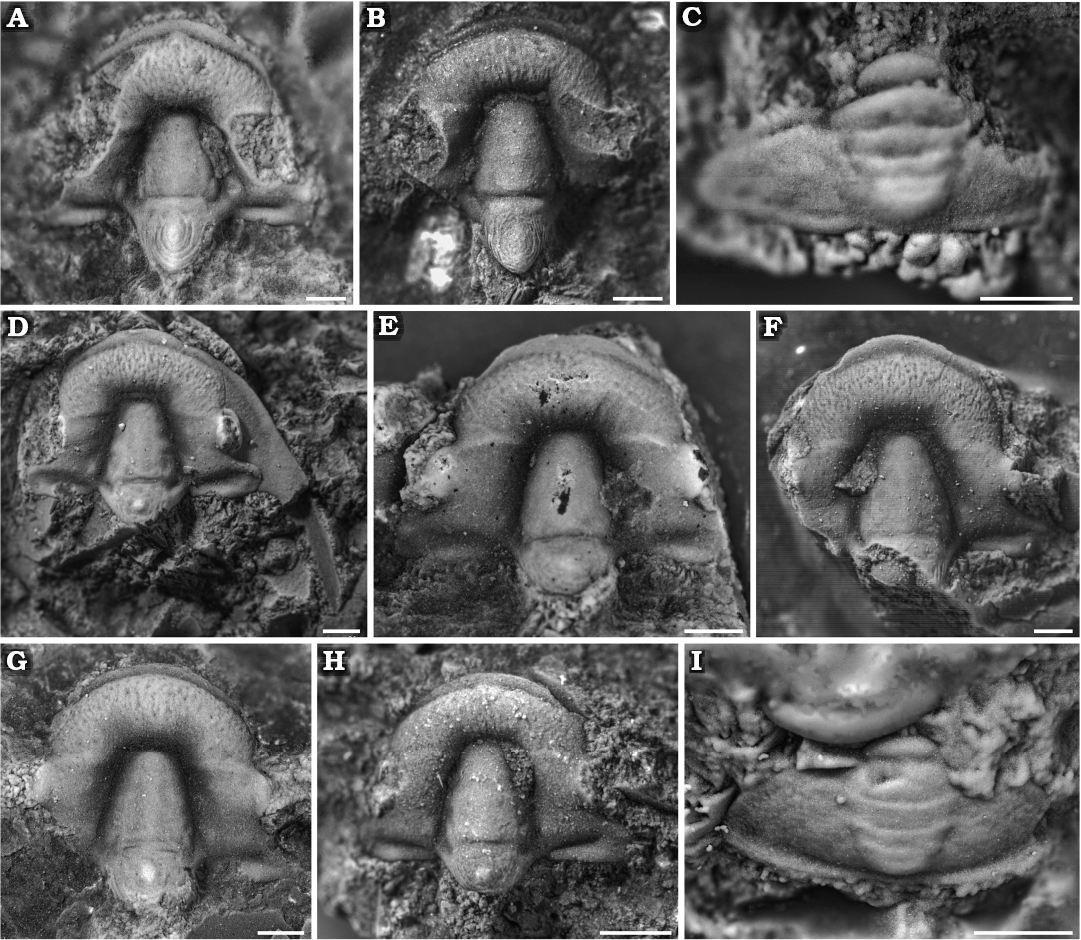
Fig. 12. Diceratocephalid trilobites from Guzhangian, Miaolingian (Cambrian), the Changhia Formation of China. Torifera sp., the Damesella paronai–Ajacicrepida ajax Zone, Julinshan section, Shandong Pronvince (A–C) and Torifera intermedia Yuan, Ren & Gao sp. nov., the Damesella paronai–Ajacicrepida ajax Zone, southern Nanzhaocun (D–I), Julinshan (E, G), and Jiulongshan (F) sections, Shandong Province. A. Holotype, NIGP205992 (field no. Ju-1-A3-1), cranidium. B. NIGP205993 (field no. Ju-1-A3-1), cranidium. C. NIGP205994 (field no. Ju-1-A3-1), pygidium. D. Holotype, NIGP205995 (field no. NZC-S1-2-1), incomplete cephalon. E. NIGP205996 (field no. Ju–1-3-1), cranidium. F. NIGP205997 (field no. Jls-91), cranidium. G. NIGP205998 (field no. Ju-1-3-1), cranidium. H. NIGP205999 (field no. NZC-S1-2-1), cranidium. I. NIGP206000 (field no. NZC-S1-2-1), pygidium. All in dorsal view. Scale bars: A–H, 500 μm; I, 200 μm.
Remarks.—In general configuration of the cranidium and pygidium, and the course of the facial suture, Torifera sp. is quite similar to Torifera triangularis Wolfart, 1974, from the Blackwelderia–Torifera–Crepicephalus Assemblage Zone (upper Cambrian) of Surkh Bum, central Afghanistan (Wolfart 1974: 97–101, text-fig. 11, pl. 12: 1–9; pl. 13: 1–6). However, it differs from the latter mainly in having the cranidium with more strongly bending forward anterior margin, narrower fixigenae between the palpebral lobes, a robust and longer triangular occipital ring, a relatively short glabella, slightly divergent anterior branches of the facial sutures, a more convex anterior border, a wider pygidial border, and closely spaced irregular wrinkles on the surface of the preglabellar field and the occipital ring instead of a pitted surface on the cranidium. It can be also distinguished from T. latisulcata (Zhang in Qiu et al., 1983) (Qiu et al. 1983: 126, pl. 41: 3; Yuan et al. 2012: 372, pl. 224: 1–9) mainly by its shorter, truncated conical glabella, longer and more robust triangular occipital ring, the presence of a pair of low bacculae at the posteroproximal corner of the fixigenae, and its wider (tr.) and narrower (sag.) pygidium. The specimens assigned to Cyclolorenzella magezhuangensis Zhang and Wang, 1985 (Yang 2008: 109–110, pl. 13: 10, 15) from the uppermost Changhia Formation of Jiulongshan section, Shandong, have been tentatively reassigned to the new species, because of the presence of low bacculae at the posteroproximal corner of the fixigenae and a truncated conical glabella.
Torifera intermedia Yuan, Ren & Gao sp. nov.
Fig. 12D–I.
Zoobank LSID: urn:lsid:zoobank.org:act:F0046226-3808-4E93-A649-3AED2431BB1D
Etymology: From Latin intermedius, intermediate; because the new species appears intermediate between species of Torifera and Wongia.
Type material: Holotype: Incomplete cephalon (NIGP 205995), Fig. 12D. Paratypes: four cranidium (NIGP 205997–206000), Fig. 12H, E, G, F; one pygidium (NIGP 205996), Fig. 12I.
Type locality: Southern Nanzhaocun section, Julinshan and Jiulongshan sections, Shandong Province, China.
Type horizon: Changhia Formation (Damesella paronai–Ajacicrepida ajax Zone), Guzhangian, Miaolingian, Cambrian.
Material.—Type material only.
Diagnosis.—Cranidium subquadrate, anterior margin moderately bending forward, with a weakly vaulted boss on preglabellar field; glabella long, truncated conical, with 3 pairs of very faint lateral glabellar furrows; fixigenae with a pair of very low bacculae at posteroproximal corner of fixigenae; occipital ring semi-elliptical, with a distinct occipital node posteriorly; posterior border gently convex, as wide as glabella at the base; posterior border furrow wide and distinct, bending slightly forward laterally; pygidium wide (tr.), transverse, semi-elliptical, bluntly rounded laterally; axis broad and long, moderately convex, reaching posterior border; tapering backwards, with 3–5 axial rings, pygidial border narrow and flat, border furrow shallow; prosopon of indistinct irregular wrinkles on the surface of preglabellar field, librigenae and occipital ring.
Description.—Cranidium subquadrate, anterior margin moderately bending forward; preglabellar field broad, with a weakly vaulted boss on preglabellar field; the anterior border furrow shallow and the anterior border narrow and gently convex; glabella long, truncated conical, with 3 pairs of very faint lateral glabellar furrows; fixigenae as wide as glabella between palpebral lobes, with a pair of very low bacculae at posteroproximal corner of fixigenae; occipital ring semi-elliptical, with a distinct occipital node posteriorly; eye ridge distinct, transverse; palpebral lobe short, about 0.4 times glabellar length; anterior branches of facial sutures gently divergent forwards, crossing anterior border furrow and then bending inward; posterior branches of facial sutures strongly divergent outwards, then gently bending inward near the end of posterior border furrow; posterior border gently convex, posterior border furrow wide and distinct, bending slightly forward laterally; librigena moderately wide and flat, with long genal spine; lateral border furrow short and shallow, disappearing opposite midpoint of glabella. Pygidium wide (tr.), transverse, semi-elliptical, and bluntly rounded laterally; axial furrow very shallow, axis broad and long, moderately convex, and reaching posterior border, tapering backwards, with 3–5 axial rings, the axial ring furrows shallow; pleural field as wide as axis, pygidial border narrow and flat, the border furrow shallow; prosopon of indistinct irregular wrinkles on the surface of preglabellar field, librigeenae and occipital ring.
Remarks.—The new species shows some characteristics of Torifera, with Torifera triangularis as the type species.It has a cranidium with a distinct anterior border and border furrow, fixigenae with low bacculae at the posteroproximal corner, distinct transverse eye ridge, wide (tr.) posterior border, and narrow (sag.) semi-elliptical pygidium. However, it differs from T. triangularis in having a semi-elliptical occipital ring and a longer glabella. In the general configuration of the glabella and occipital ring, and the librigena having a long genal spine directed posterolaterally, the new species bears some resemblances to Wongia, with W. triangulata the type species (Sun 1924: 85, pl. 5: 12a, b). However, it can be distinguished from Wongia triangulata chiefly by the presence of a distinct anterior border and border furrow, the fixigenae having low bacculae at the posteroproximal corners, a distinct transverse eye ridge, a wider posterior border (tr.), and a narrower (sag.) semi-elliptical pygidium.
Stratigraphic and geographic range.—Southern Nanzhaocun section, Julinshan and Jiulongshan sections, Damesella paronai–Ajacicrepida ajax Zone, Changhia Formation, Guzhangian, Miaolingian, Cambrian; Shandong, China.
Discussion
This study documents the stratigraphic distribution of nine nominal species and subspecies, and one species in open nomenclature of Wongia, from the uppermost Changhia Formation to the Kushan Formation in several sections in Shandong and Liaoning. In stratigraphically ascending order, these are Wongia valida, Wongia nanzhaocunensis Yuan sp. nov., Wongia sp., Wongia acalle, Wongia laevigata Yuan sp. nov., Wongia rotundata, Wongia triangulata, Wongia subcylindrica, Wongia regularis regularis, and Wongiaregularis pustulosa. The related genera Cylorenzella and Torifera also occur in these sections, adding to the stratigraphic resolution. Cyclolorenzella convexa was recovered from the Diceratocephalus armatus Zone of the uppermost Kushan Formation, at the Baijiashan section, Dalian, Liaoning, and Cyclolorenzella sp. occurs in the Wongia rotundata Zone of the lower part of the Kushan Formation, at the Julinshan section, Feixian County, Shandong. Torifera sp. and T. intermedia Yuan, Ren & Gao sp. nov. are recorded from the Damesella paronai–Ajacicrepida ajax Zone of the uppermost Changhia Formation, at the Julinshan section in Feixian County, and in the southern Nanzhaocun section (Linqu County, Shandong).
The stratigraphic distribution of Wongia (as Jiulongshania) and Cyclolorenzella was most recently revised by Park et al. 2008. Guo et al. (1996) recorded Wongia acalle and W. regularis (as Cyclolorenzella) from the Damesella–Yabeia Zone of the uppermost Changhia Formation. However, the general morphology of the cranidium in the specimens assigned to W. regularis (Guo et al. 1996: pl. 59: 17–18) seems to resemble W. nanzhaocunensis Yuan sp. nov. from the uppermost Changhia Formation, but their preservation is too poor to ascertain whether they are conspecific, or if they represents a new species. The specimens described as Wongia acalle (Guo et al. 1996: pl. 59: 12–16) may represent two species, Wongia valida (Guo et al. 1996: pl. 59: 12–15) and Wongia nanzhaocunensis Yuan sp. nov. (Guo et al. 1996: pl. 59: 16) as mentioned in the text. In previous work, Cyclolorenzella has been mentioned as being confined to a narrow stratigraphic interval within the Neodrepanura (as Drepanura) Zone of the upper Kushan Formation, China, and the Sesong Formation, Korea. New investigation reveals that Cyclolorenzella sp. occurs in the Wongia rotundata Zone (lower Kushan Formation), and Cyclolorenzella sp. occurs in the Lejopyge armata Zone, Machari Formation, Yongwol Group, Korea, dated as uppermost Drumian or lowest Guzhangian (Hong et al. 2003). In summary, Cyclolorenzella has a relatively long stratigraphic range from the uppermost Drumian or lowest Guzhangian to the upper Guzhangian. Similarly, Torifera has previously been documented as ranging from the Proagnostus bulbus Zone through the Linguagnostus reconditus Zone to, questionably, the Glyptagnostus stolidotus Zone, upper Guzhangian, in southern Asia (Afghanistan, India, Iran, Oman, Vietnam), south and southwestern China (western northwestern Hunan, eastern Guizhou, western and southeastern Yunnan, southeastern Sichuan, western Guangxi and southern Jiangsu) (Peng 2008). Torifera sp., Torifera intermedia Yuan, Ren & Gao sp. nov. is found here to occur in the Damesella paronai–Ajacicrepida ajax Zone of the uppermost Changhia Formation (lowest Guzhangian), which may represent the oldest known record of the genus in the North China Platform. The detailed stratigraphic distributions of these species of Wongia, Cyclolorenzella and Torifera in the North China Platform are shown in the Fig. 13.
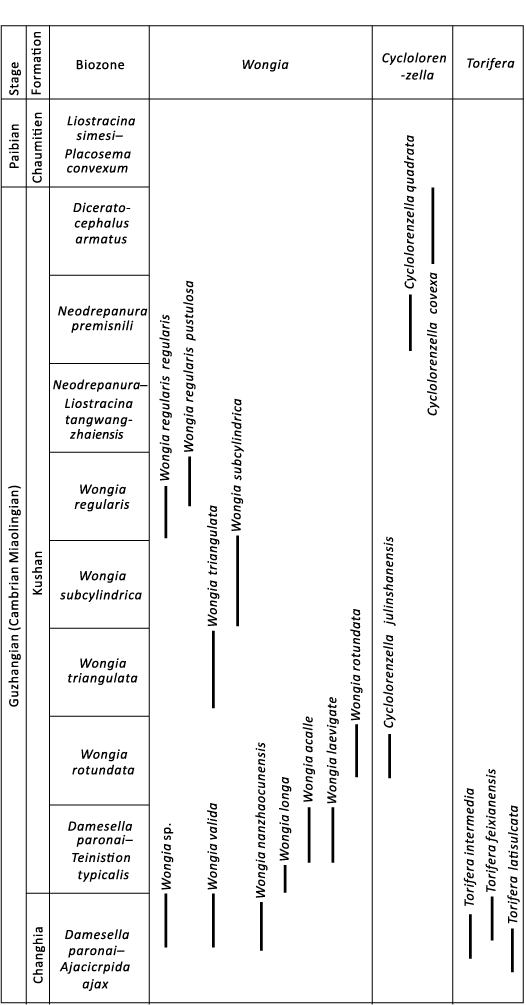
Fig. 13. Stratigraphical distribution of the species of Wongia, Cyclolorenzella, and Torifera on the North China Platform.
This study further subdivided the original genus-level biozones and established species-level biozones based on the FAD (First Appearance of Datum) of species, significantly enhancing the precision of biostratigraphic correlation. As shown in Fig. 13, the traditional Blackwelderia biozone (lower part of the Kushan Formation) was subdivided into five precise biozones: Damesella paronai–Teinistion typicalis, Wongia rotundata, Wongia triangulata, Wongia subcylindrica, and Wongia regularis zones (Ren et al. 2020). A high-resolution biostratigraphic framework was established.
Conclusions
This study revised the taxonomic placement of nineteen species of trilobites Wongia, Cyclolorenzella, and Torifera, along with the establishment of three new species and two indefinate species: Wongia nanzhaocunensis Yuan sp. nov., Wongia laevigate Yaun sp. nov., Torifera intermedia Yuan, Ren & Gao sp. nov., Cyclolorenzella sp., and Torifera sp., which delineated the first appearance, stratigraphic range, and distribution of the species within the stratigraphic sequence in North China Platform. Simultaneously, establishing the chronological sequence of taxonomic appearances in the strata provides a foundation for studying the systematic evolution of various species. The establishment of a high-resolution biostratigraphic framework holds significant importance for stratigraphic correlation, as it enables precise correlation with both global biozones and the base of the Guzhangian and Paibian stages.
Acknowledgements
We thank cordially Joseph P. Botting (Department of Natural Sciences, Amgueddfa Cymru—Museum Wales, Cardiff, UK) for improving the English. We also acknowledge that the constructive comments from two reviewers, Stephen Westrop (Oklahoma Museum of Natural History and School of Geosciences, University of Oklahoma, Norman, USA) and one anonymous reviewer who provided valuable suggestions and have significantly improved the quality of the manuscript. This study was supported by the Natural Scientific Foundation of Shandong (ZR2023MD110), the State Key Laboratory of Palaeobiology and Stratigraphy (Nanjing Institute of Geology and Palaeontology, CAS; No. 223122).
Editor: Krzysztof Hryniewicz
References
Choi, D.K. and Park, T.Y.S. 2017. Recent advances of trilobite research in Korea: Taxonomy, biostratigraphy, paleogeography, and ontogeny and phylogeny. Geoscience Journal 21: 891–911. Crossref
Chough, S.K., Lee, H.S., Woo, J, Chen, J.T., Choi, D.K., Lee, S.B., Kang, I., Park, T.Y., and Han, Z.Z. 2010. Cambrian stratigraphy of North China Platform: revisiting principal sections in Shandong, China. Geosciences Journal 14: 235–268. Crossref
Chu, C.L. 1959. Trilobites from the Kushan Formation of North and Northeastern China [in Chinese, with English abstract]. Memoirs of the Institute of Palaeontology, Academia Sinica 2: 44–128.
Duan, J.Y., An, S.L., Liu, P.J., Peng, X.D., and Zhang, L.Q. 2005. The Cambrian Stratigraphy, Fauna and Palaeogeography in Eastern Part of North China Plate [in Chinese, with English abstract]. 255 pp. Yayuan Publishing Company, Hong Kong.
Egorova, L.I., Shbanov, Y.Y., Pegel, T.V., Savitsky, V.E., Suchov, S.S., and Tchernysheva, N.E. 1982. Maya Stage of Type Locality (Middle Cambrian of Siberian Platform) [in Russian]. 146 pp. Academy of Sciences of the USSR, Ministry of Geology of the USSR, Interdepartmental Stratigraphic Committee of the USSR, Transactions.
Endo, R. and Resser, C.E. 1937. The Sinian and Cambrian formations and fossils of Southern Manchoukuo. Manchurian Science Museum Bulletin 1: 103–302, 370–474.
Ergaliev, G.K. and Ergaliev, F.G. 2008. Middle and Upper Cambrian Agnostida of the Aksai National Geological Reserve South Kazakhstan (Kyrshabakty River, Malyi Karatau Range) [in Russian]. 376 pp. Gylym Press, Almaty.
Feng, Z.Z., Peng, Y.M., Jin, Z.K., and Bao, Z.D. 2002. Lithofacies palaeogeography of the late Cambrian in China. Journal of Palaeogeography 2: 1–11.
Goncharova, B.I., Pokrovskaya, N.V.,Poletaeva, O.K., Romanenko, E.V., Semashko, A.K., and Tomashpolskaya, V.D. 1972. New Cambrian trilobites from Siberia and central Asia. In: I.E. Zanina (ed.), Novye vidy drevnix rastenii i bespozvonochnyx SSSR, 214–236. Nauka, Moscow.
Guo, H.J., Zan, S.Q., and Luo, K.L. 1996. Cambrian Stratigraphy and Trilobites of Eastern Liaoning [in Chinese, with English summary]. 184 pp. Jilin University Press, Changchun.
Harrington, H.J., Henningsmoen, G., Howell, B.F., Jaanusson, V., Lochman-Balk, C., Moore, R.C., Poulsen, Chr., Rasetti, F., Richter, E., Richter, Rud., Schmidt, H., Sdzuy, K., Struve, W., Størmer, Leif, Stubblefield, C.J., Tripp, R., Weller, J.M., and Whittington, H.B. 1959. Systematic descriptions. In: R.C. Moore (ed.), Treatise on Invertebrate Paleontology, Part O. Arthropoda 1, 170–539. Geological Society of America and University of Kansas, Lawarence, Kansas.
Hong, P.S., Lee, J.G., and Choi, D.K. 2003. Trilobites from the Lejopyge armata Zone (upper Middle Cambrian) of the Machari Formation, Yongwol Group, Korea. Journal of Paleontology 77: 895–907. Crossref
Jell, P.A. and Adrain, J.M. 2003. Available generic names for trilobites. Memoirs of the Queensland Museum 48: 331–551.
Jell, P.A. and Hughes, N.C. 1997. Himalayan Cambrian trilobites. Special Papers in Palaeontology 58: 1–113.
Kang, I. and Choi, D.K. 2007. Middle Cambrian trilobites and biostratigraphy of the Daegi Formation (Taebaek Group) in the Seokgaejae section, Taebaeksan Basin, Korea. Geosciences Journal 11: 279–296. Crossref
Kobayashi, T. 1935. The Cambro-Ordovician formations and faunas of South Chosen. Palaeontology part 3. Cambrian faunas of South Chosen with special study on the Cambrian trilobite genera and families. Journal of the Faculity of Science, Imperial University of Tokyo Section II 4 (2): 49–344.
Kobayashi, T. 1960. The Cambro-Ordovician formations and faunas of South Korea. Part 7. Palaeontology 6. Supplement to the Cambrian faunas of the Tsuibon Zone with notes on some trilobites genera and families. Journal of the Faculty of Science, Imperial University of Tokyo Section II 12 (2): 329–420.
Lazarenko, N.P. 1965. Some new Middle Cambrian trilobites from north-central Siberia [in Russian]. Učenye Zapiski Paleontologiâ i Biostratigraphiâ (NIIGA) 7: 14–36. .
Lei, Q.P. 2023. Trilobites from the Cambrian Upper Changhia Formation in Northern Anhui [in Chinese, with English abstract]. Journal of Geoscience 37: 500–511.
Lu, Y.H. 1957. Arthropoda, Trilobita [in Chinese]. In: Institute of Palaeontology, Academia Sinica (ed.), Index Fossils of China, Invertebrata, III, 249–294. Geological Publishing House, Beijing.
Lu, Y.H., Chang (Zhang), W.T., Chu (Zhu), C.L., Chien (Qian), Y.Y., and Hsiang (Xiang), L.W. 1965. Fossils of Each Group, Chinese Trilobites [in Chinese]. Vol 1: 1–362, Vol. 2: 363–766. Science Press, Beijing.
Lu, Y.H., Chien (Qian), Y.Y., and Chu (Zhu) Z.L. 1963. Trilobita [in Chinese]. 186 pp. Science Press, Beijing.
Lu, Y.H. 1954. Two new trilobite genera of the Kushan Formation [in Chinese]. Acta Palaeontologica Sinica 2: 409–438
Luo, H.L., Hu, S.X., Hou, S.G., Gao, H.G., Zhan, D.Q., and Li, W.C. 2009. Cambrian Stratigraphy and Trilobites from Southeastern Yunnan, China [in Chinese with English summary]. 252 pp. Yunnan Science and Technology Press, Kunming.
Luo, K.L. 2001. Upper Middle–Upper Cambrian trilobites of Hancheng area, Shaanxi [in Chinese, with English abstract]. Acta Palaeontologica Sinica 40: 371–387.
Mansuy, H. 1915. Fuanes cambriennes du Haut-Tonkin. Mémoires du Service Géologique de l’Indochine 4 (2): 1–29.
Nan, R.S. and Chang, S.Q. 1985. Middle and Upper Cambrian trilobites from Xishan of Fuzhouwan, Liaoning [in Chinese, with English abstract]. Acta Geologica of Liaoning Province 2: 1–25.
Nan, R.S. 1976. Trilobita [in Chinese]. In: Geological Bureau of Inner Mongolia Autonomous Region and Institute of Geology, Northeast China (eds.), Palaeontological Atlas of North China, Part 1 Inner Mongolia Autonomous Region, 333–352. Geological Publishing House, Beijing.
Öpik A A. 1967. The Mindyallan fauna of northwestern Queensland. Bureau of Mineral Resources, Geology and Geophysics, Australia Bulletin 74: 1–404.
Park, T.Y. and Choi, D.K. 2010. Two middle Cambrian diceratocephalid trilobites, Cyclolorenzella convexa and Diceratocephalus cornutus, from Korea: development and functional morphology. Lethaia 43: 73–87. Crossref
Park, T.Y., Han, Z.Z., Bai, Z.Q., and Choi, D.K. 2008. Two Middle Cambrian trilobite genera, Cyclolorenzella Kobayashi, 1960 and Jiulongshania gen. nov., from Korea and China. Alcheringa 32: 247–269. Crossref
Park, T.Y., Kihm, J.H., and Choi, D.K. 2009. A middle Cambrian trilobite fauna from the lowermost part of the Sesong Formation at Gadeoksan, northern part of Taebaek [in Korean]. Journal of Palaeontological Society of Korea 25: 119–128.
Park, T.Y., Kihm, J.H., and Choi, D.K. 2013. Late Middle Cambrian (Cambrian Series 3) trilobite faunas from the lowermost part of the Sesong Formation, Korea and their correlation with North China. Journal of Paleontology 87: 991–1003. Crossref
Park, T.Y., Woo, J., and Choi, D.K. 2010. A trilobite fauna from the breccias of the Daegi Formation at the Dongjeom section, Taebaek, Korea and its geological implication [in Korean]. Journal of Palaeontological Society of Korea 26: 173–181.
Peng, S.C. 1987. Early Late Cambrian stratigraphy and trilobite fauna of Taoyuan and Cili, Hunan [in Chinese, with English summary]. In: Nanjing Institute of Geology and Palaeontology, Academia Sinica (ed.), Collection of Postgraduate Theses of Nanjing Institute of Geology and Palaeontology, Academia Sinica, Volume 1, 53–134. Jiangsu Science and Technology Publishing House, Nanjing.
Peng, S.C. 2008. Cambrian (late Taijiangian–Taoyuanian) slope facies non-agnostoids. Chapter 7. In: Z.Y. Zhou and Y.Y. Zhen (eds.), Trilobite Record of China, 162–207. Science Press, Beijing.
Peng, S.C. 2020. Illustrations of Cambrian Stratigraphy and Index Fossils of China. Trilobites [in Chinese]. 571 pp. Zhejiang University Press, Hangzhou.
Peng, S.C., Babcock, L.E., and Lin, H.L. 2004. Polymerid Trilobites from the Cambrian of Northwestern Hunan, China. Vol. 1. Corynexochida, Lichida, and Asaphida. 333 pp. Science Press, Beijing.
Peng, S.C., Hughes, N.C., Heim, N.A., Sell, B.K., Zhu, X.J., Myrow, P.M., and Parcha, S.K. 2009. Cambrian trilobites from the Parahio and Zanskar Valleys, Indian Himalaya. Journal of Paleontology 83 (Supplement 6): 1–95. Crossref
Qiu, H.A., Lu, Y.H., Zhu, Z.L., Bi, D.C., Lin, T.R., Zhou, Z.Y., Zhang, Q.Z., Qian, Y.Y., Ju, T.Y., Han, N.R., and Wei, X. Z.,1983. Trilobita [in Chinese]. In: Nanjing Institute of Geology and Mineral Resources, Ministry of Geology and Mineral Resources (ed.), Palaeontological Atlas of East China. Vol. 1, 28–254, 576–609. Geological Publishing House, Beijing.
Ren, G.Y. 2017. Cambrian Trilobite Fauna from the Kushan Formation and the Upper Changhia Formation (Guzhangian), Shandong Province [in Chinese, with English abstract]. 284 pp. Unpublished Ph.D. Thesis, China University of Mining and Technology, Xuzhou, China.
Ren, G.Y., Yuan, J.L., Meng, F.W., Gao, J., Zhao, Y., Guo, Y., and Yang, F. 2020. New progress on the study of the Cambrian Kushan Formation (Guzhangian) in eastern North China Platform [in Chinese with English abstract]. Journal of Stratigraphy 44 (3): 1–16.
Sun, Y.C. 1924. Contribution to the Cambrian faunas of North China. Palaeontologia Sinica (series B) 1 (4): 1–109.
Walcott, C.D. 1905. Cambrian faunas of China. Proceedings of the United States National Museum 29 (1415): 1–106. Crossref
Walcott, C.D. 1906. Cambrian faunas of China. Proceedings of the United States National Museum 30 (1458): 563–595. Crossref
Walcott, C.D. 1913. The Cambrian faunas of China. In: B. Willis, E. Blackwelder, R.H. Sargent, F. Hirth, C.D. Walcott, S. Weller, and G.H. Girty (eds.), Research in China, 3–276. Carnegie Institution of Washington. Washington.
Wang, L.W., Chang, R.S., Chang, A.Z., Yan, E.Z., and Wei, X.Y. 1956. Handbook of Index Fossils of China [in Chinese]. 699 pp. New Knowledge Publishing House, Shanghai.
Wang, S.X. and Zhang, J.L. 1994. Stratigraphy and trilobite faunas of Cambrian in the Wutai Mountains, Northeast Shanxi (3). Description of genus and species (A) [in Chinese, with English abstract]. Journal of Geology and Mineral Resources of North China 9 (2): 125–152.
Wang, Z.P., Chen, J.T., Liang, T.T., Yuan, J.L., Han, C., and Liu, J.Y. 2020. Spatial variation in carbonate carbon isotopes during the Cambrian SPICE event across the eastern North China Platform. Palaeogeography, Palaeoclimatology, Palaeoecology 546: 1–11. Crossref
Whittington, H.B. and Kelly, S.R.A. 1997. Morphological terms applied to Trilobita. In: R.L. Kaesler (ed.), Treatise on Invertebrate Paleontology Part O, Arthropoda 1. Trilobita Revised. Volume 1: Introduction, Order Agnostida, Order Redlichiida, 313–329. Geological Society of America and University of Kansas Press, Lawrence.
Wittke, H. 1984. Middle and Upper Cambrian trilobites from Iran: Their taxonomy, stratigraphy and significance for provincialism. Palaeontographica A 183: 91–161.
Wolfart, R. 1974. Die Fauna (Brachiopoda, Mollusca, Trilobita) des älteren Ober-Kambriums (Ober-Kushanian) von Dorah Shah Dad, Südost-Iran, und Surkh Bum, Zentral-Afghanistan. Geologisches Jahrbuch 8: 71–184.
Yang, J.L. 1978. Middle and Upper Cambrian trilobites of western Hunan and eastern Guizhou [in Chinese]. Professional Papers of Stratigraphy and Palaeontology 4: 1–82.
Yang, X.F. 2008. Trilobite Biostratigraphy of the Transition of the Changxia and Kushan Formations (Cambrian) in Shandong and the Lower Boundary of the Kushan Stage in North China for Regional Chronostratigraphy [in Chinese, with English abstract]. 294 pp. Unpublished Ph.D. Thesis, Nanjing Institute of Geology and Palaeontology, Chinese Academy of Sciences, Nanjing, China.
Yin, G.Z. and Lee, S.J. 1978. Trilobita [in Chinese]. In: Stratigraphical and Palaeontological Working Group of Guizhou Province (ed.), Palaeontological Atlas of Southwest China, Guizhou. Volume 1. Cambrian–Devonian, 385–594, 798–829. Geological Publishing House, Beijing.
Yuan, J.L. and Li, Y. 2008. Non-agnostoids of Changhian (late Mid Cambrian), Chapter 5. In: Z.Y. Zhou and Y.Y. Zhen (eds.), Trilobite Record of China, 108–135. Science Press, Beijing.
Yuan, J.L., Li, Y., Mu, X.N., Lin, J.P., and Zhu, X.J. 2012. Trilobite fauna of the Changhia Formation (Cambrian Series 3) from Shandong and adjacent area, North China [in Chinese, with English summary]. Palaeontographica Sinica, New Series B 35: 1–758.
Yuan, J.L., Zhang, W.T., and Zhu, Z.L. 2016. Cambrian stratigraphy and trilobite fauna in southern and western marginal parts of the Ordos Platform [in Chinese, with English summary]. Palaeontologica Sinica, New Series B 36: 1–534.
Zhang, Z.Q. and Liu, M.W. 1996. Stratigraphy (Lithostratigraphy) of Shandong Province [in Chinese]. 328 pp. China University of Geosciences Press, Wuhan.
Zhang, J.L. 1985. New materials of the early Gushanian trilobites in Zhuozishan district, Nei Monggol Zizhiqu (Autonomous region) [in Chinese, with English abstract]. Bulletin of Tianjin Institute of Geology and Mineral Resources 13: 111–120.
Zhang, J.L. and Liu, Y. 1986. On the Cambrian trilobites in the region of Dashetai, Inner Mongolia [in Chinese, with English abstract]. Journal of the Hebei College of Geology 9 (1): 11–18.
Zhang, J.L. and Liu, Y. 1991. Late Cambrian Gushanian trilobites from Guyang, Nei Monggol (Autonomous region) [in Chinese, with English abstract]. Bulletin of Tianjin Institute of Geology and Mineral Resources, Chinese Academy of Geological Sciences 25: 91–106.
Zhang, J.L. and Wang, S.X. 1985. Trilobita [in Chinese]. In: Tianjin Institute of Geology and Mineral Resources (ed.), Palaeontological Atlas of North China. Vol. 1. Paleozic, 327–488, 611–624, 689–714. Geological Publishing House, Beijing.
Zhang, J.L. and Wang, S.X. 1986. Some Late Cambrian Kushanian trilobites from Pinglu, Shanxi [in Chinese, with English summary]. Acta Palaeontologica Sinica 25: 663–671.
Zhang, J.L. and Zhou, P.W. 1993. Some Late Cambrian trilobites from Gushan Formation of Qingshuihe, Inner Mongolia [in Chinese, with English summary]. Acta Palaeontologica Sinica 32: 740–746.
Zhang, W.T. and Jell, P.A. 1987. Cambrian Trilobites of North China. Chinese Cambrian Trilobites Housed in the Smithsonian Institution. 459 pp. Science Press, Beijing.
Zhang, W.T., Lu, Y.H., Zhu, Z.L., Qian, Y.Y., Lin, H.L., Zhou, Z.Y., Zhang, S.G., and Yuan, J.L. 1980. Cambrian trilobite faunas of southwestern China [in Chinese, with English summary]. Palaeontologica Sinica New Series B 16: 1–497.
Zhang, W.T., Xiang, L.W., Liu, Y.H., and Meng, X.S. 1995. Cambrian stratigraphy and trilobites from Henan. Palaeontologia Cathayana 6: 1–166.
Zhou, T.M., Liu, Y.R., Meng, X.S., and Sun, Z.H. 1977. Trilobita [in Chinese]. In: Institute of Geological Sciences of Hubei Province et al. (eds.), Palaeontological Atlas of Central and Southern China. 1. Early Palaeonzoic, 104–266, 427–450. Geological Publishing House, Beijing.
Zhou, Z.Q. and Zheng, Z.C. 1980. New data on the Upper Cambrian from the Helan Mountains [in Chinese, with English abstract]. Bulletin of Chinese Academy of Geological Sciences (Series 10) 1 (1): 60–77.
Zhou, Z.Q., Li, J.S., and Qu, X.G. 1982. Trilobita [in Chinese]. In: Xi’an Institute of Geology and Mineral Resources (ed.), Palaeontological atlas of Northwest China, Shäanxi-Gansu-Ningxia Vol. 1. Precambrian and Early Palaeozoic, 215–294. Geological Publishing House, Beijing.
Zhu, N.W. 1992. Class Trilobita [in Chinese]. In: Jilin Bureau of Geology and Mineral Resources (ed.), Palaeontological Atlas of Jilin, China, 34–369. Jilin Science and Technolgy Publishing House, Changchun.
Zhu, Z.L. 2008. Platform facies non-agnostoids of Late Cambrian (Kushanian, Changshanian and Fengshanian) [in Chinese]. In: Z.Y. Zhou and Y.Y. Zhen (eds.), Trilobite. Record of China, 136–161. Science Press, Beijing.
Zhu, Z.L. and Wittke, H.W. 1989. Upper Cambrian trilobites from Tangshan, Hebei Province, North China. Palaeontologia Cathayana 4: 199–260.
Acta Palaeontol. Pol. 71 (2): 297–322, 2026
https://doi.org/10.4202/app.01288.2025