
A titanosaurian sauropod dinosaur from the Upper Cretaceous of Antarctica
PAUL M. BARRETT, PHILIP D. MANNION, SAMANTHA L. BEESTON, MATTHEW C. LAMANNA, BRETT CLARK, ALEJANDRO OTERO, JOSÉ P. O’GORMAN, and MARK EVANS
Barrett, P.M. Mannion, P.D., Beeston, S.L., Lamanna, M.C., Clark, B., Otero, A., O’Gorman J.P., and Evans, M. 2026. A titanosaurian sauropod dinosaur from the Upper Cretaceous of Antarctica. Acta Palaeontologica Polonica 71 (2): 349–362.
Antarctica preserves a meagre Mesozoic dinosaur record, with fossils known only from the Lower Jurassic Hanson Formation of the Transantarctic Mountains and Upper Cretaceous units of the James Ross Sub-Basin of the Antarctic Peninsula. Upper Cretaceous assemblages include ankylosaurs, ornithopods, and non-avian and avian theropods, but sauropods are exceptionally rare. Here, we describe a titanosaurian caudal vertebra from a lower Campanian (Upper Cretaceous) horizon of the Santa Marta Formation of James Ross Island and discuss its implications for the evolutionary and palaeobiogeographic history of Antarctic sauropods. The specimen is a small, procoelous anterior caudal vertebra, identified as that of a non-saltasaurid eutitanosaurian. Its morphology closely corresponds to that of rinconsaurians and aeolosaurines, particularly a specimen previously assigned to the Late Cretaceous Argentinean species Muyelensaurus pecheni, and it differs from earlier-diverging titanosaurs, although its fragmentary preservation warrants a conservative taxonomic assignment of Eutitanosauria indet. Size comparisons indicate that the individual in question was small for a titanosaur, possibly reflecting immaturity or a genuinely small-bodied form. This discovery represents only the second sauropod body fossil known from Antarctica, although it was the first dinosaur bone to be collected from the continent. Coupled with the occurrence of diamantinasaurians in Patagonia and Australia during the mid-Cretaceous, its eutitanosaurian affinities imply the presence of multiple somphospondylan lineages in Antarctica, informing dispersal patterns and highlighting biogeographic links with other Gondwanan landmasses.
Key words: Sauropoda, Titanosauria, Eutitanosauria, caudal vertebra, Cretaceous, Campanian, Santa Marta Formation, Antarctica, James Ross Island.
Paul M. Barrett [p.barrett@nhm.ac.uk; ORCID: https://orcid.org/0000-0003-0412-3000 ], Fossil Reptiles, Amphibians and Birds Section, Natural History Museum, Cromwell Road, London, SW7 5BD, UK; Evolutionary Studies Centre, University of the Witwatersrand, Johannesburg, South Africa; Department of Earth Sciences, UCL, Gower Street, London, WC1E 6BT, UK.
Philip D. Mannion [philipdmannion@gmail.com; ORCID: https://orcid.org/0000-0002-9361-6941 ] and Samantha L. Beeston [samantha.beeston.23@ucl.ac.uk; ORCID: https://orcid.org/0000-0002-7403-0910], Department of Earth Sciences, UCL, Gower Street, London, WC1E 6BT, UK.
Matthew C. Lamanna [lamannam@carnegiemnh.org; ORCID: https://orcid.org/0000-0001-9845-0728 ], Section of Vertebrate Paleontology, Carnegie Museum of Natural History, 4400 Forbes Avenue, Pittsburgh, PA 15213, USA.
Brett Clark [bclark@britishmuseum.org; ORCID: https://orcid.org/0000-0002-5888-9223 ], The British Museum, Great Russell Street, London, WC1B 3DG, UK.
Alejandro Otero [alexandros.otero@gmail.com; ORCID: https://orcid.org/0000-0002-4766-7086 ] and José P. O’Gorman [joseogorman@fcnym.unlp.edu.ar; ORCID: https://orcid.org/0000-0001-9279-6314 ], División Paleontología de Vertebrados, Museo de La Plata (Anexo Laboratorios), Paseo del Bosque s/n, La Plata, B1900FWA, Argentina.
Mark Evans [maans@bas.ac.uk; ORCID: https://orcid.org/0009-0002-5928-6464 ], British Antarctic Survey, High Cross, Madingley Road, Cambridge, CB3 0ET, UK; Centre for Palaeobiology and Biosphere Evolution, University of Leicester, Leicester, LE1 7RH, UK.
Received 4 December 2025, accepted 17 February 2026, published online 29 June 2026.
Copyright © 2026 P.M. Barrett et al. This is an open-access article distributed under the terms of the Creative Commons Attribution License (for details please see http://creativecommons.org/licenses/by/4.0/), which permits unrestricted use, distribution, and reproduction in any medium, provided the original author and source are credited.
Introduction
Antarctica currently has the sparsest Mesozoic dinosaur record of any continent (Maidment and Butler 2025): nevertheless, it has yielded a diversity of taxa from the Lower Jurassic Hanson Formation of the Central Transantarctic Mountains (e.g., Hammer and Hickerson 1994; Smith and Pol 2007) and from exposures of the Upper Cretaceous Gustav and Marambio groups on islands in the James Ross Sub-Basin, adjacent to the Antarctic Peninsula (James Ross, Seymour, Snow Hill, and Vega islands; see review in Lamanna et al. 2019). We summarize the named taxa from these units in Table 1. The Hanson Formation (late Sinemurian–late Pliensbachian; Elliot et al. 2017) has also produced some unnamed early-diverging sauropodomorph material (Smith et al. 2013; Jackson et al. 2022). Additional unnamed or taxonomically indeterminate Late Cretaceous dinosaur occurrences, representing ankylosaur, non-hadrosauroid ornithopod, hadrosauroid ornithopod, non-avian and avian theropod, and sauropod body fossils, as well as putative tracks, have also been reported from the Snow Hill Island and López de Bertodano formations (Marambio Group: Santonian–Maastrichtian), as well as a single non-avian theropod bone from the Hidden Lake Formation (Gustav Group: Coniacian) (see reviews in Lamanna et al. 2019; Acosta Hospitaleche et al. 2024). We provide an overview of the non-avian dinosaur fauna of the James Ross Sub-Basin in Figs. 1B and 2B.
The presence of sauropod dinosaurs in the Cretaceous of Antarctica was first noted by Cerda et al. (2012a), who referred a single partial middle caudal vertebra from the Gamma Member of the Snow Hill Island Formation of James Ross Island to Titanosauria. To date, this single bone has represented the only direct evidence for Antarctic sauropods, although there is an unsubstantiated record of possible sauropod tracks from the López de Bertodano Formation (see discussion in Lamanna et al. 2019). Here, we describe a caudal vertebra collected from the lower Campanian (Upper Cretaceous) Santa Marta Formation of James Ross Island, which we refer to Eutitanosauria, and re-assess the importance of these finds for understanding the possible history of Antarctic sauropods.
Table 1. Named species of Mesozoic dinosaurs from Antarctica, organized by stratigraphic unit. For an overview of the Jurassic dinosaur record of the continent that also includes undescribed and/or generically indeterminate material, see Smith et al. (2013). For near-comprehensive summaries of the Cretaceous records of non-avian and avian dinosaurs from Antarctica, see Lamanna et al. (2019: table 1) and Acosta Hospitaleche et al. (2024: table 1), respectively.
|
Taxon |
Higher taxon |
Holotype |
Locality |
Formation |
Member |
Age |
Reference |
|
Glacialisaurus hammeri |
Sauropodomorpha (Massospondylidae) |
FMNH PR1823 |
Central Transantarctic Mountains (Mount Kirkpatrick) |
Hanson |
N/A |
Early Jurassic |
|
|
Cryolophosaurus ellioti |
Theropoda |
FMNH PR1821 |
Central Transantarctic Mountains (Mount Kirkpatrick) |
Hanson |
N/A |
Early Jurassic |
|
|
Antarctopelta oliveroi |
Ankylosauria (?Parankylosauria) |
MLP |
James Ross Sub-Basin (James Ross Island) |
Snow Hill Island |
Gamma (≈ Herbert Sound) |
Late Cretaceous |
|
|
Trinisaura
|
Ornithopoda |
MLP |
James Ross Sub-Basin (James Ross Island) |
Snow Hill Island |
Gamma (≈ Herbert Sound) |
Late Cretaceous |
|
|
Morrosaurus antarcticus |
Ornithopoda |
MACN Pv 19777 |
James Ross Sub-Basin (James Ross Island) |
Snow Hill Island |
Cape Lamb |
Late Cretaceous |
|
|
Imperobator antarcticus |
Theropoda (Paraves) |
UCMP 276000 |
James Ross Sub-Basin (James Ross Island) |
Snow Hill Island |
Cape Lamb |
Late Cretaceous |
|
|
Antarcticavis capelambensis |
Theropoda |
SDSM |
James Ross Sub-Basin (Vega Island) |
Snow Hill Island |
Cape Lamb |
Late Cretaceous |
|
|
Polarornis
|
Theropoda (Aves) |
TTU P 9265 |
James Ross Sub-Basin (Seymour Island) |
López de Bertodano |
Unit Klb 9 |
Late Cretaceous |
|
|
Pujatopouli soberana |
Theropoda (Aves) |
MLP-PV |
James Ross Sub-Basin (Seymour Island) |
López de Bertodano |
Unit Klb 9 |
Late Cretaceous |
|
|
Vegavis iaai |
Theropoda (Aves) |
MLP 93-I-3-1 |
James Ross Sub-Basin (Vega Island) |
López de Bertodano |
Sandwich Bluff |
Late Cretaceous |
|
|
Vegavis geitononesos |
Theropoda (Aves) |
MLP-PV |
James Ross Sub-Basin (Seymour Island) |
López de Bertodano |
Unit Klb 9 |
Late Cretaceous |
|
|
Vegavis |
Theropoda (Aves) |
AMNH FARB 30899 |
James Ross Sub-Basin (Vega Island) |
López de Bertodano |
Sandwich Bluff |
Late Cretaceous |
Institutional abbreviations.—AODF, Australian Age of Dinosaurs Fossil, Winton, Australia; BAS, British Antarctic Survey, Cambridge, UK; FMNH, Field Museum of Natural History, Chicago, USA; MACN, Museo Argentino de Ciencias Naturales “Bernardino Rivadavia”, Buenos Aires, Argentina; MAU, Museo Argentino Urquiza, Rincón de los Sauces, Argentina; MCT, Museu de Ciências da Terra, Rio de Janeiro, Brazil; MHNH, Museum d’Histoire Naturelle du Havre, Le Havre, France; MLP-PV, Museo de La Plata, Paleontología de Vertebrados, La Plata, Argentina; PVL, Fundación Instituto Miguel Lillo, San Miguel de Tucumán, Argentina; SDSM, South Dakota School of Mines and Technology, Rapid City, USA; UNPSJB, Universidad Nacional de la Patagonia San Juan Bosco, Comodoro Rivadavia, Argentina; TTU, Texas Tech University, Lubbock, USA; UCMP, University of California Museum of Paleontology, Berkeley, USA; USNM, National Museum of Natural History, Washington, D.C., USA.
Other abbreviations.—aEI, average elongation index; CCI, condylar convexity index.
Material and methods
History of discovery.—The specimen described herein (BAS D.8621.25) was discovered and collected on 9 December 1985 by Michael R.A. Thomson of the British Antarctic Survey and Reinhard Förster of the Bayerische Staatssammlung für Paläontologie und Geologie, München. It derives from a lower Campanian (Upper Cretaceous) exposure of the Beta Member (sensu Olivero et al. 1986; Olivero 2012) of the Santa Marta Formation at BAS Locality D.8621 on the Ulu Peninsula of northwestern James Ross Island, Antarctica (Fig. 1) and was discovered alongside fragmentary osteichthyan scales and a suite of invertebrate and plant fossils (Michael R.A. Thomson, unpublished field notes). To our knowledge, this specimen has not been mentioned in the literature thus far. Other fossil reptile material was collected by Thomson and Förster from the James Ross Sub-Basin during the 1985–1986 field season, and these discoveries led to the inclusion of a vertebrate palaeontologist, Jerry J. Hooker of the Natural History Museum, London, in the James Ross Island Cruise of 1988–1989 (Hooker 2000).
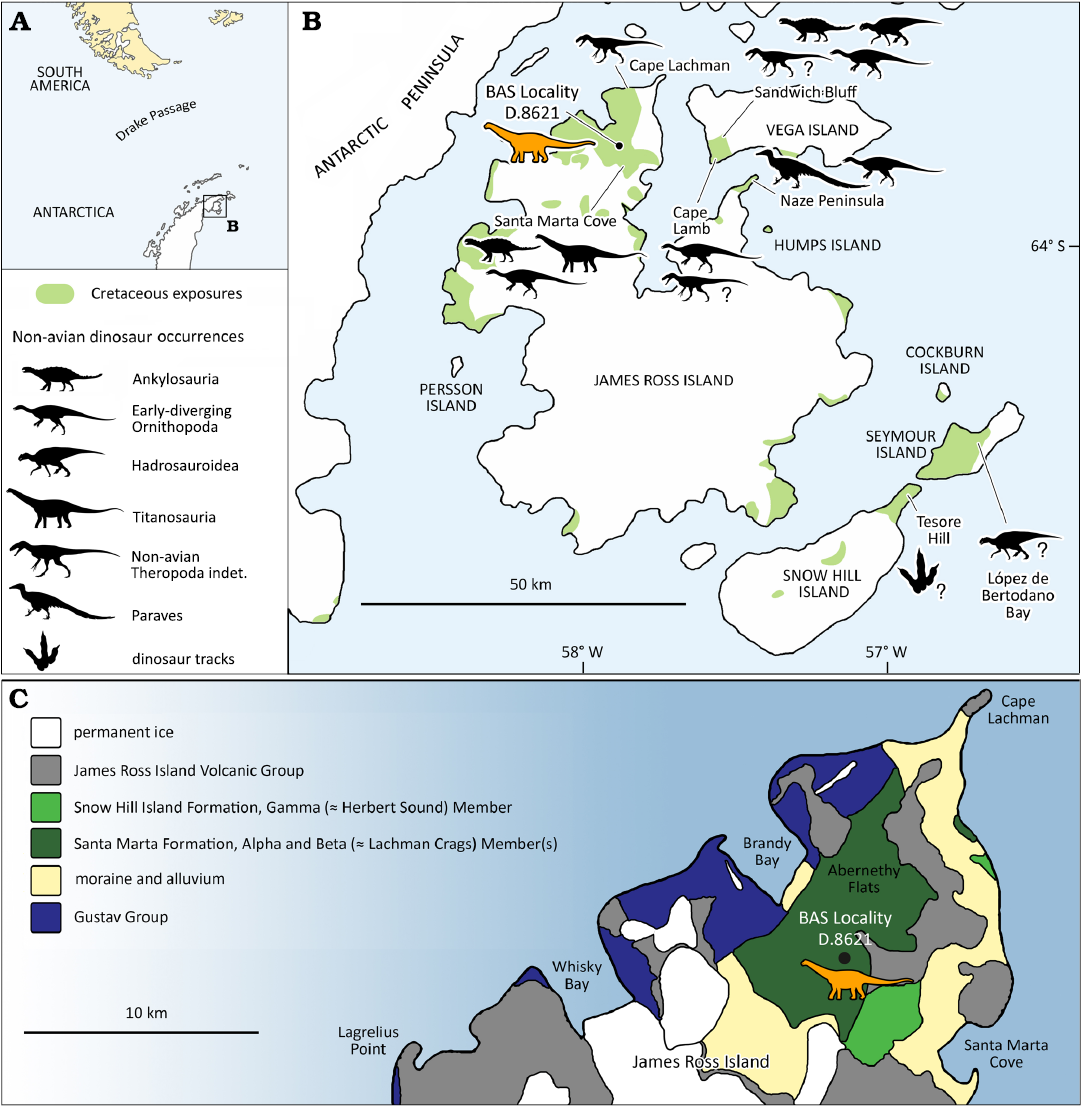
Fig. 1. Geographic provenance of BAS D.8621.25, an anterior caudal vertebra identified as Eutitanosauria indet., and other Antarctic Cretaceous non-avian dinosaur discoveries. A. Map of southern-most South America and the northern Antarctic Peninsula showing the location of the study area (modified from Lamanna et al. 2019: fig. 1a). B. Map of the James Ross Island Group showing known Cretaceous exposures and non-avian dinosaur sites, including the locality on the Ulu Peninsula of James Ross Island that yielded the eutitanosaurian vertebra described herein (BAS Locality D.8621; orange titanosaur silhouette) (modified from Lamanna et al. 2019: fig. 1b). C. Detail of Ulu Peninsula showing regional geology and position of BAS Locality D.8621 on the Abernethy Flats (orange titanosaur silhouette; modified from Pirrie 1989: fig. 1 and Keating 1992: fig. 1).
Imaging methods.—BAS D.8621.25 was computed tomography (CT) scanned using a Nikon Metrology XT H 225 ST µCT scanner based at the Imaging and Analysis Centre, Natural History Museum, London. Source conditions were set at 190 kV and 173 µA, using a reflection target with a 2 mm copper filter. The scan consisted of 3000 projections with an exposure time of 500 ms per projection and frame averaging set to 2. The resulting projections were reconstructed (using CT Pro 3D) at a voxel size of 0.062992759 mm. Screen captures of CT slices were taken in Avizo 9.7 (FEI Visualization Science Group; https://www.thermofisher.com). In addition, BAS D.8621.25 was surface scanned using an Artec Spider handheld scanner (Artec 3D, Santa Clara, CA, USA; https://www.artec3d.com/portable-3d-scanners/artec-spider), and the subsequent three-dimensional mesh was aligned and created in Artec Studio 16 Professional (www.artec3d.com/3d-software/artec-studio). These scans can be accessed via: https://www.morphosource.org/concern/media/000787762.
Measurements.—Measurements of BAS D.8621.25 and MLP-PV 11-II-20-1 (the titanosaurian caudal vertebra described by Cerda et al. 2012a) were taken with Vernier callipers to the nearest millimetre (Table 2). Two ratios that are commonly used as taxonomic and systematic characters for sauropod vertebrae were calculated for BAS D.8621.25: average Elongation Index (aEI; Upchurch 1998; Chure et al. 2010), given as centrum length (excluding articular condyle) divided by the mean average value of the cotyle transverse width and dorsoventral height; and the condylar convexity index (CCI), given as the anteroposterior length of the articular condyle divided by the mean radius of the condyle (i.e., transverse width + dorsoventral height of articular surface/4) (following Mannion et al. 2019b).
Table 2. Measurements (in mm) of the indeterminate Antarctic eutitanosaurian caudal centra BAS D.8621.25 and MLP-PV 11-II-20-1. * minimum due to damage.
|
|
BAS D.8621.25 |
MLP-PV 11-II-20-1 |
|
Anteroposterior length (excl. posterior condyle) |
59 |
180 |
|
Anteroposterior length (incl. posterior condyle) |
89 |
202 |
|
Dorsoventral height, anterior surface |
76 |
67* |
|
Dorsoventral height, posterior surface |
62 |
70* |
|
Transverse width, anterior surface |
77 |
105* |
|
Transverse width, posterior surface |
76 |
108* |
Geological setting
The James Ross Island Group was deposited in the James Ross Sub-Basin, part of a back-arc basin that evolved in response to a late Mesozoic to Paleogene active magmatic arc located along the Antarctic Peninsula (Hathway 2000; Figs. 1, 2). Approximately 5 km of Lower Cretaceous to lowermost Oligocene sediments fill the James Ross Sub-Basin and are capped by the uppermost Miocene–Quaternary James Ross Island Volcanic Group (Pirrie et al. 1997; Hathway 2000; Smellie et al. 2008). The Cretaceous rocks are divided into the Gustav Group of Aptian–Coniacian age and the overlying Marambio Group of latest Coniacian–Danian age (Pirrie et al. 2004; Reguero et al. 2022).
The Santa Marta Formation is the lowest unit within the Marambio Group (e.g., Olivero et al. 1986; Crame et al. 1991; Pirrie et al. 1997; Fig. 2). It conformably overlies the Hidden Lake Formation of the Gustav Group and is overlain by the Snow Hill Island Formation (the latter formerly considered part of the overlying López de Bertodano Formation; see Pirrie et al. 1997; Olivero 2012). Originally, the Santa Marta Formation was divided into three members, Alpha, Beta, and Gamma (Olivero et al. 1986), but more recent stratigraphic reviews have indicated that the Gamma Member (approximately equivalent to the Herbert Sound Member of Crame et al. 1991 and Pirrie et al. 1997) instead forms the lowest part of the Snow Hill Island Formation (Olivero 2012). According to Olivero (2012), the Alpha and Beta members of the Santa Marta Formation are approximately equivalent to the Lachman Crags Member of Crame et al. (1991) and Pirrie et al. (1997).
The Alpha Member reaches approximately 500 m in thickness and consists largely of massive sandstones, silty sandstones, and siltstones with occasional mudstones, conglomerates, and pebbly sandstones, whereas the Beta Member reaches up to 350 m in thickness and has similar lithologies but a higher proportion of interbedded conglomerates (Olivero et al. 1986; Crame et al. 1991). These two members were deposited during the first of three major transgressive-regressive cycles that are recorded by the Marambio Group and form a regressive sequence (with the Santa Marta Formation in the “N sequence”; Olivero 2012). These deposits are thought to represent a progradational deep-water delta system with a range of different palaeoenvironments (Olivero 2012). Marine macroinvertebrate fossils are abundant (including numerous ammonites and inoceramid bivalves, and rarer corals, crinoids, and brachiopods) and fossil wood is also common (e.g., Crame et al. 1991; Olivero 2012). Ammonite biostratigraphy (based on six ammonite assemblage zones) suggests a Santonian–early Campanian age for the Santa Marta Formation and that the Santonian–Campanian boundary lies within the Alpha Member (Olivero 2012). Ammonite Assemblage 1 (proposed to be Santonian; Olivero 2012) occurs within the lower 250 m of the Alpha Member, whereas the upper part of the member yields ammonite assemblages 2 and 3 (both lower Campanian; Olivero 2012). The first appearances of Ammonite Assemblage 4 taxa (lower Campanian) are within the Beta Member, as are the remaining ammonite assemblages (5 and 6; see Olivero 2012). However, alongside this biostratigraphic work, radioisotopic dating places the Coniacian–Santonian boundary within the lower part of the Santa Marta Formation (in the lower 150 m of the Lachman Crags Member sensu Pirrie et al. 1997), so the unit likely spans the uppermost Coniacian to lower Campanian (McArthur et al. 2000). Consequently, the base of Ammonite Assemblage 1 (sensu Olivero 2012) is also probably upper Coniacian.
The Santa Marta Formation forms the gravel-covered plain of the Abernethy Flats at the head of Brandy Bay and the slope up to the Lachman Crags on the Ulu Peninsula of northwestern James Ross Island. According to the unpublished field notes of one of the collectors (Michael R.A. Thomson, see above: BAS Archives), the conglomeratic horizon that yielded the eutitanosaurian vertebra BAS D.8621.25 is correlative with units II–IV of the stratigraphic section taken at BAS Locality (or station) D.8618 some 500 to 600 m to the north. Locality D.8618 corresponds to locality 7 of Feldmann et al. (1993) and BAS localities D.8663 and D.8664 of Pirrie (1989: figs. 13, 14). As such, the stratum that produced BAS D.8621.25 is part of the Beta Member of the Santa Marta Formation following the nomenclature of Olivero et al. (1986) and Olivero (2012). More specifically, units II–IV of Locality D.8618 were logged by Duncan Pirrie in his detailed unpublished section of Locality D.8664 as fossiliferous conglomerate beds 414, 429, and 433, the lowermost of which yielded abundant specimens of Baculites sp. (BAS Archives). This ammonite was present, but rare, at Locality D.8621 and was accompanied by Scaphites sp., Natalites sp., and pachydiscid ammonites. Ammonite genera collected from units II–IV of Locality D.8618 (Baculites, Gaudryceras, Maorites, Natalites, Oiophyllites, Scaphites) are suggestive of Ammonite Assemblage 4 of Olivero (2012). Sample BAS D.8664.184a from bed 429 was included in the study of McArthur et al. (2000), producing a numerical date of 82.6 ± 0.5 Ma, thus confirming the early Campanian age of BAS D.8621.25 (Fig. 2).
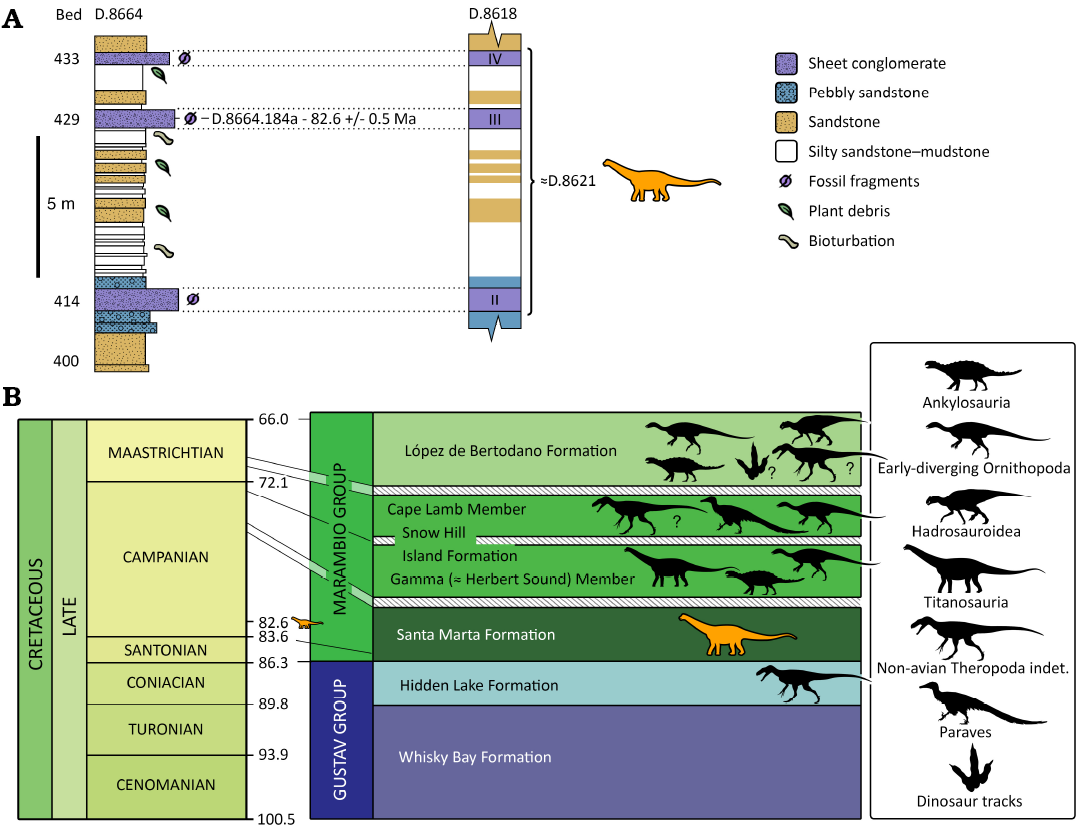
Fig. 2. Stratigraphic context of the anterior caudal vertebra of Eutitanosauria indet. (BAS D.8621.25) and other Antarctic Cretaceous non-avian dinosaur discoveries. A. Stratigraphic columns of BAS localities D.8664 and D.8618 showing the approximate position of the stratum at BAS Locality D.8621 that yielded the titanosaurian vertebra described herein (BAS D.8621.25; indicated by orange titanosaur silhouette) (modified from Pirrie 1989: fig. 14 and unpublished field notes by Duncan Pirrie). B. Stratigraphic position of Eutitanosauria indet. (BAS D.8621.25; orange titanosaur silhouette) relative to other Antarctic Cretaceous non-avian dinosaur discoveries (modified from Lamanna et al. 2019: fig. 1d; see Fig. 1B herein for key to dinosaur occurrences). BAS D.8621.25 is currently the only dinosaur fossil known from the Coniacian–Campanian Santa Marta Formation.
Tetrapod fossils from the Santa Marta Formation are rare, fragmentary, and generically indeterminate. They include the partial carapace of a chelonioid turtle from the Alpha Member (de la Fuente et al. 2010), the metacarpal of a pterodactyloid pterosaur (found ex situ so member unknown; Kellner et al. 2019), and various indeterminate plesiosaur specimens from both members (reviewed in O’Gorman et al. 2019). BAS D.8621.25 is the only dinosaur fossil known thus far from the Santa Marta Formation.
Angiosperm leaves preserved in the Santa Marta Formation have been used for palaeoclimatic analysis (Hayes et al. 2006; Francis et al. 2008). These fossils were derived from vegetation growing on the adjacent emergent Antarctic Peninsula volcanic arc, which was also the likely environment of the Santa Marta dinosaur fauna. This provides a mean annual temperature of approximately 19°C for the upper Coniacian–lower Santonian part of the Santa Marta Formation, broadly equivalent to the Alpha Member of Olivero et al. (1986). Estimates of annual precipitation, ranging between 673–1991 (±580) mm, with higher levels in the growing season, resemble those of modern tropical rainforests. This indicates a tropical or subtropical climate at high palaeolatitudes without significant sub-freezing temperatures during the winter (Francis et al. 2008). It should be noted that an angiosperm leaf collected at Locality D.8621 and included in the Santa Marta Formation flora in the analysis of Hayes et al. (2006) is now recognised as being derived from the underlying Hidden Lake Formation due to its preservation in a distinctive volcaniclastic matrix (Whitham et al. 2006; Francis et al. 2008).
Systematic palaeontology
Sauropoda Marsh, 1878
Titanosauria Bonaparte & Coria, 1993
Lithostrotia Upchurch et al., 2004
Eutitanosauria Sanz et al., 1999
Eutitanosauria indet.
Figs. 3, 4, 5A.
Material.—BAS D.8621.25, a partial anterior caudal vertebra consisting of a complete centrum and partial neural arch pedicles. BAS Locality D.8621 (-63.8833°, -57.9167°), Abernethy Flats, southeast of Brandy Bay and northwest of Santa Marta Cove, Ulu Peninsula, northwestern James Ross Island, Antarctica. Beta Member of the Santa Marta Formation (sensu Olivero et al. 1986; Olivero 2012; correlative to the upper section of the Lachman Crags Member sensu Crame et al. 1991; Pirrie et al. 1997); lower Campanian, Upper Cretaceous.
Description.—External morphology (Fig. 3): Many of the surfaces are encrusted with a thin veneer of matrix. The centrum is procoelous (Fig. 3A1, A2), with a shallowly concave anterior articular surface (Fig. 3A3) and a strongly convex, hemispherical posterior articular surface (Fig. 3A4), forming a distinct condyle. Overall, the centrum is wedge-shaped in lateral view, tapering posteriorly; and ovate in ventral (Fig. 3A5) and dorsal (Fig. 3A6) views, again tapering posteriorly. The non-condylar centrum has an aEI of 0.77. Anterior and posterior chevron facets are absent. Although the region in which the posterior facets would be situated is too poorly preserved to ascertain if their absence is genuine or an artefact, it seems likely that anterior facets were either entirely absent or only subtle features.
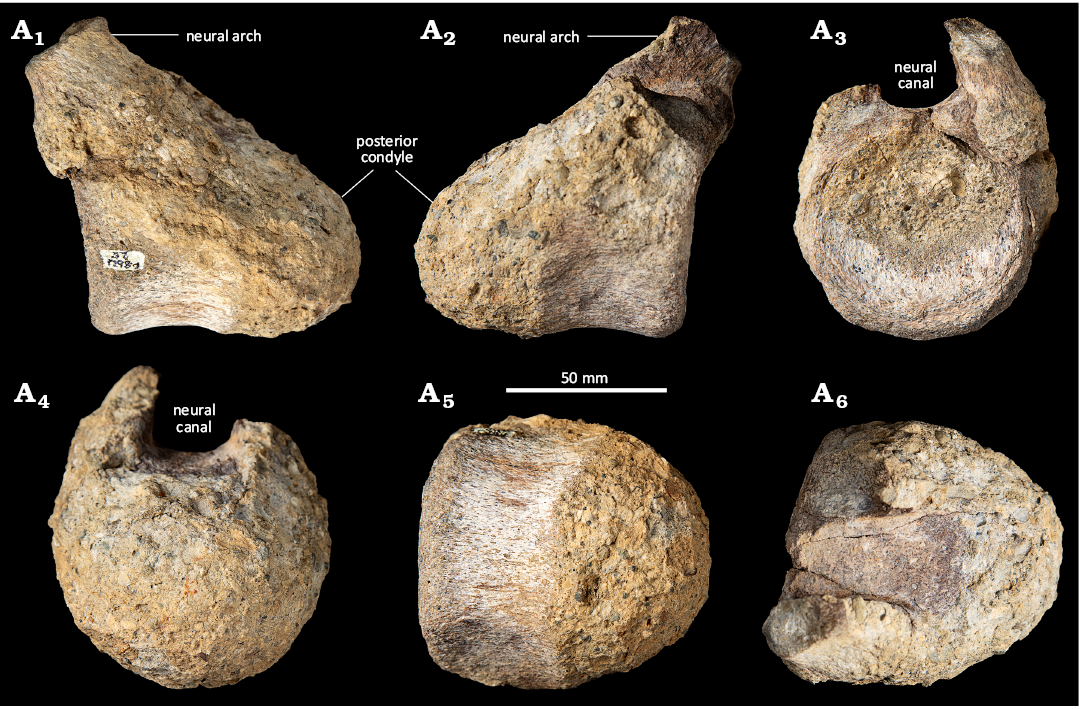
Fig. 3. Eutitanosauria indet. (BAS D.8621.25) from the Upper Cretaceous (lower Campanian) Beta Member (≈ upper Lachman Crags Member) of the Santa Marta Formation of James Ross Island, Antarctica. Anterior caudal vertebra in left (A1) and right (A2) lateral, anterior (A3), posterior (A4), ventral (A5), and dorsal (A6) views.
In anterior view, the articular surface has a circular outline and is approximately as tall dorsoventrally as it is wide transversely. In lateral view, the anterior margin of the centrum is subvertical along most its length, becoming gently concave towards its dorsalmost third. Posteriorly, the articular condyle is convex to the same degree both transversely and dorsoventrally, giving it a smoothly rounded continuous surface. Poor preservation means that it is not possible to determine whether the condyle is separated from the lateral surface of the main body of the centrum by a distinct rim. The condyle occupies the entire posterior surface and is not displaced either dorsally or ventrally with respect to the long axis of the centrum. It is slightly wider transversely than it is tall dorsoventrally and the centrum has a CCI of 0.78.
The lateral surfaces of the centrum are gently concave longitudinally and dorsoventrally convex (“saddle-shaped”) and converge slightly toward the midline as they extend ventrally. External pneumatic fossae/foramina, nutrient foramina, and ridges are absent, as confirmed by CT images where obscured by matrix. In lateral view, the ventral margin of the centrum is bowed gently dorsally, although this bowing would have been more strongly developed if posterior chevron facets were present. Subtle “breaks-in-slope” distinguish the lateral surfaces of the centrum from its ventral surface, but these do not form distinct ventrolateral bounding ridges. The ventral surface is weakly convex transversely and shallowly concave anteroposteriorly (although it might have appeared more strongly concave if posterior chevron facets were present). Neither a midline keel nor groove is present.
The floor of the neural canal slopes slightly ventrally as it extends posteriorly from its highest point at the anterior end of the centrum. It bears neither foramina nor any other noteworthy features. The neural arch pedicles are positioned on the anterior half of the centrum, extending up to its anterior margin. That on the right side is represented only by its broken base, but the left pedicle is more complete. What remains of the latter projects anterodorsally in lateral view. In anterior view, the pedicle extends dorsomedially towards its antimere and forms the lateral border of the large neural canal opening. The broken terminus of the left neural arch pedicle has an elliptical transverse cross-section whose long axis extends anterolaterally-posteromedially. Although the neurocentral suture on the left side superficially appears to be open, the CT scans support the interpretation that this instead represents breakage; this junction is not visible on the right side, where it appears fused, reinforcing a taphonomic explanation for the left-side feature.
Although not preserved on either side, it seems probable that caudal ribs were present. Based on the raised nature of the broken surfaces and a break-of-slope on both lateral surfaces of the centrum, these were likely to have been dorsoventrally extensive processes that extended from the dorsal half of the centrum onto the lower portion of the neural arch.
Internal morphology (Fig. 4).—Broken and eroded surfaces around the anterior articular surface, both neural arch pedicles, and the ventral surface of the centrum reveal a spongious internal bone texture. CT scan data confirm this, with densely packed, apneumatic trabeculae in the centre of the centrum that become progressively slightly less-densely packed towards the edges of the centrum and the broken neural arch pedicles (Fig. 4A1–A5, B1–B5). At first glance externally, the centrum appears to be camellate. However, it is clear from the CT scans that these possible chambers are not genuine but due to differential erosion of the conglomeratic matrix and pebbles adhered to the bone surface of much of the vertebra. These pebbles are especially evident in Fig. 4A3, A4, B4, B5.
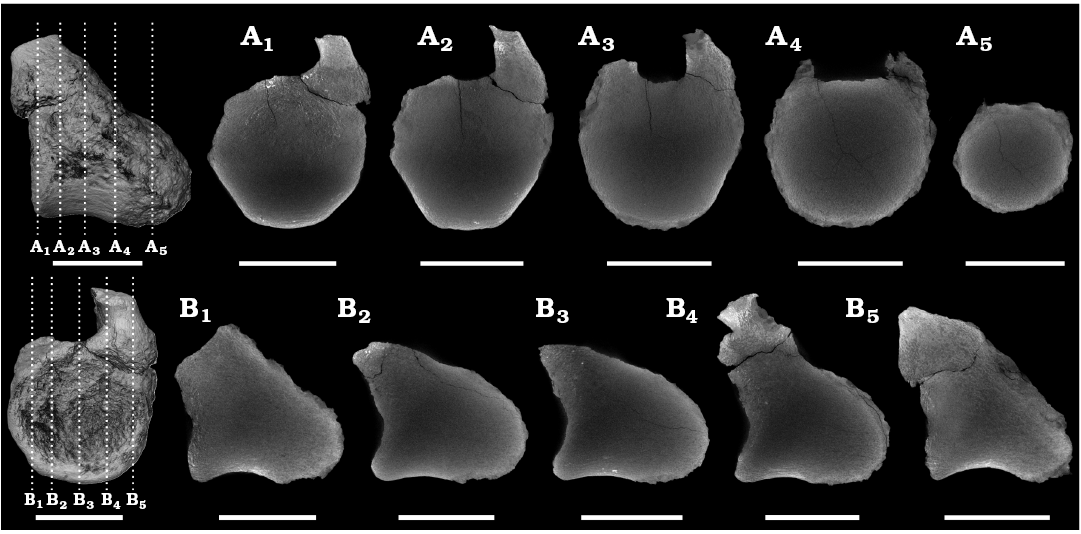
Fig. 4. Computed tomographic (CT) images of anterior caudal vertebra of Eutitanosauria indet. A. BAS D.8621.25 in left lateral view, showing axial CT slices at locations indicated (anterior–posterior, A1–A5). B. BAS D.8621.25 in anterior view, showing sagittal CT slices at locations indicated (right–left lateral, B1–B5). Scale bars 50 mm.
Ontogenetic stage.—At least based on the right side (and probably also the left side; see above), the centrum and neural arch are fully fused. This has typically been regarded as indicative of skeletal maturity, with the neurocentral synostoses often only partially fused or fully open in skeletally immature archosaurian individuals. However, the timing of fusion can vary throughout the vertebral column and there is no currently recognised pattern amongst sauropods (Griffin et al. 2021). BAS D.8621.25 is small compared to the anterior caudal vertebrae of most other sauropods. For example, its dimensions are approximately 60% those of the corresponding element in the titanosaur Baurutitan britoi (MCT 1490-R) and roughly 75% those of the “dwarfed” saltasaurine titanosaur Neuquensaurus australis (e.g., MLP-PV CS 1392), although they are comparable to those of another dwarfed titanosaur, Magyarosaurus dacus (Díez Díaz et al. 2025). Even though size is a poor ontogenetic indicator (Griffin et al. 2021), and Magyarosaurus demonstrates that some adult titanosaurs exhibited similarly small body sizes, the relative size of BAS D.8621.25 might suggest that the individual was not fully grown at the time of death.
Comparisons
External morphology.—Based on comparisons with other sauropods (Fig. 5), the overall morphology of BAS D.8621.25 (Figs. 3, 5A) is most consistent with an identification as a caudal vertebra, probably from the anteriormost region of the tail. Within Sauropoda, well-developed procoely in anterior caudal vertebrae, with a CCI of at least 0.6, is primarily a feature of lithostrotian titanosaurs, some mamenchisaurids, and turiasaurians (e.g., Wilson 2002; Upchurch et al. 2004; Royo-Torres et al. 2006; D’Emic 2012; Mannion et al. 2013). The anterior caudal vertebrae of most non-titanosaurian somphospondylans, including diamantinasaurians (Fig. 5B), lack procoelous centra (Poropat et al. 2020; Beeston et al. 2024), whilst procoely is only incipiently developed in the anterior caudal vertebrae of early-diverging titanosaurs (Salgado et al. 1997; Gorscak and O’Connor 2019). In some lithostrotians, including members of Aeolosaurini and Lirainosaurinae, the condyle is dorsally displaced (Powell 2003; Mocho et al. 2024; Díez Díaz et al. 2025). The anterior-most caudal centra of turiasaurians typically have a much lower aEI than BAS D.8621.25 (Mannion et al. 2019b). As is also the case in many other titanosaurs (e.g., Baurutitan britoi, Mendozasaurus neguyelap, Muyelensaurus pecheni, Narambuenatitan palomoi, Volgatitan simbirskiensis), BAS D.8621.25 lacks the deep ventral groove and ventrolateral ridges seen in the anterior caudal centra of some other titanosaurian taxa, including Alamosaurus sanjuanensis, Andesaurus delgadoi, Malawisaurus dixeyi, Overosaurus paradasorum, Rapetosaurus krausei, and Saltasaurus loricatus (Wilson 2002; Upchurch et al. 2004; Curry Rogers 2009; Mannion et al. 2019b; Díez Díaz et al. 2025). However, these features of the ventral surface are often absent in the anteriormost caudal vertebrae (Mannion et al. 2019b). BAS D.8621.25 also lacks a lateral fossa, contrasting with a small number of titanosaurs (e.g., Alamosaurus sanjuanensis, Pellegrinisaurus powelli, Xianshanosaurus shijiagouensis) in which a small fossa or foramen is present in anterior caudal centra (Wilson 2002; Mannion et al. 2013; Cerda et al. 2021). Although the anterior margin of the centrum is concave in lateral view, BAS D.8621.25 lacks the strong anterior canting that characterises the anterior caudal centra of a small number of titanosaurs, including aeolosaurines and Qunkasaura pintiquiniestra (Santucci and Arruda-Campos 2011; Mannion et al. 2019a; Mocho et al. 2024).
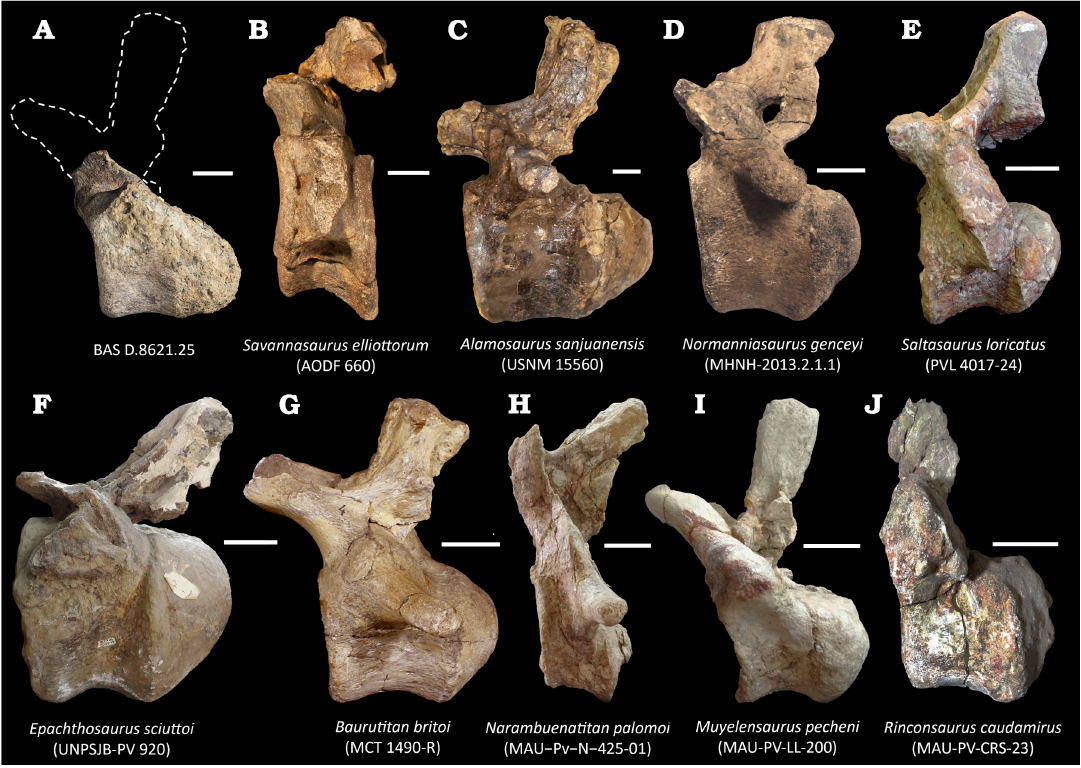
Fig. 5. Comparison of representative titanosaurian anterior caudal vertebrae in left lateral view. A. Eutitanosauria indet. (BAS D.8621.25) Santa Marta Fm.; Upper Cretaceous, lower Campanian; James Ross Island, Antarctica. B. Savannasaurus elliottorum Poropat et al., 2016, Winton Fm.; Upper Cretaceous, Cenomanian–lower Turonian; Queensland, Australia (AODF 660). C. Alamosaurus sanjuanensis Gilmore, 1922, North Horn Fm.; Upper Cretaceous, upper Maastrichtian, Utah, USA (USNM 15560). D. Normanniasaurus genceyi Le Loeuff et al., 2013, Poundingue Ferrugineux Fm.; Lower Cretaceous, Albian; Seine-Maritime, France (MHNH-2013.2.1.1). E. Saltasaurus loricatus Bonaparte & Powell, 1980, Lecho Fm.; Upper Cretaceous, lower Maastrichtian; Salta, Argentina (PVL 4017-24) (reversed from right lateral view). F. Epachthosaurus sciuttoi Powell, 1990, Bajo Barreal Fm.; Upper Cretaceous, upper Cenomanian–lower Turonian; Chubut, Argentina (UNPSJB-PV 920) (reversed from right lateral view).G. Baurutitan britoi Kellner et al., 2005, Serra da Galga Fm.; Upper Cretaceous, Maastrichtian; Minas Gerais, Brazil (MCT 1490-R). H. Narambuenatitan palomoi Filippi et al., 2011, Anacleto Fm.; Upper Cretaceous, lower Campanian; Neuquén, Argentina (MAU-PV-N-425-01). I. Aeolosaurini indet. (formerly assigned to Muyelensaurus pecheni Calvo et al., 2007, Plottier Fm.; Upper Cretaceous, late Coniacian; Neuquén, Argentina; MAU-PV-LL-200) (reversed from right lateral view). J. Rinconsaurus caudamirus Calvo & González Riga, 2003, Bajo de la Carpa Fm.; Upper Cretaceous, middle Santonian; Neuquén, Argentina (MAU-PV-CRS-23). Scale bars 100 mm.
An anteriorly situated neural arch is characteristic of the anterior caudal vertebrae of most sauropods (Upchurch et al. 2004). In many taxa, there is a small gap between the anterior margin of the centrum and that of the base of the neural arch, with the latter typically subvertical. Among titanosaurs with procoelous anterior caudal vertebrae, this includes Alamosaurus sanjuanensis (USNM 15560; Fig. 5C), Normanniasaurus genceyi (MHNH-2013.2.1.1; Fig. 5D), Saltasaurus loricatus (PVL 4017-24; Fig. 5E), Epachthosaurus sciuttoi (UNPSJB-PV 920; Fig. 5F), Malawisaurus dixeyi (Gomani 2005: fig. 14), Rukwatitan bisepultus (Gorscak et al. 2014: fig. 6). In most taxa that lack a gap, the base of the arch is subvertical, e.g., Baurutitan britoi (MCT 1490-R; Fig. 5G) and Narambuenatitan palomoi (MAU-PV-N-425-01; Fig. 5H). By contrast, the anterior position and anterodorsal projection of the base of the neural arch of BAS D.8621.25 is most similar to those of the titanosaurians Aeolosaurus rionegrinus (Powell 2003: pl. 11: 1a, 2a), a specimen formerly referred to Muyelensaurus pecheni (MAU-PV-LL-200, but see Discussion regarding affinities of this specimen; Fig. 5I), and Rinconsaurus caudamirus (MAU-PV-CRS-23; Fig. 5J).
Internal morphology.—The internal morphology of titanosaurian caudal vertebrae differs across the clade (Poropat et al. 2020). Most species for which the internal morphology has been assessed are characterized by apneumatic centra and neural arches, as is the case in BAS D.8621.25. This includes Andesaurus delgadoi, Epachthosaurus sciuttoi, Mendozasaurus neguyelap, Mnyamawamtuka moyowamkia, Pellegrinisaurus powelli, Punatitan coughlini, and Rinconsaurus caudamirus (Gorscak and O’Connor 2019; Hechenleitner et al. 2020; Poropat et al. 2020; Cerda et al. 2021; Pérez Moreno et al. 2022). The anterior caudal vertebrae of a small number of titanosaurs (and close relatives) are characterized by apneumatic centra, but have pneumatic neural arches, including diamantinasaurians, Malawisaurus dixeyi, and Bonatitan reigi (Wedel 2009; Poropat et al. 2020; Beeston et al. 2024; Zurriaguz 2024). Both the centra and neural arches are pneumatic in the anterior caudal vertebrae of Xianshanosaurus shijiagouensis (Mannion et al. 2013) and saltasaurines, with a camellate internal bone structure extending into the posterior caudal vertebrae in the latter clade (Cerda et al. 2012b; Zurriaguz and Cerda 2017). The anterior caudal centra are also pneumatic in Volgatitan simbirskiensis, although this cannot be assessed in the neural arches because none are preserved (Averianov and Efimov 2018).
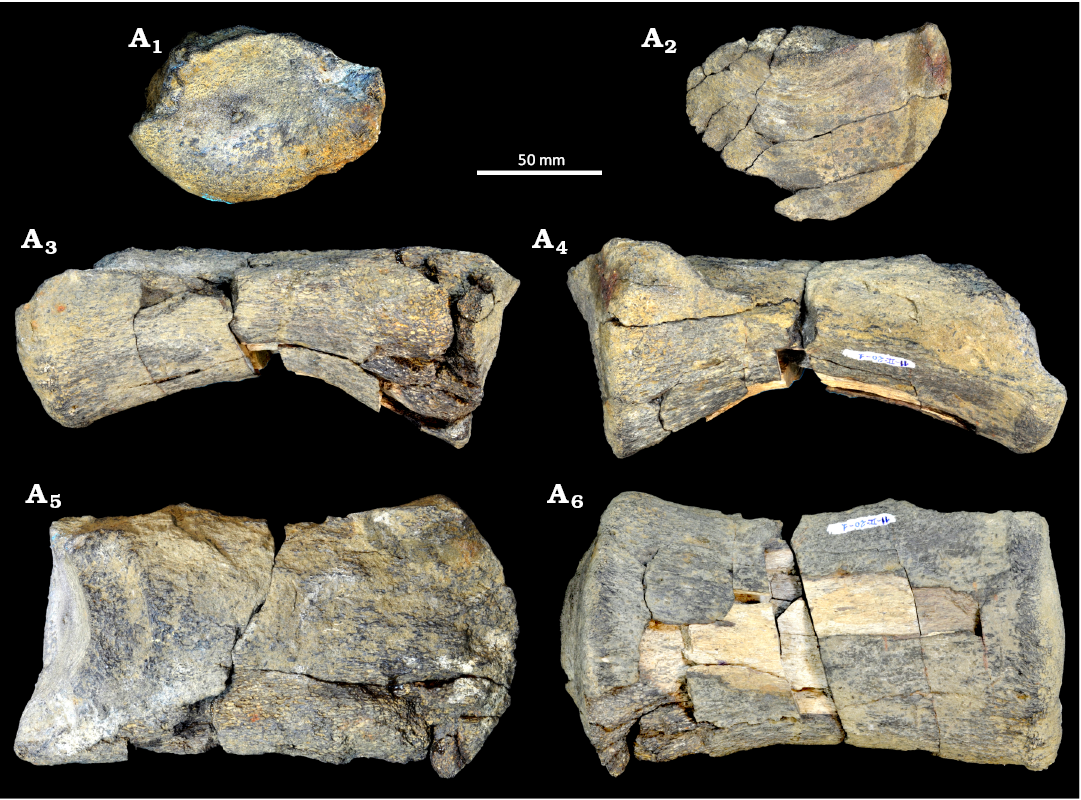
Fig. 6. Eutitanosaurian sauropod from the Upper Cretaceous (upper Campanian) Gamma Member of the Snow Hill Island Formation of James Ross Island, Antarctica; originally identified and described by Cerda et al. (2012a). MLP-PV 11-II-20-1, partial middle caudal vertebral centrum in anterior (A1), posterior (A2), left (A3) and right (A4) lateral, dorsal (A5), and ventral (A6) views, according to our revised interpretation.
Discussion
Affinities of BAS D.8621.25.—The well-developed procoely of BAS D.8621.25 supports its identification as a lithostrotian titanosaurian sauropod (Upchurch et al. 2004). It is clearly distinct from the anterior caudal vertebrae of most non-lithostrotian somphospondylans, including Australian diamantinasaurians (Fig. 5B). Within Lithostrotia, BAS D.8621.25 can be excluded from the South American saltasaurine clade due to the absence of camellate internal bone structure (Cerda et al. 2012b). The anterior position and anterodorsal orientation of the neural arch of BAS D.8621.25 is most reminiscent of members of Aeolosaurini (e.g., Santucci and Arruda-Campos 2011: fig. 5) and Rinconsauria (Fig. 5I, J). These two clades of primarily Gondwanan taxa are sometimes recovered as closely related to each other, but other analyses place them as phylogenetically distant lineages (see Díez Díaz et al. 2025; Pérez Moreno et al. in press). The morphology of both the anterior margin of the centrum and the centrally positioned condyle of BAS D.8621.25 are closest to that of an anterior caudal vertebra (MAU-PV-LL-200; Fig. 5I) previously assigned to the Late Cretaceous Argentinean rinconsaurian Muyelensaurus pecheni (Calvo et al. 2007) but recently attributed to an indeterminate aeolosaurine (Pérez Moreno et al. in press). Given the issues of distinguishing rinconsaurians from aeolosaurines, the present state of flux in understanding of titanosaurian phylogenetic interrelationships, and the fragmentary nature of BAS D.8621.25, we conservatively regard the combination of character states present in this specimen as supporting its identification as a non-saltasaurid eutitanosaurian sauropod.
Comments on MLP-PV 11-II-20-1.—Cerda et al. (2012a) identified MLP-PV 11-II-20-1, an incomplete tetrapod bone from the upper Campanian (Upper Cretaceous) Gamma Member of the Snow Hill Island Formation (sensu Olivero 2012) of James Ross Island, as a partial middle caudal vertebral centrum of a lithostrotian titanosaurian sauropod (Fig. 6). This was based on its anteriorly concave and posterior convex articular surfaces, which were taken as evidence of procoely; Cerda et al. (2012a) also ruled out saltasaurine affinities due to the absence of camellate internal structure. However, the specimen is incomplete and difficult to interpret, and we suggest that it was misoriented by Cerda et al. (2012a). Specifically, rather than representing the right side of an incomplete titanosaurian caudal centrum, we interpret MLP-PV 11-II-20-1 as the ventral half of a caudal centrum, such that Cerda et al.’s (2012a) purported lateral views (Cerda et al. 2012a: fig. 2b, e) actually depict the centrum in ventral view and the anterior and posterior views should each be rotated through 90° (anticlockwise for the anterior views, Cerda et al. 2012a: fig. 2a, d; clockwise for the posterior views, Cerda et al. 2012a: fig. 2c, f) to lie in their correct orientations. As noted by Cerda et al. (2012a), the presence of procoely and the absence of camellae supports non-saltasaurine eutitanosaurian affinities for MLP-PV 11-II-20-1 (see discussion of these features, above), but the bone is too poorly preserved for any other meaningful comparisons.
Implications.—Although
it remained unrecognised until now, the titanosaurian sauropod identity
of BAS D.8621.25 means that it is the first non-avian dinosaur fossil to
have been recovered from Antarctica (in 1985, see above), whereas the
ankylosaur partial skeleton later named Antarctopelta
oliveroi, which is usually considered to be the earliest-known
discovery, was found in 1986 (e.g., Olivero et al. 1991).
Moreover, BAS D.8621.25 is currently the only dinosaur specimen known
from the Santa Marta Formation (specifically, from a lower Campanian
horizon of that unit), which makes it the second-stratigraphically
oldest Cretaceous
dinosaur fossil from the continent after a taxonomically indeterminate
non-avian theropod tibia from the Coniacian-aged Hidden Lake Formation
of James Ross Island (Molnar et al. 1996; Lamanna
et al. 2019).
As titanosaurian and non-titanosaurian somphospondylan remains are abundant in the Cretaceous of South America (e.g., Powell 2003; Gallina et al. 2022; Santucci and Filippi 2022) and Australia (e.g., Hocknull et al. 2009, 2021; Poropat et al. 2016, 2017, 2020; Beeston et al. 2024), and are also known from the Upper Cretaceous of New Zealand (Molnar and Wiffen 2007), the presence of somphospondylans in Antarctica is unsurprising given that it must have been the landmass through which the ancestors of these lineages dispersed at some time in the Cretaceous (e.g., Poropat et al. 2016). Currently, the only somphospondylans known from Australia are Austrosaurus mckillopi, a titanosauriform of uncertain phylogenetic affinities (Poropat et al. 2017), and diamantinasaurians, a clade which is either an early-branching titanosaurian lineage or, more likely, the immediate sister group of the latter (e.g., Poropat et al. 2021; Carballido et al. 2022; Beeston et al. 2024; Díez Díaz et al. 2025). However, the eutitanosaurian affinities of both BAS D.8621.25 and MLP-PV 11-II-20-1 demonstrate that they were not early-diverging titanosauriforms or diamantinasaurians (see Comparisons, above) and therefore imply that more than one somphospondylan lineage occupied Antarctica, although not necessarily at the same time (known diamantinasaurians are early Late Cretaceous in age, so their ancestors would have been present in Antarctica prior to this; Poropat et al. 2016). Unfortunately, the absence of mid-Cretaceous and latest Cretaceous dinosaur fossils from Antarctica and Australia, respectively, means that it is not currently possible to determine whether or not these lineages were sympatric. However, an isolated caudal vertebra from the Campanian of New Zealand (Molnar and Wiffen 2007) is likely that of a eutitanosaur, as it exhibits strong procoely. The Antarctic Peninsula, including James Ross Island, would seem to have been the most likely eutitanosaur dispersal route from South America to Zealandia (Mortimer 2025: fig. 11), By contrast, eutitanosaurs are currently unknown from the Cretaceous of Australia.
The presence of sauropods in the Upper Cretaceous of the Antarctic Peninsula and New Zealand is consistent with habitat suitability models, which suggest that some parts of northern Antarctica might have been suitable as sauropod dispersal routes (Chiarenza et al. 2022). However, although these models suggest that sauropods could have inhabited these regions, they also show that sauropod habitat occupancy was marginal at this time, which might explain the comparative rarity of sauropods in the region (Chiarenza et al. 2022). By contrast, modelled habitat suitability is higher for both theropods and ornithischians (Chiarenza et al. 2022), which might explain the higher frequency of their discovery thus far.
Conclusions
BAS D.8621.25 is an anterior caudal vertebra from the lower Campanian (Upper Cretaceous) Santa Marta Formation of James Ross Island. It can be identified as that of a non-saltasaurine eutitanosaurian sauropod based on internal and external morphological features and pertains either to a juvenile or small-bodied adult individual. Although described here for the first time, it was the first dinosaur fossil to be collected from Antarctica, represents only the second sauropod body fossil to be recovered from the continent, and is the first dinosaur specimen from the Santa Marta Formation. Its presence is consistent both with habitat suitability models and the known distribution of other Late Cretaceous Gondwanan eutitanosaurians.
Acknowledgements
We thank Lucie Goodayle (Natural History Museum, London, UK) for the images of the specimen in Fig. 3. Andrew McAfee (Carnegie Museum of Natural History, Pittsburgh, USA) assisted with the construction of Figs. 1, 2, 5, and 6. Stephen Poropat (Curtin University, Perh, Australia) kindly provided us with the photograph of Savannasaurus used in Fig. 5. We are grateful to the following for providing access to sauropod specimens in their care: Leonardo Filippi (MAU); Rafael Costa da Silva (MCT); Gabrielle Baglione (MHNH); Marcelo Reguero, Yanina Herrera, and Patricio Knight (all MLP-PV); Jaime Powell (PVL); Gabriel Casal, Lucio Ibiricu, and Rubén Martínez (all UNPSJB); and Michael Brett-Surman (USNM). Alexandra Tataran (BAS) provided access to material from the BAS Archives Service. PDM’s research was supported by funding from The Royal Society (UF160216, URF\R\221010, RGF\EA\201037). This contribution was improved by constructive reviews from Verónica Díez Díaz (Museum für Naturkunde, Berlin, Germany) and Flavio Bellardini (Universidad Nacional de Río Negro, General Roca, Argentina), and we thank the Handling Editor Daniel Barta (Oklahoma State University, Tahlequah, USA) for his prompt handling of the manuscript.
Editor: Daniel Barta
References
Acosta Hospitaleche, C., Irazoqui, F., Bona, P., and Paulina-Carabajal, A. 2024. Review of the Cretaceous avian diversity of Antarctica: a changing scenario for the evolution of early neornithine birds. Advances in Polar Science 35: 1–13.
Averianov, A. and Efimov, V. 2018. The oldest titanosaurian sauropod of the Northern Hemisphere. Biological Communications 63: 145–162. Crossref
Beeston S.L., Poropat, S.F., Mannion, P.D., Pentland, A.H., Enchelmaier, M.J., Sloan, T., and Elliott, D.A. 2024. Reappraisal of sauropod dinosaur diversity in the Upper Cretaceous Winton Formation of Queensland, Australia, through 3D digitisation and description of new specimens. PeerJ 12: e17180.
Bonaparte, J.F. and Coria, R.A. 1993. Un nuevo y gigantesco saurópodo titanosaurio de la Formación Río Limay (Albiano–Cenomaniano) de la Provincia del Neuquén, Argentina. Ameghiniana 30: 271–282.
Bonaparte, J.F. and Powell, J.E. 1980. A continental assemblage of tetrapods from the Upper Cretaceous beds of El Brete, northwestern Argentina (Sauropoda–Coelurosauria–Carnosauria-Aves). Mémoires de la Société Géologique de France, Nouvelle Série 139: 19–28.
Calvo, J.O. and González Riga, B.J. 2003. Rinconsaurus caudamirus gen. et sp. nov., a new titanosaurid (Dinosauria, Sauropoda) from the Late Cretaceous of Patagonia, Argentina. Revista Geológica de Chile 30 (2): 333–353. Crossref
Calvo, J.O., González Riga, B.J., and Porfiri, J.D. 2007. A new titanosaur sauropod from the Late Cretaceous of Neuquén, Patagonia, Argentina. Arquivos do Museu Nacional 65: 485–504.
Carballido, J.L., Otero, A., Mannion, P.D., Salgado, L., and Pérez Moreno, A. 2022. Titanosauria: a critical reappraisal of its systematics and the relevance of the South American record. In: A. Otero, J.L. Carballido, and D. Pol (eds.), South American Sauropodomorph Dinosaurs: Record, Diversity and Evolution, 269–298. Springer, Cham. Crossref
Cerda, I., Paulina Carabajal, A., Salgado, L., Coria, R.A., Reguero, M.A., Tambussi, C.P., and Moly, J.J. 2012a. The first record of a sauropod dinosaur from Antarctica. Naturwissenschaften 99: 83–87. Crossref
Cerda, I., Salgado, L., and Powell, J. 2012b. Extreme postcranial pneumaticity in sauropod dinosaurs from South America. Paläontologische Zeitschrift 86: 441–449. Crossref
Cerda, I., Zurriaguz, V.L., Carballido, J.L., González, R., and Salgado, L. 2021. Osteology, paleohistology and phylogenetic relationships of Pellegrinisaurus powelli (Dinosauria: Sauropoda) from the Upper Cretaceous of Argentinean Patagonia. Cretaceous Research 128: 104957. Crossref
Chatterjee, S. 2002. The morphology and systematics of Polarornis, a Cretaceous loon (Aves: Gaviidae) from Antarctica. In: Z. Zhou and F. Zhang (eds.), Proceedings of the 5th Symposium of the Society of Avian Paleontology and Evolution, Beijing, 1–4 June 2000, 125–155. Science Press, Beijing.
Chiarenza, A.A., Mannion, P.D., Farnsworth, A., Carrano, M.T., and Varela, S. 2022. Climatic constraints on the biogeographic history of Mesozoic dinosaurs. Current Biology 32: 570–585. Crossref
Chure, D., Britt, B.B., Whitlock, J.A., and Wilson, J.A. 2010. First complete sauropod dinosaur skull from the Cretaceous of the Americas and the evolution of sauropod dentition. Naturwissenschaften 97: 379–391. Crossref
Clarke, J.A., Tambussi, C.P., Noriega, J.L., Erickson, G.M., and Ketcham, R.A. 2005. Definitive fossil evidence for the extant avian radiation in the Cretaceous. Nature 433: 305–308. Crossref
Cordes-Person, A., Acosta Hospitaleche, C., Case, J., and Martin, J. 2020. An enigmatic bird from the lower Maastrichtian of Vega Island, Antarctica. Cretaceous Research 108: 104314. Crossref
Coria, R.A., Moly, J.J., Reguero, M., Santillana, S., and Marenssi, S. 2013. A new ornithopod (Dinosauria: Ornithischia) from Antarctica. Cretaceous Research 41: 186–193.
Crame, J.A., Pirrie, D., Riding, J.B., and Thomson, M.R.A. 1991. Campanian–Maastrichtian (Cretaceous) stratigraphy of the James Ross Island area, Antarctica. Journal of the Geological Society 148: 1125–1140. Crossref
Curry Rogers, K.A. 2009. The postcranial osteology of Rapetosaurus krausei (Sauropoda: Titanosauria) from the Late Cretaceous of Madagascar. Journal of Vertebrate Paleontology 29: 1046–1086. Crossref
de la Fuente, M., Novas, F.E., Isasi, M.P., Lirio, J.M., and Nuñez, H.J. 2010. First Cretaceous turtle from Antarctica. Journal of Vertebrate Paleontology 30: 1275–1278. Crossref
D’Emic, M.D. 2012. The early evolution of titanosauriform sauropod dinosaurs. Zoological Journal of the Linnean Society 166: 624–671.
Díez Díaz, V., Mannion, P.D., Csiki-Sava, Z., and Upchurch, P. 2025. Revision of Romanian sauropod dinosaurs reveals high titanosaur diversity and body-size disparity on the latest Cretaceous Haţeg Island, with implications for titanosaurian biogeography. Journal of Systematic Palaeontology 23: 2441516. Crossref
Elliot, D.H., Larsen, D., Fanning, C.M., Fleming, T.H., and Vervoort, J.D. 2017. The Lower Jurassic Hanson Formation of the Transantarctic Mountains: implications for the Antarctic sector of the Gondwana plate margin. Geological Magazine 154: 777–803. Crossref
Ely, R.C. and Case, J.A. 2019. Phylogeny of a new gigantic paravian (Theropoda; Coelurosauria; Maniraptora) from the Upper Cretaceous of James Ross Island, Antarctica. Cretaceous Research 101: 1–16. Crossref
Feldmann, R.M., Tshudy, D.M., and Thomson, M.R.A. 1993. Late Cretaceous and Paleocene decapod crustaceans from James Ross Basin, Antarctic Peninsula. Memoir of the Paleontological Society 28: 1–41. Crossref
Filippi, L.S., García, R.A., and Garrido. A.C. 2011. A new titanosaur sauropod dinosaur from the Upper Cretaceous of North Patagonia, Argentina. Acta Palaeontologica Polonica 56 (3): 505–520. Crossref
Francis, J.E., Ashworth, A.C., Cantrill, D.J., Crame, J.A., Howe, J., Stephens, R.S., Tosolini, A.-M., and Thorn, V. 2008. 100 million years of Antarctic climate evolution: evidence from fossil plants. In: A.K. Cooper, , P.J. Barrett, H. Stagg, B. Storey, E. Stump, W. Wise, and the 10th ISAES editorial team (eds.), Antarctica: A Keystone in a Changing World, 19–28. The National Academies Press, Washington, D.C. Crossref
Gallina, P.A., González Riga, B.J., and Ortiz David, L.D. 2022. Time for giants: titanosaurs from the Berriasian–Santonian age. In: A. Otero, J.L. Carballido, and D. Pol (eds.), South American Sauropodomorph Dinosaurs: Record, Diversity and Evolution, 299–340. Springer, Cham. Crossref
Gilmore, C.W. 1922. A new sauropod dinosaur from the Ojo Alamo Formation of New Mexico. Smithsonian Miscellaneous Collections 72 (14): 1–9.
Gomani, E.M. 2005. Sauropod dinosaurs from the Early Cretaceous of Malawi, Africa. Palaeontologia Electronica 8: 27A.
Gorscak, E. and O’Connor, P.M. 2019. A new African titanosaurian sauropod dinosaur from the middle Cretaceous Galula Formation (Mtuka Member), Rukwa Rift Basin, southwestern Tanzania. PLoS ONE 14: e0211412. Crossref
Gorscak, E., O’Connor, P.M., Stevens, N.J., and Roberts, E.M. 2014. The basal titanosaurian Rukwatitan bisepultus (Dinosauria, Sauropoda) from the middle Cretaceous Galula Formation, Rukwa Rift Basin, southwestern Tanzania. Journal of Vertebrate Paleontology 34: 1133–1154. Crossref
Griffin, C.T., Stocker, M.R., Colleary, C., Stefanic, C.M., Lessner, E.J., Riegler, M., Formoso, K., Koeller, K., and Nesbitt, S.J. 2021. Assessing ontogenetic maturity in extinct saurian reptiles. Biological Reviews 96: 470–525. Crossref
Hammer, W.R. and Hickerson, W.J. 1994. A crested theropod dinosaur from Antarctica. Science 264: 828–830. Crossref
Hathway, B. 2000. Continental rift to back-arc basin: Jurassic–Cretaceous stratigraphical and structural evolution of the Larsen Basin, Antarctic Peninsula. Journal of the Geological Society 157: 417–432. Crossref
Hayes, P.A., Francis, J.E., Cantrill, D.J., and Crame, J.A. 2006. Palaeoclimate analysis of Late Cretaceous of angiosperm leaf floras, James Ross Island, Antarctica. In: J.E. Francis, D. Pirrie, and J.A. Crame (eds.), Cretaceous–Tertiary high-latitude palaeoenvironments: James Ross Basin, Antarctica. Geological Society, London, Special Publications 258: 49–62.
Hechenleitner, E.M., Leuzinger, L., Martinelli, A.G., Rocher, S., Fiorelli, L.E., Taborda, J.R.A., and Salgado, L. 2020. Two Late Cretaceous sauropods reveal titanosaurian dispersal across South America. Communications Biology 3: 622. Crossref
Hocknull, S.A., White, M.A., Tischler, T.R., Cook, A.G., Calleja, N.D., Sloan, T., and Elliott, D.A. 2009. New mid-Cretaceous (latest Albian) dinosaurs from Winton, Queensland, Australia. PLoS ONE 4: e6190. Crossref
Hocknull, S.A., Wilkinson, M., Lawrence, R.A., Konstantinov, V., Mackenzie, S., and Mackenzie, R. 2021. A new giant sauropod, Australotitan cooperensis gen. et sp. nov., from the mid-Cretaceous of Australia. PeerJ 9: e11317. Crossref
Hooker, J.J. 2000. Ancient bones in the frozen continent. In: P.J. Whybrow (ed.), Travels with the Fossil Hunters, 176–195. Cambridge University Press, Cambridge.
Irazoqui, F., Acosta Hospitaleche, C., Gelfo, J.N., Paulina Carabajal, A., Bona, P., and Acosta Burlaille, L. 2026a. Diving in the Maastrichtian of Marambio (Seymour) Island: a new member of the Neoaves in the Cretaceous Antarctic avifauna. Cretaceous Research 179: 106259. Crossref
Irazoqui, F., Acosta Hospitaleche, C., Paulina-Carabajal, A., Bona, P., and Vega, N. 2026b. New species of Vegavis (Neornithes) from Antarctica highlights unexpected Cretaceous Antarctic diversity. Diversity 18: 82.
Jackson, L.S., Smith, N.D., and Makovicky, P. 2022. Cranial description of a new basal sauropodomorph from the Early Jurassic of Antarctica. Journal of Vertebrate Paleontology, Program and Abstracts 2022: 187–188.
Keating, J.M. 1992. Palynology of the Lachman Crags Member, Santa Marta Formation (Upper Cretaceous) of north-west James Ross Island. Antarctic Science 4: 293–304. Crossref
Kellner, A.W.A., Campos, D.d’A., and Trotta. M.N.F. 2005. Description of a titanosaurid caudal series from the Bauru Group, Late Cretaceous of Brazil. Arquivos do Museu Nacional, Rio de Janeiro 63 (3): 529–564.
Kellner, A.W.A., Rodrigues, T., Costa, F.R., Weinschütz, L.C., Figueiredo, R.G., de Souza, G.A., Brum, A.S., Eleutério, L.H.S., Mueller, C.W., and Sayão, J.M. 2019. Pterodactyloid pterosaur bones from Cretaceous deposits of the Antarctic Peninsula. Anais da Academia Brasileira de Ciências 91 (Supplement 2): e20191300. Crossref
Lamanna, M.C., Case, J.A., Roberts, E.M., Arbour, V.M., Ely, R.C., Salisbury, S.W., Clarke, J.A., Malinzak, D.A., West, A.R., and O’Connor, P.M. 2019. Late Cretaceous non-avian dinosaurs from the James Ross Basin, Antarctica: description of new material, updated synthesis, biostratigraphy, and paleobiogeography. Advances in Polar Science 30: 228–250.
Le Loeuff, J., Suteethorn, S., and Buffetaut, E. 2013. A new sauropod dinosaur from the Albian of Le Havre (Normandy, France). Oryctos 10: 23–30.
Maidment, S.C.R. and Butler, R.J. 2025. New frontiers in dinosaur exploration. Biology Letters 21: 20250045. Crossref
Mannion, P.D., Upchurch,
P., Barnes, R.N., and Mateus, O. 2013. Osteology of the Late Jurassic
Portuguese sauropod dinosaur Lusotitan
atalaiensis (Macronaria) and the evolutionary history of
basal titanosauriforms. Zoological
Journal of the Linnean Society 168: 98–206. Crossref
Mannion, P.D., Upchurch, P., Jin, X., and Zheng, W. 2019a. New information on the Cretaceous sauropod dinosaurs of Zhejiang Province, China: impact on Laurasian titanosauriform phylogeny and biogeography. Royal Society Open Science 6: 191057. Crossref
Mannion, P.D., Upchurch, P., Schwarz, D., and Wings, O. 2019b. Taxonomic affinities of the putative titanosaurs from the Late Jurassic Tendaguru Formation of Tanzania: phylogenetic and biogeographic implications for eusauropod dinosaur evolution. Zoological Journal of the Linnean Society 185: 784–909. Crossref
Marsh, O.C. 1878. Principal characters of American Jurassic dinosaurs, part I. American Journal of Science (series 3) 16: 411–416. Crossref
McArthur, J.M., Crame, J.A., and Thirlwall, M.F. 2000. Definition of Late Cretaceous stage boundaries in Antarctica using strontium isotope stratigraphy. The Journal of Geology 108: 623–640. Crossref
Mocho, P., Escaso, F., Marcos-Fernández, F., Páramo, A., Sanz, J.L, Vidal, D., and Ortega, F. 2024. A Spanish saltasauroid titanosaur reveals Europe as a melting pot of endemic and immigrant sauropods in the Late Cretaceous. Communications Biology 7: 1016. Crossref
Molnar, R.E. and Wiffen, J. 2007. A presumed titanosaurian vertebra from the Late Cretaceous of North Island, New Zealand. Arquivos do Museu Nacional 65: 505–510.
Molnar, R.E., López Angríman, A., and Gasparini, Z. 1996. An Antarctic Cretaceous theropod. Memoirs of the Queensland Museum 39: 669–674.
Mortimer, N. 2025. Tectonics, geology and origins of Te Riu-a-Māui/Zealandia, New Zealand. Journal of Geology and Geophysics 68: 531–567. Crossref
O’Gorman, J.P., Otero, R., Reguero, M., and Gasparini, Z. 2019. Cretaceous Antarctic plesiosaurs: stratigraphy, systematics and paleobiogeography. Advances in Polar Science 30: 210–227.
Olivero, E.B. 2012. Sedimentary cycles, ammonite diversity and palaeoenvironmental changes in the Upper Cretaceous Marambio Group, Antarctica. Cretaceous Research 34: 348–366. Crossref
Olivero, E.B., Gasparini, Z., Rinaldi, C.A., and Scasso, R. 1991. First record of dinosaurs in Antarctica (Upper Cretaceous, James Ross Island): palaeogeographical implications. In: M.R.A. Thomson, J.A. Crame, and J.W. Thomson (eds.), Geological Evolution of Antarctica, 617–622. Cambridge University Press, Cambridge.
Olivero, E.B., Scasso, R.A., and Rinaldi, C.A. 1986. Revision of the Marambio Group, James Ross Island, Antarctica. Contribuciones Científicas del Instituto Antártico Argentino 331: 1–28.
Pérez Moreno, A., Carballido, J.L., Otero, A., and Salgado, L. (in press). Osteological reassessment of Muyelensaurus pecheni (Dinosauria: Sauropoda): systematics and its phylogenetic implications for the clade Rinconsauria. Historical Biology [https://doi.org/10.1080/08912963.2025.2585363] Crossref
Pérez Moreno, A., Carballido, J.L., Otero, A., Salgado, L., and Calvo, J.O. 2022. The axial skeleton of Rinconsaurus caudamirus (Sauropoda: Titanosauria) from the Late Cretaceous of Patagonia, Argentina. Ameghiniana 59: 1–46. Crossref
Pirrie, D. 1989. Shallow marine sedimentation within an active margin basin, James Ross Island, Antarctica. Sedimentary Geology 63: 61–82. Crossref
Pirrie, D., Crame, J.A., Lomas, S.A., and Riding, J.B. 1997. Late Cretaceous stratigraphy of the Admiralty Sound region, James Ross Basin, Antarctica. Cretaceous Research 18: 109–137. Crossref
Pirrie, D., Feldmann, R.M., and Buatois, L.A. 2004. A new decapod trackway from the Upper Cretaceous, James Ross Island, Antarctica. Palaeontology 47: 1–12. Crossref
Poropat, S.F., Kundrát, M., Mannion, P.D., Upchurch, P., Tischler, T.R., and Elliott, D.A. 2021. Second specimen of the Late Cretaceous Australian sauropod dinosaur Diamantinasaurus matildae provides new anatomical information on the skull and neck of early titanosaurs. Zoological Journal of the Linnean Society 192: 610–674. Crossref
Poropat, S.F., Mannion, P.D., Upchurch, P., Hocknull, S.A., Kear, B.P., Kundrát, M., Tischler, T.R., Sloan, T., Sinapius, G.H.K., Elliott, J.A., and Elliott, D.A. 2016. New Australian sauropods shed light on Cretaceous dinosaur palaeobiogeography. Scientific Reports 6: e34467. Crossref
Poropat, S.F., Mannion, P.D., Upchurch, P., Tischler, T.R., Sloan, T., Sinapius, G.H.K., Elliott, J.A., and Elliott, D.A. 2020. Osteology of the wide-hipped titanosaurian sauropod dinosaur Savannasaurus elliottorum from the Upper Cretaceous Winton Formation of Queensland, Australia. Journal of Vertebrate Paleontology 40: e1786836. Crossref
Poropat, S.F., Nair, J.P., Syme, C.E., Mannion, P.D., Upchurch, P., Hocknull, S.A., Cook, A.G., Tischler, T.R., and Holland, T. 2017. Reappraisal of Austrosaurus mckillopi Longman, 1933 from the Allaru Mudstone of Queensland, Australia’s first named Cretaceous sauropod dinosaur. Alcheringa 41: 543–580. Crossref
Powell, J.E. 1990. Epachthosaurus sciuttoi (gen. et sp. nov.), un dinosaurio sauropodo del Cretácico de Patagonia (Provincia de Chubut, Argentina). Actas del V Congreso Argentino de Paleontologia y Bioestratigrafia, Tucumán, Argentina 1: 123–128.
Powell, J.E. 2003. Revision of South American titanosaurid dinosaurs: palaeobiological, palaeobiogeographical and phylogenetic aspects. Records of the Queen Victoria Museum 111: 1–173.
Reguero, M.A., Gasparini, Z., Olivero, E.B., Coria, R.A., Fernández, M.S., O’Gorman, J.P., Gouiric-Cavalli, S., Acosta Hospitaleche, C., Bona, P., Iglesias, A., and Gelfo, J.N. 2022. Late Campanian–early Maastrichtian vertebrates from the James Ross Basin, West Antarctica: updated synthesis, biostratigraphy, and paleobiogeography. Anais da Academia Brasileira de Ciências 94: e20211142. Crossref
Royo-Torres, R., Cobos, A., and Alcalá, L. 2006. A giant European dinosaur and a new sauropod clade. Science 314: 1925–1927. Crossref
Rozadilla, S., Agnolin, F.L., Novas, F.E., Aranciaga Rolando, A.M., Motta, M.J., Lirio, J.M., and Isasi, M.P. 2016. A new ornithopod (Dinosauria, Ornithischia) from the Upper Cretaceous of Antarctica and its palaeobiogeographical implications. Cretaceous Research 57: 311–324. Crossref
Salgado, L. and Gasparini, Z. 2006. Reappraisal of an ankylosaurian dinosaur from the Upper Cretaceous of James Ross Island (Antarctica). Geodiversitas 28: 119–135.
Salgado, L., Coria, R.A., and Calvo, J.O. 1997. Evolution of titanosaurid sauropods. I: phylogenetic analysis based on the postcranial evidence. Ameghiniana 34: 3–32.
Santucci, R.M. and Arruda-Campos, A.C. 2011. A new sauropod (Macronaria, Titanosauria) from the Adamantina Formation, Bauru Group, Upper Cretaceous of Brazil and the phylogenetic relationships of Aeolosaurini. Zootaxa 3085: 1–33. Crossref
Santucci, R.M. and Filippi, L.S. 2022. Last titans: titanosaurs from the Campanian–Maastrichtian age. In: A. Otero, J.L. Carballido, and D. Pol (eds.), South American Sauropodomorph Dinosaurs: Record, Diversity and Evolution, 341–391. Springer, Cham. Crossref
Sanz, J.L., Powell, J.E., Le Loeuff, J., Martinez, R., and Pereda Suberbiola, X. 1999. Sauropod remains from the Upper Cretaceous of Laño (northcentral Spain). Titanosaur phylogenetic relationships. Estudios del Museo de Ciencias Naturales de Alava 14: 235–255.
Smellie, J.L., Johnson, J.S., McIntosh, W.C., Esser, R., Gudmundsson, M.T., Hambrey, M.J., and De Vries, B.V.W. 2008. Six million years of glacial history recorded in volcanic lithofacies of the James Ross Island Volcanic Group, Antarctic Peninsula. Palaeogeography, Palaeoclimatology, Palaeoecology 260: 122–148. Crossref
Smith, N.D., Hammer, W.R., and Makovicky, P.J. 2013. New dinosaurs from the Early Jurassic Hanson Formation of Antarctica, and patterns of diversity and biogeography in Early Jurassic sauropodomorphs. Geological Society of America Abstracts with Programs 45: 897.
Smith, N.D. and Pol, D. 2007. Anatomy of a basal sauropodomorph dinosaur from the Early Jurassic of Antarctica. Acta Palaeontologica Polonica 52: 667–674.
Upchurch, P. 1998. The phylogenetic relationships of sauropod dinosaurs. Zoological Journal of the Linnean Society 124: 43–103. Crossref
Upchurch, P., Barrett, P.M., and Dodson, P. 2004. Sauropoda. In: D.B. Weishampel, P. Dodson, and H. Osmólska (eds.), The Dinosauria. 2nd Edition, 259–322. University of California Press, Berkeley. Crossref
Wedel, M.J. 2009. Evidence for bird-like air sacs in saurischian dinosaurs. Journal of Experimental Zoology 311: 611–628. Crossref
Whitham, A.G., Ineson, J.R., and Pirrie, D. 2006. Marine volcaniclastics of the Hidden Lake Formation (Coniacian) of James Ross Island, Antarctica: an enigmatic element in the history of a back-arc basin. In: J.E. Francis, D. Pirrie, and J.A. Crame (eds.), Cretaceous–Tertiary High-Latitude Palaeoenvironments: James Ross Basin, Antarctica. Geological Society of London, Special Publications 258: 21–47. Crossref
Wilson, J.A. 2002. Sauropod dinosaur phylogeny: critique and cladistic analysis. Zoological Journal of the Linnean Society 136: 215–275. Crossref
Zurriaguz, V.L. 2024. Variation in the postcranial pneumaticity in derived titanosaurs (Dinosauria: Sauropoda). Historical Biology 37: 1465–1479. Crossref
Zurriaguz, V.L. and Cerda, I.A. 2017. Caudal pneumaticity in derived titanosaurs (Dinosauria: Sauropoda). Cretaceous Research 73: 14–24.
Acta Palaeontol. Pol. 71 (2): 349–362, 2026
https://doi.org/10.4202/app.01315.2025