
Survivors of the extreme: fungus gnats from the PETM recovery interval of the Eocene Fur Formation in Denmark
ALICJA PEŁCZYŃSKA, WIESŁAW KRZEMIŃSKI, and AGNIESZKA SOSZYŃSKA
Pełczyńska, A., Krzemiński, W., and Soszyńska, A. 2026. Survivors of the extreme: Fungus gnats from the PETM recovery interval of the Eocene Fur Formation in Denmark. Acta Palaeontologica Polonica 71 (3): 449–459.
The Fur Formation (approx. 55 Ma) of Denmark provides valuable insight into the early Eocene ecosystems of Europe. The study of its biota, which developed shortly after the Paleocene/Eocene Thermal Maximum (PETM) episode of rapid global warming, offers a unique opportunity to investigate fauna that evolved during an abrupt climatic change, similar to those observed nowadays. In this study, we report the discovery of another insect family from the Fur Fm., Keroplatidae (Diptera: Nematocera), represented by a well-preserved male specimen of Macrocera furastica sp. nov. and a single wing belonging to an unidentified Macrocera species. Both specimens were found in the formation unit corresponding to the PETM recovery phase.
Key words: Keroplatidae, Diptera, fossil insects, paleodiversity, Baltic amber, Fur Formation, Denmark, Eocene.
Alicja Pełczyńska [alicja.pelczynska@edu.uni.lodz.pl; ORCID: https://orcid.org/0000-0002-7000-3552 ], University of Lodz, Faculty of Biology and Environmental Protection, Department of Invertebrate Zoology and Hydrobiology, 90-237 Łódź, Poland; University of Copenhagen, Faculty of Science, Natural History Museum of Denmark, 2100 Copenhagen, Denmark.
Wiesław Krzemiński [wieslawk4@gmail.com; ORCID: https://orcid.org/0000-0001-5685-891X ], Institute of Systematics and Evolution of Animals, Polish Academy of Sciences, 31-016 Kraków, Poland.
Agnieszka Soszyńska [agnieszka.soszynska@biol.uni.lodz.pl; ORCID: https://orcid.org/0000-0002-2661-6685 ], University of Lodz, Faculty of Biology and Environmental Protection, Department of Invertebrate Zoology and Hydrobiology, 90-237 Łódź, Poland.
Received 8 January 2026, accepted 20 April 2026, published online 18 August 2026.
Copyright © 2026 A. Pełczyńska et al. This is an open-access article distributed under the terms of the Creative Commons Attribution License (for details please see http://creativecommons.org/licenses/by/4.0/), which permits unrestricted use, distribution, and reproduction in any medium, provided the original author and source are credited.
Introduction
The early Eocene Fur Formation (approx. 55 Ma) of Denmark (Fig. 1) represents one of the most remarkable European Lagerstätten, known for its palaeoclimatic framework. This exceptional palaeontological site records environmental conditions that prevailed shortly after the Paleocene/Eocene Thermal Maximum (PETM), a period of global warming that is widely regarded as an analogue to the ongoing anthropogenic climate change (Rasmussen et al. 2016; Foster et al. 2018; Svensen et al. 2019; Madsen and Rasmussen 2021; Stokke et al. 2021).
Extensive volcanic activity within the North Atlantic Igneous Province (NAIP) at the Paleocene/Eocene boundary triggered a CO₂-induced greenhouse effect (Larsen et al. 2003). As a result, sea surface temperature (SST) in the Limfjord area (a shallow strait system in northern Denmark) rose by 7–10°C, reaching nearly 30°C in less than 10 000 years (Madsen and Rasmussen 2021; Stokke et al. 2020). More than 200 volcanic ash layers interbedded within the roughly 60 meter thick clayey diatomite of the Fur Formation (Fig. 1C) represent isochronous marker horizons that subdivide the formation into numerous time slices (Pedersen and Pedersen 2013).
This well-defined stratigraphy allows for precise dating of the layers and their placement within the broader climatic context. Notably, the investigated specimens are derived from a unit formed during the PETM recovery. This phase succeeded the warming and lasted for approx. 160 000 years, during which SSTs decreased by about 10°C (Stokke et al. 2020; Jones et al. 2023). Therefore, organisms preserved within this layer record the faunal response to the climatic shift, representing taxa that survived or successfully adapted to these environmental changes, including dragonflies and aquatic beetles whose habitat preferences reflect the post-PETM cooling trend (Prokin et al. 2024; Simonsen et al. 2024).
Although this recovery interval is not yet well explored, the diatomites of the Fur Formation as a whole have already provided remains of numerous terrestrial organisms, including an exceptionally diverse insect fauna. More than 20 000 specimens have been recorded, representing over 200 species in 15 orders (Rust 1998; Shcherbakov et al. 2025). Some of the numerous important palaeoentomological discoveries from this site includes discovery of the oldest Cicadellinae leafhoppers (Hemiptera: Cicadellidae), the oldest Spondylidinae longhorn beetles (Coleoptera: Cerambycidae), the oldest Mesypochrysa lacewings (Neuroptera: Chrysopidae), and the earliest known pyralid moths (Lepidoptera: Pyralidae) in the fossil record (Heikkilä et al. 2018; Dietrich and Perkovsky 2023; Makarkin and Perkovsky 2023; Legalov et al. 2024). Representatives of groups that are very rarely preserved as compression fossils are also known from this site, such as Berothidae (Neuroptera: Berothidae) (Makarkin et al. 2024). These exceptional taphonomic conditions resulted from anoxic bottom conditions and the following absence of bioturbation, enabling the preservation of such delicate insects (Rust 1998; Madsen and Rasmussen 2021).
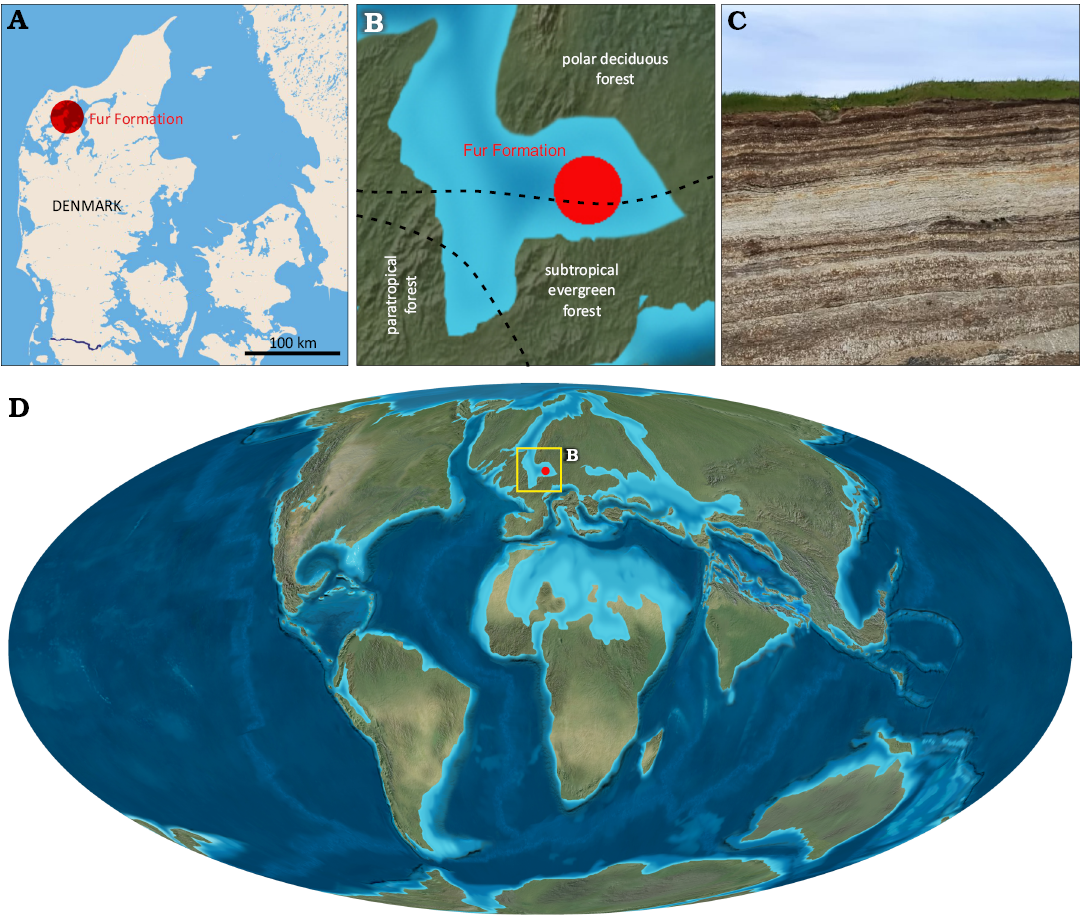
Fig. 1. A. Location of the Fur Formation on a modern map of Denmark (used and modified after © OpenStreetMap). B. Palaeogeographic map of the early Eocene showing the depositional area of the Fur Formation (indicated by the red dot); forest complexes after Madsen and Rasmussen (2021). C. Clayey diatomite (light beige layers) interbedded with multiple volcanic ash layers (greyish-brown). D. Global palaeogeographic map of the early Eocene, the position of Fur Formation. Palaeogeographic maps used with permission © 2016 Colorado Plateau Geosystems Inc.
Many of the insects reported from Fur Fm. belong to the order Diptera. Among them the most abundant are relatively large nematoceran flies of the Tipulomorpha, which constitute more than half of all known dipteran specimens from this locality (Ansorge and Schröder 1999; Krzemiński 2001). However, this interesting predominance likely reflects taphonomic bias only. This phenomenon can be explained by the fact that the diatomite deposits of the Fur Formation were formed at a distance of about 100 km from land (Fig. 1B) (Rust and Møller Andersen 1999; Madsen and Rasmussen 2021). The composition of the insect fauna of the Fur Formation resembles that of “aerial plankton” without wingless insects and larvae (Rust and Møller Andersen 1999). It means that preserved insects did not reach that place by active flight offshore, drowned in inland water streams that carried them to the sea, or drowned near the shore and their body had to remain buoyant on the water surface long enough to drift to that place, but were carried from land by wind (Rust 1998). Most nematoceran flies are weak, short-distance fliers, so the active flight over such a distance is highly unlikely. However, taxa with large wing surfaces, such as Tipulomorpha, could more easily be carried away by air currents (like a kite) and remain buoyant on the water surface for longer (their wings acting like rafts) (Rust 1998; Madsen and Rasmussen 2021). Conversely, smaller taxa were less likely to be preserved due to their reduced wing surface area and the fragility of their bodies, which decayed considerably faster. Moreover, the taxonomic composition of assemblage suggests an environment dominated by meadows with bushes and isolated trees, along with abundant freshwater habitats (Rust and Møller Andersen 1999). Given that Keroplatidae are typically associated with forested habitats, their presence in this setting is unexpected. Given all this, the discovery reported here, representing the first record of small and delicate flies from the family Keroplatidae, is particularly noteworthy.
The family Keroplatidae, comprising nearly 1000 species in almost 100 genera, is one of the larger and more diverse groups within the superfamily Sciaroidea (Evenhuis 2006). Its fossil record dates back to the Cretaceous period, with numerous taxa described from various fossil resins, including Spanish, Burmese, Cambay, Fushun, Baltic, Oise, Dominican, Taimyr, and Canadian amber, as well as Tanzanian copal. Compression fossils of Keroplatidae are extremely rare and are only known from a few localities worldwide (Pełczyńska et al. 2024, 2025).
Perhaps the most characteristic group within this family is the subfamily Macrocerinae, with genus Macrocera Meigen, 1803, being the most speciose. These flies have a delicate anatomy and typically possess extraordinarily long, filiform antennae that can be five times the length of their bodies (Matile 1990).
This paper presents the description of a new species belonging to this genus. Macrocera furastica sp. nov. is described based on a well-preserved male compression fossil with discernible genital structures. A second compression fossil containing a single wing representing an unidentified species of Macrocera is also reported. This discovery represents the earliest known occurrence of Keroplatidae in the Eocene of Europe. It extends the fossil record of this family and further emphasises the palaeontological significance of the Fur Formation and its potential for future discoveries.
Institutional abbreviations.—FUM, Fur Museum, Nederby, Fur Island, Denmark.
Other abbreviations.—A1/A2, firs/second branch of anal vein; C, costal vein; cerc, cercus; Cu, cubital vein; epand, epandrium; frm, radio-medial fusion; Gc, gonocoxite; Gs, gonostylus; h, humeral crossvein; Mb, mediobasal vein; M1/M2, first/second branch of media; M₃₊₄, fourth branch of media; m-cu, medio-cubital crossvein; PETM, Paleocene/Eocene Thermal Maximum; Rb, radiobasal vein; Rs, radial sector; R₁, anterior branch of radius; R₂₊₃/R₂₊₃₊₄₊₅, second branch of radius; R₄₊₅, third branch of radius; Sc, subcostal vein; SST, sea surface temperature; TIX, tergite 9.
Nomenclatural acts.—This published work and the nomenclatural acts it contains have been registered in ZooBank: urn:lsid:zoobank.org:pub:818028AB-CA28-450D-AA8F-0B7AA43B39FA.
Material and methods
Investigated specimens (FUM-N 12525 and FUM-N 12528) were found by Søren Kristensen on the north coast of Fur Island at the Stolleklint outcrop, Denmark, within the so-called “striated” concretionary level, situated between ash layers -29 and -25, following the ash layer numeration by Bøggild (1918). They are assigned to the PETM recovery interval, as this unit occurs from ash layer -33 up to a level between ash layers -21a and -19 (Simonsen et al. 2024), based on analyses of dinoflagellate cyst assemblages (Heilmann-Clausen 1994), δ¹³C values (Jones et al. 2019), and TEX86-derived temperature data (Stokke et al. 2020).
Prior to imaging, the specimens were wetted with distilled water to enhance the visibility of insect remains within the matrix. This method was chosen as it is commonly used in palaeontological imaging and considered safe for compression fossils (Kerp and Bomfleur 2011).
Photographic documentation was prepared using a Canon EOS 5D Mark IV digital camera equipped with a Canon MP-E 65 mm f/2.8 1–5× macro lens. A series of photographs at different focal planes were taken manually using a stand equipped with a micrometer screw, by gradually lowering the camera mounted above the specimen toward it. The camera was triggered via Helicon Remote software and the resulting images were subsequently combined into focus-stacked photographs in Helicon Focus 8. Line drawings were created in CorelDRAW 2018 software based on the photographs and measurements were taken using ImageJ software (Schneider et al. 2012).
The morphological terminology used in this publication mainly follows the nomenclature outlined in the Manual of Afrotropical Diptera (Volume 1) by Cumming and Wood (2017). The wing vein nomenclature follows that used in our previous works (Pełczyńska et al. 2024, 2025), based on the nomenclature proposed by Ševčík et al. (2020, 2022). The following terminology is applied: basal part of M1+2 = M1+2 section from its origin to the start of frm; M1+2 fork stem = M1+2 section from the end of the radio-medial fusion to the M1+2 fork; R2+3+4+5 fork stem = R2+3+4+5 section from the end of the radio-medial fusion to the R2+3+4+5 fork.
Systematic palaeontology
Class Insecta Linnaeus, 1758
Order Diptera Linnaeus, 1758
Infraorder Bibionomorpha Hennig, 1948
Superfamily Sciaroidea Billberg, 1820
Family Keroplatidae Rondani, 1856
Subfamily Macrocerinae Rondani, 1856
Tribe Macrocerini Rondani, 1856
Genus Macrocera Meigen, 1803
Type species: Macrocera lutea Meigen, 1804, by original designation; Germany, Recent.
Macrocera furastica sp. nov.
Figs. 2, 3.
Zoobank LCID: urn:lsid:zoobank.org:act:9268B919-6684-4830-A737 -B544F1C2CC8F.
Etymology: A combination of Fur, the name of the island from which the material originates, and fantastic, referring to the extraordinary palaeontological significance of the Fur Formation.
Holotype: FUM-N 12525, male, compression fossil (Fig. 2A).
Type locality: Stolleklint outcrop, north coast of the Fur Island, Denmark.
Type horizon: Fur Formation, concretionary level between ash layers -29 and -25 (ash layer numbering after Bøggild 1918); lower Eocene (lower Ypresian, approx. 55 Ma; Stokke et al. 2020).
Material.—Holotype only.
Diagnosis.—Sc vein terminating in C before the level of the basal cell tip; R1 ending in C before the R2+3+4+5 fork; R2+3+4+5 fork situated distinctly distally to the level of the M1+2 fork; R2+3 approx. 0.5× the length of the R2+3+4+5 fork stem; basal part of Mb distinct; M1+2 fork stem approx. 5× as long as frm; M3+4 reaching the wing margin at the level of the R2+3 termination; mid tibial spurs shorter than the apical width of the tibia; male genitalia approx. as wide as the apex of the abdomen; gonocoxites short and robust, forming two arms; gonostyli broad, approx. as long as the gonocoxites, ending with two robust, highly sclerotised teeth of subequal length, pointed ventrally.
Description.—Body (Fig. 2A): approx. 5.9 mm long; wing approx. 4.8 mm long and 1.7 mm wide (length:width ratio 2.8); antennae incomplete, but the preserved segments indicate a length distinctly exceeding that of the wing. Head (Fig. 3A): wider than long; cerebral sclerite present (Fig. 3A); antennae incomplete (Fig. 3B); flagellomeres distinctly elongate (Fig. 3C), the longest preserved approx. 10× as long as broad, densely covered with short setae and bearing a row of longer setae. Wing (Fig. 2C): membrane without microtrichia; C with minute trichia throughout length; microtrichia present on all veins except A; C terminates at tip of wing, after end of R4+5; Sc ending in C shortly before the level of tip of Rb cell; R1 extends beyond half-length of wing, ending in C before the level where R2+3+4+5 forks, on approx. half of the distance between end of Cu and M3+4; R2+3 approx. 0.5× the length of the R2+3+4+5 fork stem; R2+3+4+5 fork distinctly after the level where M1+2 forks; frm relatively short; most of the Mb vein distinct, fading towards its distal end, not reaching the basal cell tip; M1+2 fork stem approx. 5× longer than frm, ending before the level of Cu termination; M1 approx. 5.9× longer than M1+2 fork stem; M2 cell opening approx. 1.5× wider than opening of cell M1; M3+4 base faint and interrupted; opening of M3+4 cell approx. 1.6× wider than opening of M2 cell; basal part of M1+2 and m-cu partially atrophied; Cu reaching wing margin; A2 absent. Thorax (Fig. 2A): higher than long; scutum sparsely covered with short setae; scutellum bearing a row of trichia; pleural sclerites not recognizable. Legs (Fig. 2A, B): coxa covered with sparse, long setae; femora uniformly covered with short, dense setae, irregularly disposed; tibiae densely covered with two types of setae: short, irregularly disposed over the entire surface, and a row of several more pronounced, thicker setae along the apical half of tibia; tibial spurs (Fig. 2B) preserved only on the mid tibiae, two in number and distinctly shorter than the apical width of the tibiae. Abdomen (Fig. 2A): densely covered with thin and long setae; male terminalia (Fig. 3C) densely covered with long setae, approx. as wide as the apex of the abdomen; gonocoxites short and robust, forming two arms; gonostyli approx. as long as gonocoxites, ending with two robust, highly sclerotised teeth of subequal length, pointed ventrally.
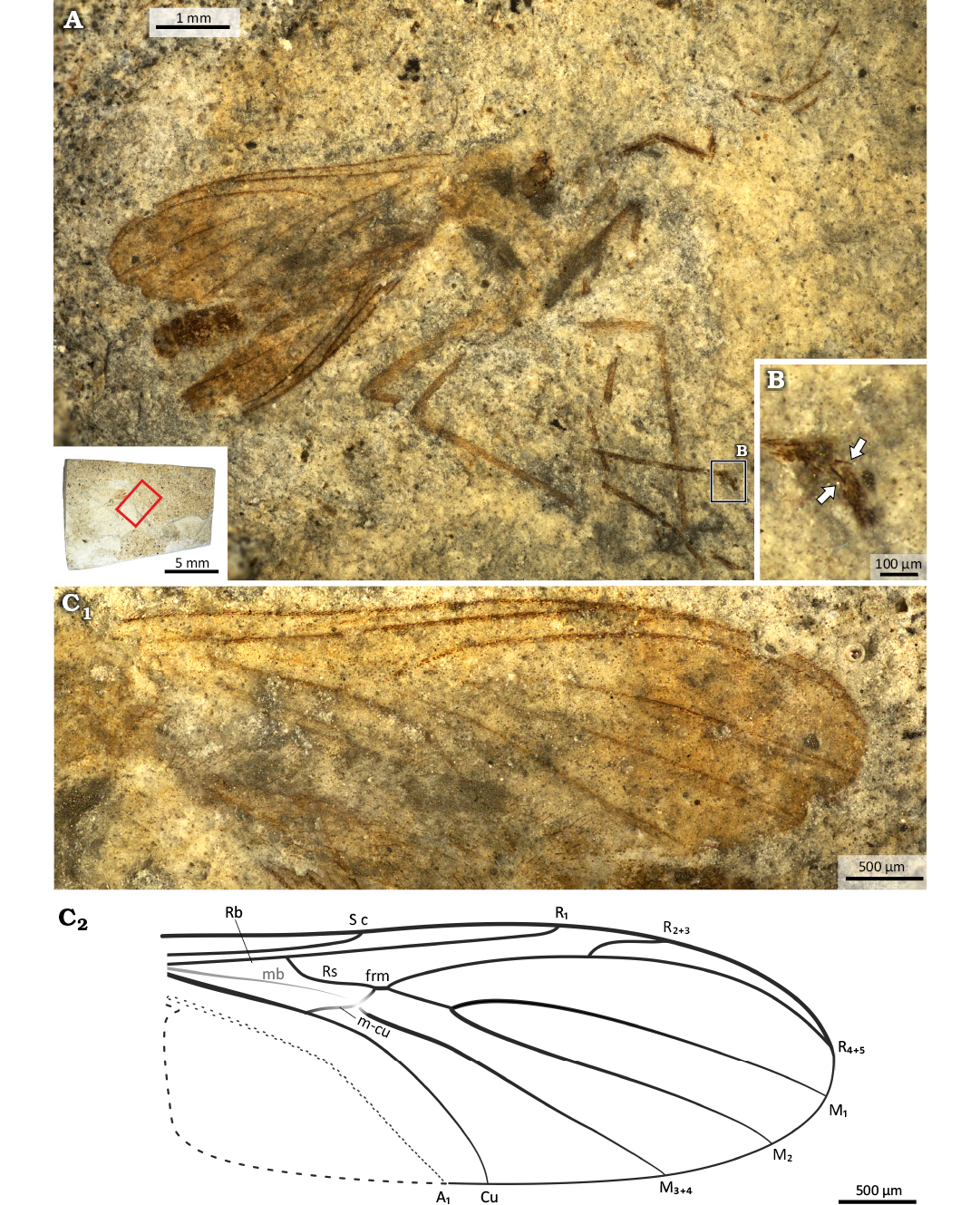
Fig. 2. Fungus gnat Macrocera furastica sp. nov. (holotype, male, FUM-N 12525), lower Ypresian, lower Eocene, Fur Formation, Stolleklint, Fur Island, western Limfjorden, northern Jutland, Denmark. A. General view of the specimen (inset: slab with indicated position of the compression). B. Apical part of mid tibia, spurs indicated by arrows. C. Left wing, C1, photograph; C2, interpretative drawing of wing venation.
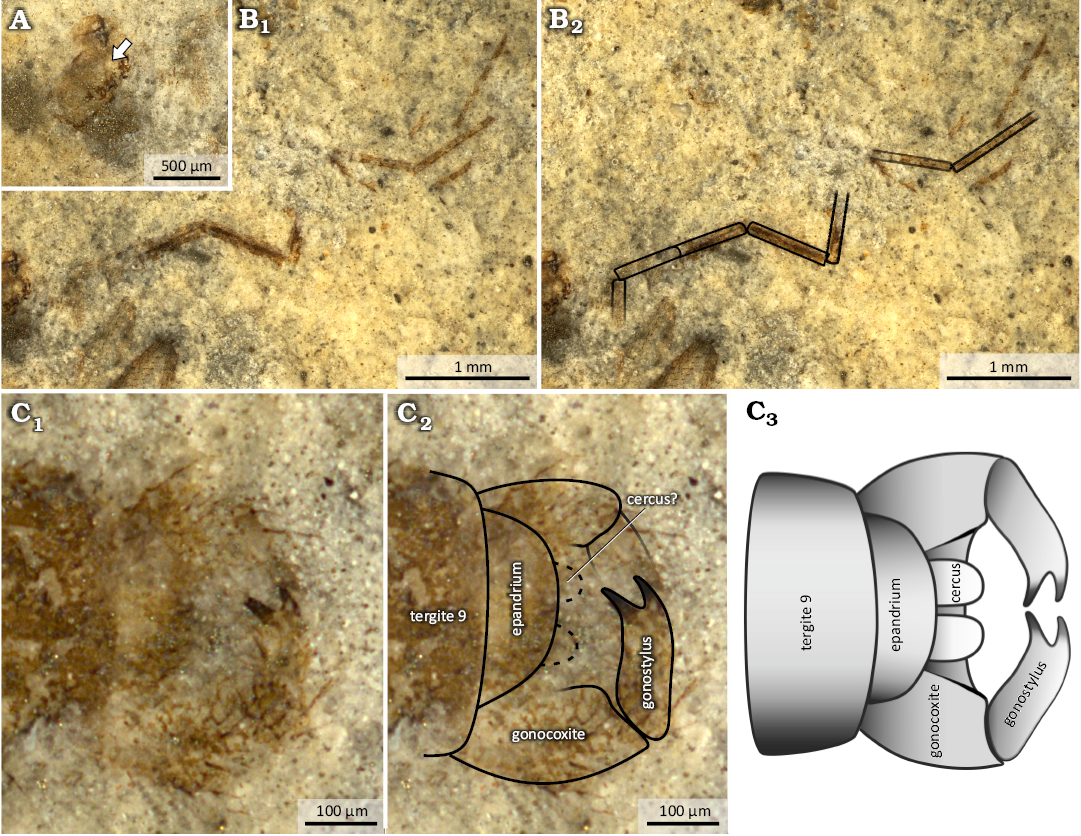
Fig. 3. Fungus gnat Macrocera furastica sp. nov. (holotype, male, FUM-N 12525), lower Ypresian, lower Eocene, Fur Formation, Stolleklint, Fur Island, western Limfjorden, northern Jutland, Denmark. A. Head, dorsal view, cerebral sclerite indicated by arrow. B. Flagellomeres, B1, photograph; B2, flagellomeres outlined for clarity. C. Genitalia, dorsal view; C1, photograph; C2, outline of genital structures clarifying interpretation; C3, hypothetical reconstruction of the genitalia.
Remarks.—Wings appear to be infuscate in the apical part, from approx. two-thirds of their length, this may be an artefact resulting from the fossilization process, although it is also possible that the wing membrane had a pattern; anal sector of the wing poorly preserved in the holotype, therefore A1 vein and shape of anal angle indicated by a dashed line in the drawing (Fig. 2C2); in the reconstruction of the male genitalia (Fig. 3C2), the area where a pair of cerci should be present is marked as corresponding to a darker trace visible on the fossil surface; however, the interpretation of this structure is highly uncertain and therefore indicated by a dashed line; the reconstruction of the complete genitalia (Fig. 3C3) is speculative and serves only to illustrate the probable morphology.
Stratigraphic and geographic range.—Type horizon and locality only.
Macrocera sp.
Fig. 4.
Material.—FUM-N 12528, isolated wing (compression fossil, Fig. 4A), Stolleklint outcrop, north coast of Fur Island, Denmark; lower Eocene (lower Ypresian, approx. 55 Ma; Stokke et al. 2020).
Measurements.—Wing (Fig. 4A) 4.6 mm long, 2.0 mm wide (length:width ratio 2.3).
Description.—Wing membrane without microtrichia; C with minute trichia throughout length; microtrichia present on all veins except A; C terminates at tip of wing, after end of R4+5, on approx. half of distance between end of R4+5 and M1; Sc long, ending in C after tip of basal cell, on approx. end of frm; R1 extends beyond half-length of wing, ending in C before level where R2+3+4+5 forks, on approx. half of the distance between end of Cu and M3+4; R2+3 approx. 0.3× the length of the R2+3+4+5 fork stem; R2+3+4+5 fork far after the level where M1+2 forks; frm short, ending before level at which A1 reach wing margin; most of the Mb vein distinct, fading towards its distal end, not reaching the basal cell tip; M1+2 fork stem approx. 4.4× longer than frm, ending before the level of A1 termination; M1 approx. 5.4× longer than M1+2 fork stem; M2 cell opening approx. 1.7× wider than opening of M1 cell; basal part of M3+4 faint, yet its trace discernible and nearly straight; opening of M3+4 cell approx. 1.3× wider than opening of M2 cell; basal part of M1+2 and m-cu partially atrophied; Cu reaching wing margin; A1 converging towards Cu distally, reaching wing margin; A2 absent.
Remarks.—The wing appears to be infuscate along the apical and posterior margins. Although this may represent a taphonomic artefact, it is possible that it reflects an original pigmentation pattern of the wing membrane (see Discussion). The shape of the anal angle remains uncertain and is therefore indicated by a dashed line.
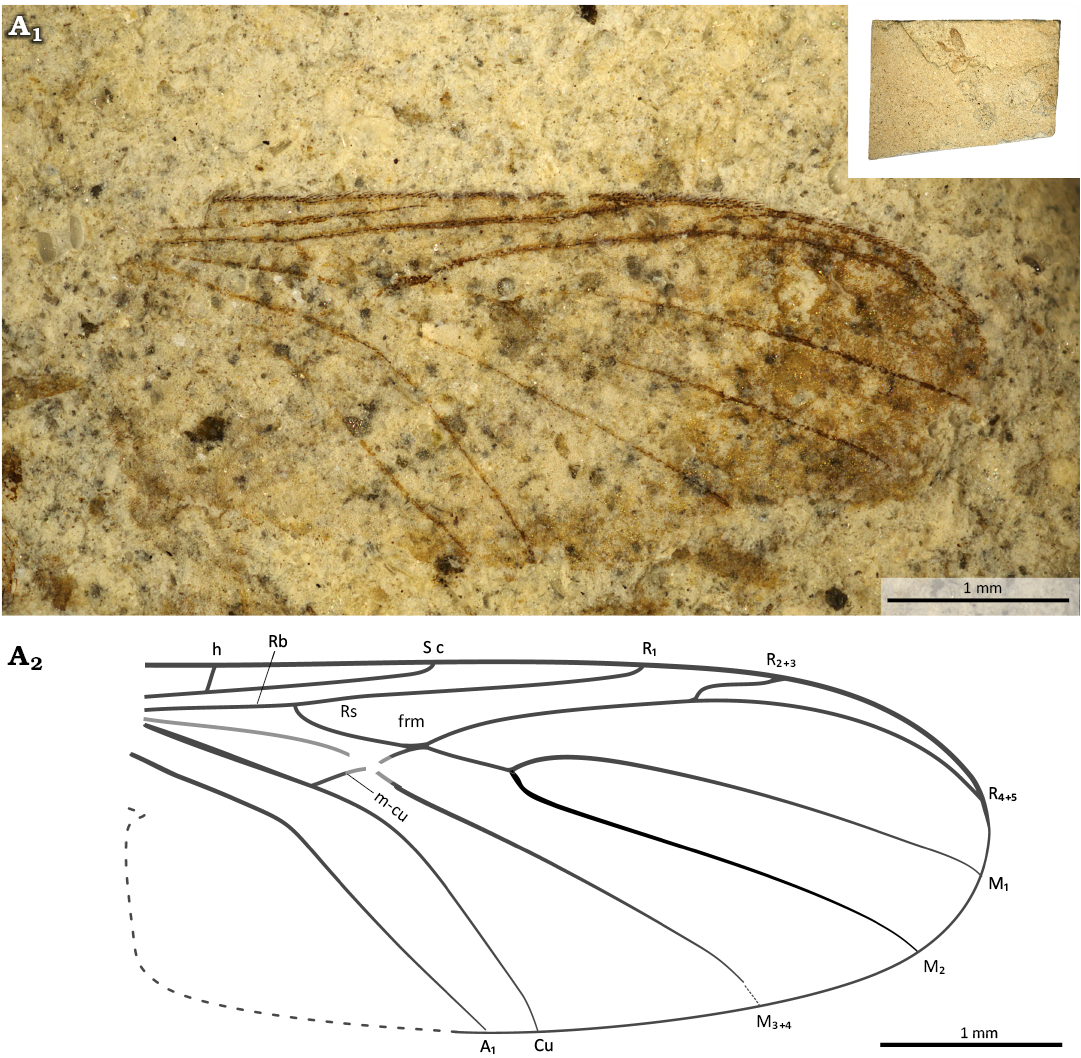
Fig. 4. Wing of fungus gnat Macrocera sp. (FUM-N 12528), lower Ypresian, lower Eocene, Fur Formation, Denmark. A1, wing (inset: general view of the slab, position of the compression indicated); A2, interpretative drawing of wing venation.
Discussion
Justification of the taxonomic assignment.—Species described herein undoubtedly belongs to the subfamily Macrocerinae of the Keroplatidae family, as evidenced by its wing venation (presence of radio-medial fusion; Fig. 2C) and head morphology (presence of a cerebral sclerite, which is a unique apomorphy diagnostic for this group; Fig. 3A) (Matile 1990). In addition, the convergence of veins M3+4 and Cu near their termination at the wing margin, the atrophy of the basal part of M3+4, the remarkable elongation of the flagellomeres (up to ten times longer than wide), and the presence of two short tibial spurs on the mid leg (shorter than the apical width of the tibiae) form a distinctive set of morphological features characteristic of the Macrocera (Matile 1990). All these features taken together provide strong support for the proposed taxonomic placement of the new species, Macrocera furastica sp. nov.
However, Macrocera is a highly diverse genus comprising more than 200 species that exhibit substantial morphological variation, which may indicate the paraphyly of the group (Matile 1990; Evenhuis 2006; Mantič et al. 2020). This is probably due to the fact that historically, new species have been primarily assigned to Macrocera based on the presence of long, filiform antennae, a character of unclear phylogenetic significance. Consequently, the delimitation of Macrocera remains challenging (Matile 1990; Mantič et al. 2020).
The additional specimen (FUM-N 12528), consisting of an isolated wing, is very similar to the wing of Macrocera furastica sp. nov. both in terms of its venation and coloration (Fig. 5). It is relatively broad, base of M3+4 is atrophied and veins M3+4 and Cu terminate convergently which is characteristic of the genus Macrocera. However, the second wing differs from that of M. furastica sp. nov. in noteworthy details such as its broader shape (higher lenght:width ratio, 2.8 vs. 1.3), presence of longer Sc vein, which terminates at approx. the same level as the end of frm, vein Sc does not reach the level of the basal cell tip, and generally different shape of the basal cell (Fig. 5). It is therefore evident that this wing belongs to a representative of Macrocera. However, it remains uncertain whether the observed minor morphological differences fall within intraspecific variation and may reflect, for example, sexual dimorphism. Given the incompleteness of the specimen and the lack of additional diagnostic characters, we refrain from assigning a formal taxonomic name. Nevertheless, the discovery of additional specimens with comparable wing venation in the future may provide a basis for the description of a new species from the Fur Formation.
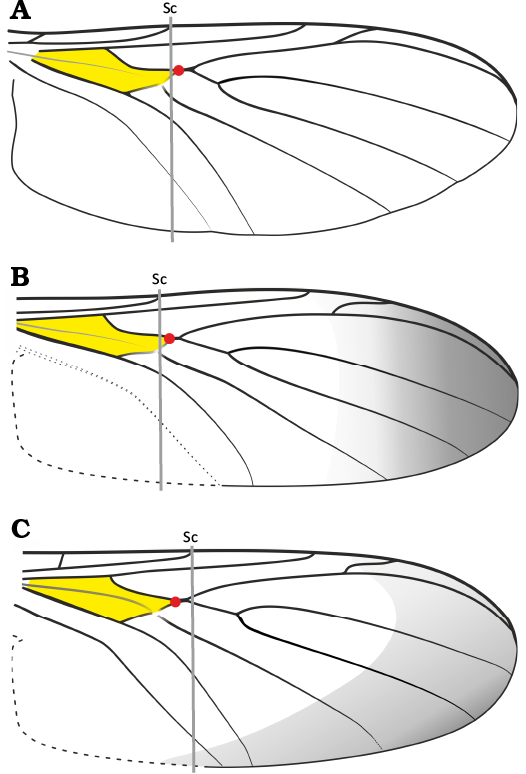
Fig. 5. Comparison of wings of fungus gnat Macrocera showing the relative position of the Sc vein ending (grey line) in relation to the apical tip of the basal cell (red dot); shape of the basal cell highlighted in yellow; infuscated areas of the wing indicated with shading, missing parts shown with dotted lines. A. Macrocera lutea Meigen, 1804, type species of the genus, extant (redrawn after Matile 1990). B. Macrocera furastica sp. nov., holotype, male, FUM-N 12525. C. Macrocera sp. (FUM-N 12528). Not to scale.
Comparison with other fossil Macrocera.—To date, eight fossil species of Macrocera have been described, with its fossil record extending back to the Cretaceous period. In particular, the oldest species, M. minor (Blagoderov & Arillo, 2002), has been identified within Álava amber from Spain, dated to the late Albian, approx. 105 Ma (Barrón et al. 2015; Pérez-de la Fuente et al. 2020). Additionally, three other species (M. vonneguti Pełczyńska & Blagoderov, 2025; M. sevciki Pełczyńska & Krzemiński, 2025; M. pawli Pełczyńska, 2025) come from the Burmese amber of Myanmar, dated to the earliest Cenomanian, approx. 99 Ma (Shi et al. 2012; Pełczyńska et al. 2025).
Only two species, M. apithanos Kerr & Greenwalt, 2022, and Macrocera electricornis Evenhuis, 2006, have been derived from Eocene materials. Macrocera apithanos Kerr & Greenwalt, 2022, comes from compression fossils from the Kishenehn Formation of the USA, dated to the Lutetian (45.8–46.6 Ma; Kerr and Greenwalt 2022) and M. electricornis (Evenhuis 2006) has been discovered in the Baltic amber, dated to mid-Priabonian (36–35 Ma; Ross et al. 2026).
The remaining two, younger fossils of Macrocera include M. archaica Armbruster, 1938, from the Miocene Randeck Maar Formation of Germany, dated to 15.98–13.82 Ma (Mörs 1995) and Macrocera umbonata Statz, 1944, from the Rott Formation of Germany and dated to the Oligocene, approx. 23–24 Ma (Rasser et al. 2013).
The newly described species, M. furastica sp. nov. can be distinguished from M. apithanos by the structure of the genitalia. The gonostylus of M. furastica sp. nov. ends with two apical teeth, whereas in M. apithanos it is assumed to be hook-shaped. The wing venation of M. furastica sp. nov. also differs from M. apithanos, as their basal cells are smaller and closed by a strongly curved Rs vein, bent towards the posterior wing margin, whereas in M. apithanos the Rs vein is almost straight. Other differences between new species and M. apithanos include the relative lengths of the M1 and M1+2 fork stem (5.9× and 5.4 vs. 10.3×) and the ratio of the openings of cells M2 and M1 (1.7× and 1.7 vs. 1.2×). Additionally, the cross-vein m-cu, which defines the basal cell, runs horizontally in M. furastica sp. nov., whereas in M. apithanos it is inclined around 45°.
Subsequently, comparing wing venation of new species with M. electricornis length of their frm is distinctly smaller (character regarded as apomorphic by Matile 1990). Furthermore, M. furastica sp. nov. differs from M. electricornis in the length of the tibial spurs, which in the case of M. furastica sp. nov. are very short and do not even exceed the apical width of the tibiae. In contrast, in the case of M. electricornis they are at least 1.4× longer than it.
Finally, referring to the younger fossils of Macrocera, M. archaica Armbruster, 1938, is characterized by a very short R1 vein that terminates in C before the M1+2 fork (in new species R1 vein ends far beyond this level of the wing), whereas M. umbonata Statz, 1944, is notable for vein R4+5 reaching the wing margin very close to the M1 tip (in new species this distance is much greater).
Comparison with modern fauna.—The newly described species closely resembles extant representatives of Macrocera. This similarity is most evident in the wing venation, which is relatively conservative within the genus and, in M. furastica sp. nov., closely resembles that of the extant type species, Macrocera lutea Meigen, 1804 (Fig. 5). The male terminalia with the gonostylus bearing two apical teeth, likewise, represent the most common condition within Macrocera (Matile 1990). Notably, feature that may provide a more specific point of comparison is the hypothesized infuscation on the wing membrane, discussed in detail below.
Pattern on wing membrane.—Both investigated specimens from the Fur Formation appear to have parts of their wing surfaces infuscated (Fig. 5). The question arises whether this is a taphonomic artifact or a genuine remnant of the original pigmentation of the wing membrane. However, the presence of symmetrical patches on the left and right wings of the holotype of Macrocera furastica sp. nov., as well as the similarity in shape of the pattern observed on the additional wing fossil (FUM-N 12528), suggests that this feature is not a result of random taphonomic processes. Comparable infuscation is also present on the wings of another species known from compression fossils namely, M. apithanos. Moreover, pigmentation on the wing membrane is common among numerous extant Macrocera species, with darker patches usually situated near the apical tip of the wing (e.g., M. phalerata Wiedemann, 1818, M. fascipennis Staeger, 1840, or M. angulata Meigen, 1818; Matile 1990). Taking this into consideration, we hypothesise that the observed infuscation represents remnants of a true wing pattern, a feature that may potentially have a diagnostic significance, but confirmation of this will require discovery of additional specimens.
Conclusions
Small-sized, delicate-bodied insect groups such as gnats from the Keroplatidae family are rarely well-preserved as compression fossils. Therefore, the discovery of the almost complete holotype of Macrocera furastica sp. nov. from the Fur Formation is of considerable significance. Together with the additional specimen this finding helps us to better understand the biodiversity that developed in the early Eocene under unique paleoenvironmental conditions following the episode of Paleocene/Eocene Thermal Maximum (PETM).
Acknowledgements
The authors would like to sincerely thank René Lyng Sylvestersen (FUM-N), Jan Audun Rasmussen and Henrik Madsen (both Museum Mors, Nykøbing Mors, Denmark) for providing access to the material examined in this study, as well as for the warm hospitality offered to the Polish paleoentomological team during the research visit to the Fur Formation in the summer of 2022. The authors also thank the reviewers, Eirik Rindal (Natural History Museum, University of Oslo, Norway) and Katarzyna Kopeć (Institute of Systematics and Evolution of Animals, Polish Academy of Sciences, Kraków, Poland) for their constructive comments. This research was funded by the National Science Centre, Poland (grant no. 2020/37/B/NZ8/03042).
Authors’ contributions
AP took the lead in writing the manuscript and was responsible for material preparation, photography, and graphic illustrations. AP and WK made taxonomic decisions. AS and WK were involved in developing the research concept, arranging access to the material, supervising the project and securing financial support. All authors provided critical feedback, contributed to refining the manuscript, and approved the final version.
Conflict of interest: The authors declare that they have no conflicts of interest in relation to this work.
Data availability statement: The data underlying this article will be shared on reasonable request to the corresponding author.
Editor: Krzysztof Hryniewicz
References
Ansorge, J. and Schröder, F. 1999. Bittacomorphinae (Diptera: Ptychopteridae) aus der alttertiären Fur-Formation (Moler) von Dänemark. Studia Dipterologica 6: 305–320.
Armbruster, L. 1938. Versteinerte Honigbienen aus dem obermiocänen Randecker Maar. Archiv für Bienenkunde 19: 97–133.
Barrón, E., Peyrot, D., Rodríguez-López, J.P., Meléndez, N., López del Valle, R., Najarro, M., Rosales, I., and Comas-Rengifo, M.J. 2015. Palynology of Aptian and upper Albian (Lower Cretaceous) amber-bearing outcrops of the southern margin of the Basque-Cantabrian basin (northern Spain). Cretaceous Research 52: 292–312. Crossref
Billberg, G.J. 1820. Enumeratio insectorum in Museo. 138 pp. Typis Gadelianis. Stockholm.
Blagoderov, V. and Arillo, A. 2002. New Sciaroidea (Insecta : Diptera) in Lower Cretaceous amber from Spain. Studia Dipterologica 9: 3–12.
Bøggild, O.B. 1918. Den vulkanske aske i moleret samt en oversigt over Danmarks ældre Tertierbjergarter. Danmarks Geologiske Undersøgelse II. Række 33 (1): 1–159. Crossref
Cumming, J.M. and Wood, D. 2017. Adult morphology and terminology (chapter 3). In: A.H. Kirk-Spriggs, and B.J. Sinclair (eds.). Manual of Afrotropical Diptera: Volume 1, Suricata 4, 89–133. SANBI Publications, Pretoria.
Dietrich, C.H. and Perkovsky, E.E. 2023. First leafhopper from the earliest Eocene Fur Formation (Denmark) representing a new genus of Cicadellinae (Hemiptera: Cicadomorpha). Palaeoentomology 6: 447–450. Crossref
Evenhuis, N.L. 2006. Catalog of the Keroplatidae of the World (Insecta: Diptera). Bishop Museum Bulletin in Entomology 13: 1–177.
Foster, G.L., Hull, P., Lunt, D.J., and Zachos, J.C. 2018. Placing our current ‘hyperthermal’ in the context of rapid climate change in our geological past. Philosophical Transactions. Series A, Mathematical, Physical, and Engineering Sciences 376 (2130): 20170086. Crossref
Hennig, W. 1948. Die Larvenformen der Dipteren. Vol. 1. 184 pp. Akademie Verlag, Berlin.
Heikkilä, M., Simonsen, T.J., and Solis, M.A. 2018. Reassessment of known fossil Pyraloidea (Lepidoptera) with descriptions of the oldest fossil pyraloid and a crambid larva in Baltic amber. Zootaxa 4483: 101–127.
Heilmann‐Clausen, C. 1994. Review of Paleocene dinoflagellates from the North Sea region. GFF 116: 51–53. Crossref
Jones, M.T., Percival, L.M.E., Stokke, E.W., Frieling, J., Mather, T.A., Riber, L., Schubert, B.A., Schultz, B., Tegner, C., Planke, S., and Svensen, H.H. 2019. Mercury anomalies across the Palaeocene–Eocene Thermal Maximum. Climate of the Past 15: 217–236. Crossref
Jones, M.T., Stokke, E.W., Rooney, A.D., Frieling, J., Pogge von Strandmann, P.A.E., Wilson, D.J., Svensen, H.H., Planke, S., Adatte, T., Thibault, N., Vickers, M.L., Mather, T.A., Tegner, C., Zuchuat, V., and Schultz, B.P. 2023. Tracing North Atlantic volcanism and seaway connectivity across the Paleocene–Eocene Thermal Maximum (PETM). Climate of the Past 19: 1623–1652. Crossref
Kerp, H. and Bomfleur, B. 2011. Photography of plant fossils—new techniques, old tricks. Review of Palaeobotany and Palynology 166: 117–151. Crossref
Greenwalt, D.E., Amorim, D.D.S., Hauser, M., Kerr, P.H., Fitzgerald, S.J., Winterton, S.L., Brown, B.V., Evenhuis, N.L., and Sinclair, B.J. 2022. Diptera of the Middle Eocene Kishenehn Formation II. Palaeontologia Electronica 25: a39. Crossref
Krzemiński, W. 2001. New fossil Tipuloidea (Diptera) from the Fur Formation of Denmark in the collection of the Natural History Museum in London. Polskie Pismo Entomologiczne 70: 333–339.
Larsen, L.M., Fitton, J.G., and Pedersen, A.K. 2003. Paleogene volcanic ash layers in the Danish Basin: compositions and source areas in the North Atlantic Igneous Province. Lithos 71: 47–80. Crossref
Legalov, A., Vasilenko, D., and Perkovsky, E. 2024. A new species of the genus Cephalallus Sharp, 1905 (Coleoptera: Cerambycidae) from the Ypresian of Denmark. Ecologica Montenegrina 71: 261–268. Crossref
Linnaeus, C. 1758. Systema naturæ per regna tria naturæ, secundum classes, ordines, genera, species, cum characteribus, differentiis, synonymis, locis. Tomus I. Editio decima, reformata. 824 pp. Laurentius Salvius, Stockholm. Crossref
Madsen, H. and Rasmussen, J.A. 2021. Geologien fortæller: Moler og fossiler / What geology tells: The mo-clay and its fossils. 103 pp. Museum Mors, Nykøbing Mors.
Makarkin, V.N. and Perkovsky, E.E. 2023. New Limaiinae (Neuroptera: Chrysopidae) from the early Eocene Fur Formation, Denmark, including an unexpected finding of a Mesozoic genus. Zootaxa 5383: 57–66. Crossref
Makarkin, V., Legalov, A., Simonsen, T., and Perkovsky, E. 2024. First record of Berothidae (Neuroptera) from the early Eocene of Denmark. Ecologica Montenegrina 79: 1–10. Crossref
Mantič, M., Sikora, T., Burdíková, N., Blagoderov, V., Kjærandsen, J., Kurina, O. and Ševčík, J. 2020. Hidden in Plain Sight: Comprehensive Molecular Phylogeny of Keroplatidae and Lygistorrhinidae (Diptera) Reveals Parallel Evolution and Leads to a Revised Family Classification. Insects 11 (6): 348. Crossref
Matile, L. 1990. Recherches sur la systématique et l’évolution des Keroplatidae (Díptera, Mycetophiloidea). 682 pp. Mémoire du Muséum national d’Histoire naturelle, Paris.
Meigen, J.W. 1803. Versuch einer neuen Gattungseinteilung [sic!] der eurpoäischen zweiflügligen Insekten. Magazin für Insektenkunde 2: 259–281.
Meigen, J.W. 1804. Klassifikazion und beschreibung der europäischen zweiflügligen insekten: (Diptera Linn.). 414 pp. Karl Reichard, Braunschweig.
Meigen, J.W. 1818. Systematische Beschreibung der bekannten europäischen zweiflügeligen Insekten. 332 pp. Friedrich Wilhelm Forstmann, Aachen. Crossref
Mörs, T. 1995. Die Sedimentationsgeschichte der Fossillagerstätte Rott und ihre Alterseinstufung anhand neuer Säugetierfunde (Oberoligozän, Rheinland). CFS Courier Forschungsinstitut Senckenberg 187: 1–129.
Pedersen, G.K. and Pedersen, S.A.S. 2013. Geology of the early Eocene Fur Formation, a unique deposit in the North Sea Basin: Excursion guide to geological key localities on Mors and Fur, northern Denmark. Geological Survey of Denmark and Greenland Report 2013: 47.
Pełczyńska, A., Blagoderov, V., Krzemiński, W., and Soszyńska, A. 2025. Long story of long antennae: Mesozoic origins of the subfamily Macrocerinae (Diptera: Keroplatidae). Acta Geologica Sinica (English Edition) 99: 1225–1248. Crossref
Pełczyńska, A., Krzemiński, W., Blagoderov, V., Vilhelmsen, L., and Soszyńska, A. 2024. Eocene amber provides the first fossil record and bridges distributional gap in the rare genus Robsonomyia (Diptera: Keroplatidae). Scientific Reports 14 (1): 9252. Crossref
Pérez-de la Fuente, R., Engel, M.S., Delclòs, X., and Peñalver, E. 2020. Straight-jawed lacewing larvae (Neuroptera) from Lower Cretaceous Spanish amber, with an account on the known amber diversity of neuropterid immatures. Cretaceous Research 106: 104200. Crossref
Prokin, A.A., Hájek, J., Vasilenko, D.V., and Perkovsky, E.E. 2024. The oldest Rhantus (Coleoptera, Dytiscidae) from the earliest Eocene Fur Formation, Denmark. Zootaxa 5458: 263–274. Crossref
Rasmussen, J.A., Madsen, H., Schultz, B.P., Sylvestersen, R.L., and Bonde, N. 2016. The Lowermost Eocene Deposits and Biota of the Western Limfjord Region, Denmark—Field Trip Guidebook. 2nd International Mo-clay Meeting, 2–4 Nov. 2016 at Museum, Skive and the Fossil and Mo-clay Museum, Museum Mors, Nykøbing Mors, Denmark. 35 pp.
Rasser, M.W., Bechly, G., Böttcher, R., Ebner, M., Heizmann, E.P.J., Höltke, O., Joachim, C., Kern, A.K., Kovar-Eder, J., Nebelsick, J.H., Roth-Nebelsick, A., Schoch, R.R., Schweigert, G., and Ziegler, R. 2013. The Randeck Maar: Palaeoenvironment and habitat differentiation of a Miocene lacustrine system. Palaeogeography, Palaeoclimatology, Palaeoecology 392: 426–453. Crossref
Rondani, C. 1856. Dipterologiae Italicae Prodromus. Vol. I: Genera italica ordinis Dipterorum ordinatim disposita et distincta et in familias et stirpes aggregata. 226 pp. A. Stocchi, Parma. Crossref
Ross, A.J., Bojarski, B., and Szwedo, J. 2026. A critical review of the ageof Baltic amber from the Samland Peninsula, Russia. Earth and Envi-ronmental Science Transactions of The Royal Society of Edinburgh, 1–14 [published online at https://doi.org/10.1017/S1755691025100960] Crossref
Rust, J. 1998. Biostratinomie von Insekten aus der Fur-Formation von Dänemark (Moler, oberes Paleozän/unteres Eozän). Paläontologische Zeitschrift 72: 41–58. Crossref
Rust, J. and Møller Andersen, N. 1999. Giant ants from the Paleogene of Denmark with a discussion of the fossil history and early evolution of ants (Hymenoptera: Formicidae). Zoological Journal of the Linnean Society 125: 331–348. Crossref
Schneider, C.A., Rasband, W.S., and Eliceiri, K.W. 2012. NIH Image to ImageJ: 25 years of image analysis. Nature Methods 9: 671–675. Crossref
Ševčík, J., Krzemiński, W., and Skibińska, K. 2020. Intriguing and beautiful: Adamacrocera adami gen. et sp. nov. from the Upper Cretaceous amber of Myanmar represents a new subfamily of Keroplatidae (Diptera: Bibionomorpha). Insects 11 (9): 552. Crossref
Ševčík, J., Krzemiński, W., and Skibińska, K. 2022. Extant genus in the Mesozoic: Paleoplatyura Meunier (Diptera: Keroplatidae) found in the Cretaceous amber of Myanmar. Insects 13 (1): 24. Crossref
Shcherbakov, E.O., Perkovsky, E.E., Sylvestersen, R.L., and Anisyutkin, L.N. 2025. The northernmost Eocene genus and species of praying mantises (Mantodea Burmeister, 1838) from Fur Formation, Denmark. Zootaxa 5715: 433–440. Crossref
Shi, G., Grimaldi, D., Harlow, G., Wang, J., Wang, J., Yang, M., Lei, W., Li, Q.-L., and Li, X. 2012. Age constraint on Burmese amber based on U-Pb dating of zircons. Cretaceous Research 37: 155–163. Crossref
Simonsen, T.J., Archibald, S.B., Rasmussen, J.A., Sylvestersen, R.L., Olsen, K., and Ware, J.L. 2024. Stolleagrion foghnielseni (Odonata, Cephalozygoptera, Dysagrionidae) gen. et sp. nov.: a new odonatan from the PETM recovery phase of the earliest Ypresian Fur Formation, Denmark. Zootaxa 5415: 493–498. Crossref
Staeger, R.C. 1840. Systematisk fortegnelse over de i Danmark hidtil fundne Diptera. Naturhistorisk Tidsskrift 1: 228–288.
Statz, G. 1944. Neue Dipteren (Nematocera) aus dem Oberoligozän von Rott. III. Familie: Limnobiidae (Stelzmücken), IV. Familie: Tipulidae (Schnaken), V. Familie: Culicidae (Stechmücken). Palaeontographica Abteilung A 95: 93–121.
Stokke, E.W., Jones, M.T., Riber, L., Haflidason, H., Midtkandal, I., Schultz, B.P., and Svensen, H.H. 2021. Rapid and sustained environmental responses to global warming: the Paleocene–Eocene Thermal Maximum in the eastern North Sea. Climate of the Past 17: 1989–2013. Crossref
Stokke, E.W., Jones, M.T., Tierney, J.E., Svensen, H.H., and Whiteside, J.H. 2020. Temperature changes across the Paleocene–Eocene Thermal Maximum—a new high-resolution TEX86 temperature record from the Eastern North Sea Basin. Earth and Planetary Science Letters 544: 116388. Crossref
Svensen, H., Bjærke, M.R., and Kverndokk, K. 2019. The Past as a Mirror: Deep Time Climate Change Exemplarity in the Anthropocene. Culture Unbound: Journal of Current Cultural Research 11: 330–352. Crossref
Wiedemann, C.R.W. 1818. Neue Insecten vom Vorgebirge der guten Hoffnung. Zoologisches Magazin 1 (2): 40–48.
Acta Palaeontol. Pol. 71 (3): 449–459, 2026
https://doi.org/10.4202/app.01326.2026