
The first Late Jurassic elcanid orthopteran from Poland and its palaeoecological implications
MONIKA MICHALSKA and BŁAŻEJ BŁAŻEJOWSKI
Michalska, M. and Błażejowski, B. 2026. The first Late Jurassic elcanid orthopteran from Poland and its palaeoecological implications. Acta Palaeontologica Polonica 71 (3): 475–483.
The elcanid ?Panorpidium polonicum Michalska sp. nov. is described based on a single tegmen from the Tithonian (Upper Jurassic) Kcynia Formation at the Owadów-Brzezinki quarry, central Poland. This specimen represents the first record of the family Elcanidae, and the first Late Jurassic orthopteran fossil found in Poland. Venational characters allow tentative assignment to Panorpidium, extending the stratigraphic range of the genus into the Upper Jurassic and making ?Panorpidium polonicum Michalska sp. nov. the oldest known species of the genus. This find provides new evidence for the palaeobiogeographic distribution of elcanids and contributes to the sketchy background of the enigmatic superfamily Elcanoidea. It also highlights the importance of the Owadów-Brzezinki site for understanding Late Jurassic arthropod diversity.
Key words: Insecta, Orthoptera, Elcanidae, Upper Jurassic, Owadów-Brzezinki quarry.
Monika Michalska [m.michalska@twarda.pan.pl; ORCID: https://orcid.org/0009-0004-1505-5618 ] and Błażej Błażejowski [bblazej@twarda.pan.pl; ORCID: https://orcid.org/0000-0001-6320-9870 ], Institute of Paleobiology, Polish Academy of Sciences, ul. Twarda 51/55, 00-818 Warsaw, Poland; Museum of the Earth of the Polish Academy of Sciences, Aleja Na Skarpie 20/26-27, 00-488 Warsaw, Poland.
Received 4 February 2026, accepted 14 May 2026, published online 26 August 2026.
Copyright © 2026 M. Michalska and B. Błażejowski. This is an open-access article distributed under the terms of the Creative Commons Attribution License (for details please see http://creativecommons.org/licenses/by/4.0/), which permits unrestricted use, distribution, and reproduction in any medium, provided the original author and source are credited.
Introduction
The fossil record of the order Orthoptera can be traced back to the Carboniferous, with division into two suborders, Ensifera (long-horned orthopterans: crickets, katydids) and Caelifera (short-horned orthopterans: grasshoppers, locusts), in the late Permian (Chang et al. 2020). Within Orthoptera, the phylogenetic position of the extinct superfamily Elcanoidea remains unsettled, as it exhibits features of both suborders. Its wing venation is similar to that of Caelifera (Béthoux and Nel 2002), whereas morphological features such as long filiform antennae and well-developed ovipositor have led Elcanoidea to be placed within Ensifera (Zessin 1987; Gorochov et al. 2006; Fang et al. 2015).
Jurassic insects from Poland are represented by Early Jurassic material, including poorly known specimens from fire clays at Grójec and a relatively rich insect assemblage from Sołtyków (known also as Odrowąż) near Kielce, Holy Cross Mts. (Węgierek and Zherikhin 1997). To date, no Middle Jurassic insects have been reported from Poland, and Late Jurassic insects are known only from the Owadów-Brzezinki quarry (NW margin of the Holy Cross Mts). Previously, Bechly and Kin (2013) described a dragonfly from Owadów-Brzezinki, which was the first record of the family Eumorbaeschnidae (Odonata, Anisoptera, Aeshnoptera) outside the Solnhofen lithographic limestone. Recently, review studies have been published that include insects from this site; these studies briefly describe their state of preservation and pondering taphonomic factors influencing the collecting difficulties (Błażejowski et al. 2023b; Michalska et al. 2025).
In this paper, the authors present the first Late Jurassic (Tithonian) orthopteran from Owadów-Brzezinki, Poland, assigned to the family Elcanidae. To date, Polish fossil record of Orthoptera preserved in sedimentary rocks has been restricted exclusively to Carboniferous deposits (Dvořák et al. 2019; Kania-Kłosok et al. 2025). Members of the family Elcanidae are known from both compression fossils and amber inclusions, with geographic distribution spanning Europe, Asia, and North and South America (e.g., Zessin 1987; Ansorge 2003; Gorochov et al. 2006; Fang et al. 2018; Kočárek 2020; Nel and Jouault 2022; Willmott et al. 2025; Yu et al. 2025).
Institutional abbreviations.—ZPAL, Institute of Paleobiology, Polish Academy of Sciences, Warsaw, Poland.
Other abbreviations.—CP, posterior costa; ScA/P, subcosta anterior/posterior; RA/P, radius anterior/posterior; MA/P, media anterior/posterior; CuA/P, cubitus anterior/posterior; CuPaα, anterior branch of first posterior cubitus; CuPaβ, posterior branch of first posterior cubitus; CuPb, second posterior cubitus; 1A, anterior anal vein.
Nomenclatural acts.—This published work and the nomenclatural acts it contains have been registered in ZooBank: urn:lsid:zoobank.org:pub:60B45D05-DC73-4E0E-BF81-A586756BE8C8.
Geological setting
The Owadów-Brzezinki palaeontological site is an active quarry, located near Tomaszów Mazowiecki (Fig. 1B), in the Łódzkie Voivodeship (central Poland), providing a rich assemblage of marine and terrestrial organisms, i.e., insects, ammonites, horseshoe crabs, lobster-like crustaceans, fishes, ichthyosaurs, plesiosaurs, turtles, crocodylomorphs, and others (Kin et al. 2013; Błażejowski et al. 2016, 2019, 2020, 2023b). Geologically, it is situated in the NW margin of the Holy Cross Mts. Two formations are exposed at the locality, Kcynia Formation and Pałuki Formation (Fig. 1A), both placed near the lower/upper Tithonian boundary, Upper Jurassic (Błażejowski et al. 2023a; Matyja and Wierzbowski 2016). Moreover, multi-phase karst sinkhole deposits are present in the Owadów-Brzezinki quarry, containing Lower Cretaceous (Valanginian) sands and clays, as well as Miocene siliceous sinter, coal clay, and speleothem fragments (Chrząstowska et al. 2025; Wierzbowski et al. 2026).
The fossil insect collection from Owadów-Brzezinki (initiated in 2013 and since 2022 expanded with a particular focus on insects) currently comprises 46 specimens. All insects (Orthoptera, Coleoptera and Odonata) were found in the fine-grained, laminated limestones of the highly fossiliferous part of the Kcynia Formation (Fig. 1C), corresponding to lagoonal conditions. Insects are notoriously hard to detect in this locality, due to their disintegration and their colouration being similiar to the yellowish host rocks. To date, beetles (their elytra and abdomens) are the most abundant insects in the collection; however, orthopteran fossils slightly predominate among the isolated wings and testify to a terrestrial ecosystem surrounding the lagoon (Błażejowski et al. 2023a, b; Michalska et al. 2025). The specimen presented in this paper is the only representative of the family Elcanidae and represents the most complete wing preserved in the collection.
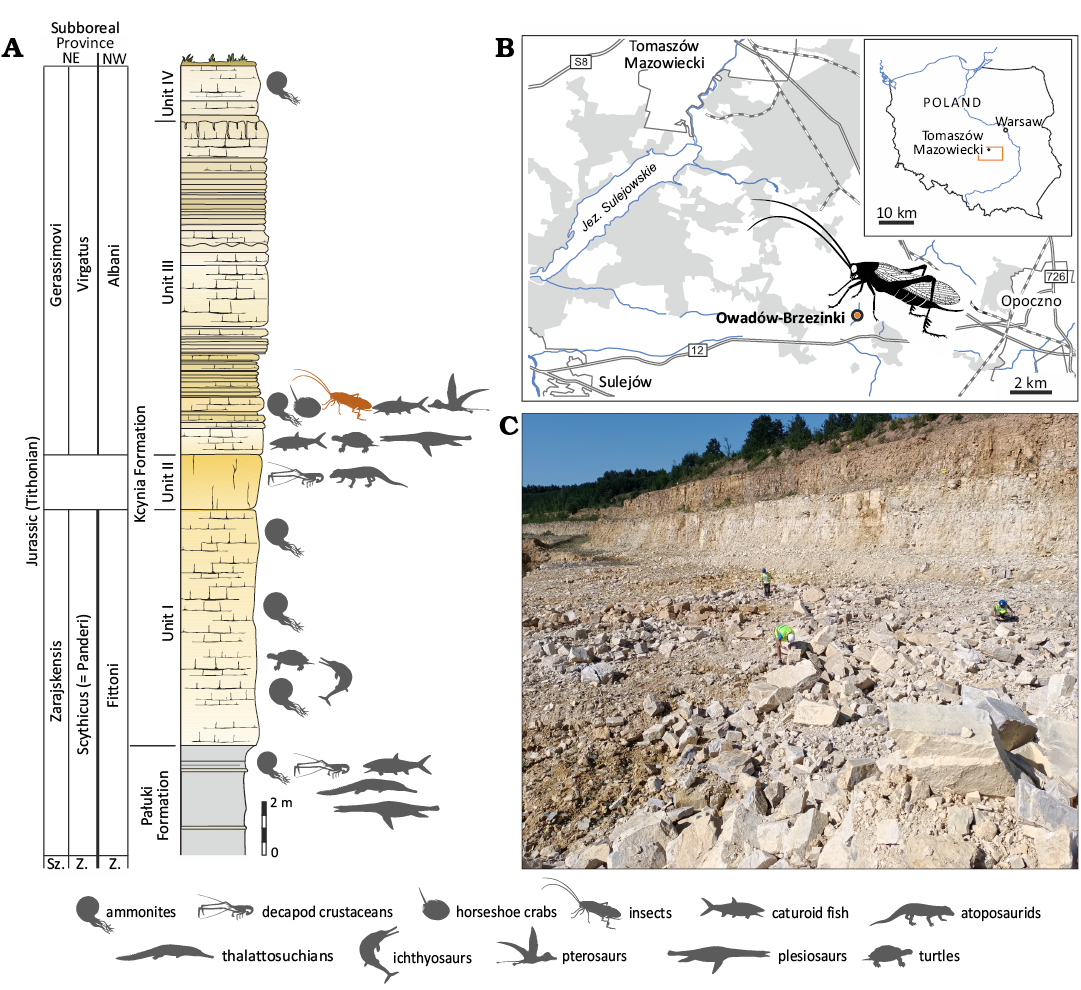
Fig. 1. Owadów-Brzezinki Quarry. A. Lithological succession and biostratigraphy. The topmost part of the Pałuki Fm. and overlying limestones of the Kcynia Formation (Units I–IV): Sz, subzone; Z, zone. B. Location of investigated site with a hypothetical reconstruction of ?Panorpidium polonicum Michalska sp. nov. C. Excavations at the quarry in 2024.
Material and methods
This study describes a new species of elcanid based on one tegmen, collected by Kamil Humański (ZPAL) in 2024 in Owadów-Brzezinki. The specimen is deposited at ZPAL collection in Warsaw, Poland.
Microscopic investigations were performed using an OPTA-TECH STX 12. The specimen was prepared using a vibro tool (pneumatic needle). Photographs were taken with a Canon 450D and then edited with GIMP 2.6. The drawing was made from enlarged photographs using CorelDRAW Home & Student X8. The wing venation nomenclature is based on that of Béthoux and Nel (2002).
Systematic palaeontology
Class Insecta Linnaeus, 1758
Order Orthoptera Olivier, 1789
Superfamily Elcanoidea Handlirsch, 1906
Family Elcanidae Handlirsch, 1906
Subfamily ?Elcaninae Handlirsch, 1906
Genus ?Panorpidium Westwood, 1854
Type species: Panorpidium tessellatum Westwood, 1854; middle Purbeck, upper Berriasian; Durlston Bay, Dorset, UK.
Species included: Panopridium acusicaudum Tian et al., 2022; P. bimaculatum Gorochov et al., 2006; ?P. parvum Gorochov et al., 2006; P. proximum Gorochov et al., 2006; P. sibiricum Sharov, 1968; P. spica Kim et al., 2021; P. stenos Yu & Liu H. in Yu et al., 2025; P. tessellatum Westwood, 1854; P. validum Tian et al., 2022; P. yixianensis Fang et al., 2015.
?Panorpidium polonicum Michalska sp. nov.
Fig. 2.
ZooBank LSID: urn:lsid:zoobank.org:act:3FF5724C-A5E5-444C-B13 B-75484DD21B02.
Etymology: From Polonia, Latin name of Poland, the country from which the specimen was collected.
Holotype: ZPAL I. 1/O-B/49, imprint part (no counterpart), almost complete right tegmen, sex unknown.
Type locality: Owadów-Brzezinki Quarry (coordinates 51°22′46″N 20°07′54″E), Owadów, near Tomaszów Mazowiecki, Łódzkie Voivodeship, Poland.
Type horizon: Lowermost part of the unit III, Kcynia Formation, Tithonian, Upper Jurassic.
Material.—Holotype only.
Diagnosis.—Forewing characters only; large size; six branches of ScP; three longitudinal branches between basal part of RP and CuA+CuPaα; area between MP and posterior wing margin narrow; area between ScP and R very narrow; R forking into RA and RP before ScP reaching anterior margin; RP with over 10 branches; MP originating before ScA reaching anterior margin; CuPa much longer than CuPaα.
Measurements.—Length of preserved imprint 25 mm; probable length of tegmen ~29 mm, 6 mm wide in widest part.
Description.—CP distally curved, reaching anterior margin distally to the fusion point of CuPaα and M+CuA, with numerous branchlets; ScA reaching anterior margin after origin of MP, anteriorly curved, with ca. four parallel branches; ScP ending in anterior margin beyond the origin of basal part of RP, i.e., before R forking into RA and RP, several short branches connecting with ScA and six branches distally reaching anterior margin; area of ScP wider than ScA; stem R long and strong, branching into RA and RP close to the middle of wing length; area between ScP and R narrow; RA long, simple, with numerous (most likely 22) oblique branches reaching anterior margin; RP with over 10 branches, several preserved branches forked shortly before reaching posterior margin; numerous simple crossveins between the branches of RP; area between RA and RP narrow, with one row of veinlets in-between, creating cells decreasing in length towards apex; M branched into MA and MP slightly distally to the end of CP; three longitudinal branches (MA1, MA2, MP) between basal part of RP and CuA+CuPaα; MA branching into MA1 and MA2 almost at the level of the end of ScA; MA1 nearly straight, forked distally, origin before the basal part of RP; MA2 nearly straight, slightly curved reaching posterior margin; MP simple, reaching posterior margin beyond mid-length of wing; no crossveins in area between R and M basal of origin of RP; area between MP and posterior wing margin narrow and covered by crossveins; CuA+CuPaα slightly undulate, originating before the end of CP and ending in posterior margin obliquely, beyond mid-length of wing; CuPa emerging obliquely from CuP, ca. three times as long as CuPaα, branching into CuPaα and CuPaβ close to the wing base; CuPaα located before the base of CuA+CuPaα; area between CuA+CuPaα and CuPaβ with one row of crossveins; distal parts of CuPaβ and CuPb not preserved; anal area not preserved; colouration hyaline or not preserved; wing apex slightly pointed.
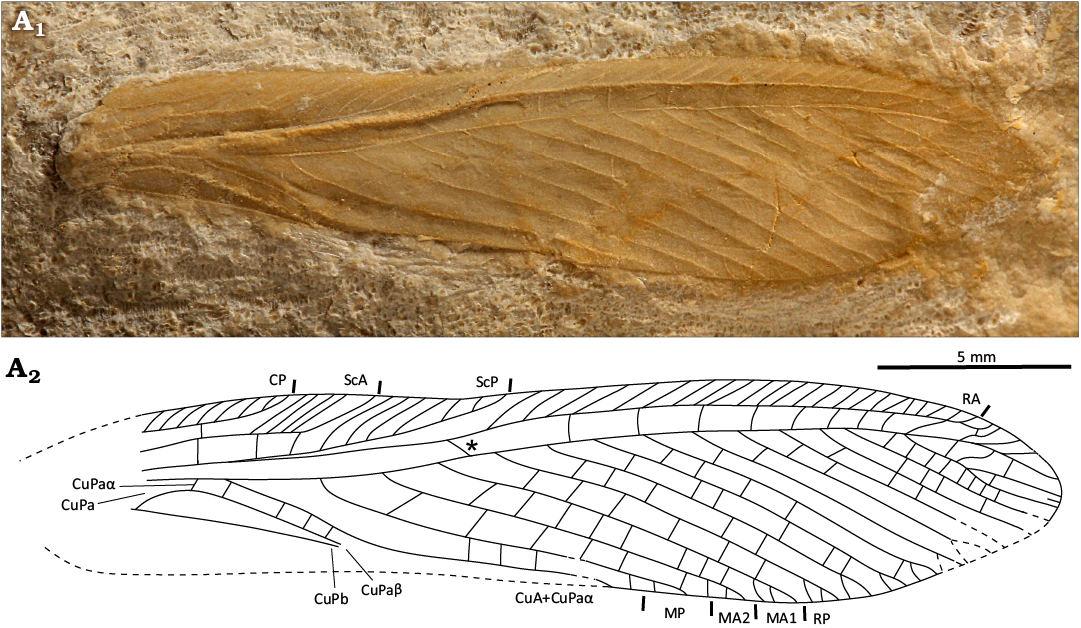
Fig. 2. Elcanid orthopteran ?Panorpidium polonicum Michalska sp. nov., holotype ZPAL I. 1/O-B/49, from Upper Jurassic of Owadów-Brzezinki, Poland. Photograph of tegmen (A1); photo by Dariusz Nast (PAS Museum of Earth, Warsaw. Poland). Reconstruction of wing (A2). Abbreviations: CP, posterior costa; ScA/P, subcosta anterior/posterior; RA/P, radius anterior/posterior; MA/P, media anterior/posterior; CuA/P, cubitus anterior/posterior; CuPaα, anterior branch of first posterior cubitus; CuPaβ, posterior branch of first posterior cubitus; CuPb, second posterior cubitus. Asterisk indicates position of basal part of RP.
Remarks.—This new species is assigned to Elcanoidea Handlirsch, 1906, due to MA being well aligned with distal part of RP. It shares with Elcanidae Handlirsch, 1906, the following features: absence of crossveins in the area between R and M basal of origin of RP, CuA+CuPaα reaching posterior margin obliquely, CuPa emerging obliquely from CuP. It can be possibly assigned to Elcaninae Handlirsch, 1906, by its relatively narrow area between RA and RP, CuPaα not in contact with the base of CuA+CuPaα, and the origin of MA1 branch located before the basal part of RP. It falls in Panorpidium Westwood, 1854, because of the following characters: three longitudinal branches between the basal part of RP and CuA+CuPaα, six branches of ScP, large size, and narrow area between MP and posterior wing margin. The new species can be distinguished from all other Panorpidium species except P. sibiricum by its larger size of the forewing and possibly colouration, additionally, from P. bimaculatum, P. proximum, P. sibiricum, and P. tesselatum by CuPa much longer than CuPaα and narrower area between ScP and R; from P. acusicaudum and P. validum by R forking into RA and RP before ScP reaching anterior margin, and MP originating before ScA reaching anterior margin; from P. spica and P. parvum by more branches of ScP ending at the anterior margin. It differs from P. stenos by more RP branches; and from P. yixianensis by having three longitudinal branches between basal part of RP and CuA+CuPaα.
Stratigraphic and geographic range.—Type horizon and locality only.
Discussion
Systematic placement of ?Panorpidium polonicum Michalska sp. nov.—The superfamily Elcanoidea Handlirsch, 1906, can be easily distinguished by the media anterior (MA) being well aligned with the distal part of the radius posterior (RP) (Nel et al. 2024; a feature shared by ?Panorpidium polonicum Michalska sp. nov.), and it is currently divided into two families, the Permo-Triassic Permelcanidae Sharov, 1962 (Sharov 1962; Poschmann et al. 2023) and the Triassic–?Paleogene Elcanidae Handlirsch, 1906 (Fang et al. 2018; Schubnel et al. 2020). The status of Permelcanidae remains debated, with some authors treating it as a paraphyletic family in the Elcanidae stem group (Nel et al. 2024). The main difference between Permelcanidae and Elcanidae is a characteristic feature of the latter: the presence of specialised spurs on the hind tibia (Nel et al. 2024). Thus, considering the absence of data concerning preserved spurs and the Jurassic age of ?Panorpidium polonicum Michalska sp. nov., the classification of the new tegmen within Elcanidae sensu stricto is uncertain. Regardless, the presence of two branches of MA (a feature shared by ?Panorpidium polonicum Michalska sp. nov.) is also a character present in the Elcanidae sensu stricto (Poschmann et al. 2023; Nel et al. 2024), suggesting that the new fossil is better assigned to Elcanidae.
Gorochov et al. (2006) divided the family Elcanidae into two subfamilies, Elcaninae Handlirsch, 1906, and Archelcaninae Gorochov et al., 2006. Since the tegmen represents the only remaining structure of the insect, its classification was based only on the forewing venation features. Although the structure of distal parts of CuPaβ, CuPb, and 1A is unknown in the tegmen, which makes it impossible to determine if they are free (as in Archelcaninae; Fig. 3B) or fused together (as in Elcaninae; in Eubaisselcana Gorochov, 1986, only CuPb and 1A are fused; Fig. 3A), three other tegminal features listed by Gorochov et al. (2006) and Gorochov and Coram (2022) suggest its placement within Elcaninae: (i) a relatively narrow area between RA and RP; (ii) CuPaα located before the base of CuA+CuPaα (i.e., CuPaα is not in contact with this base; such a position is more usual for Elcaninae, although occurs also in Archelcaninae); (iii) the origin of the MA1 branch located before the anastomosis of RP and this branch (i.e., before the basal part of RP; such a position is also more usual for Elcaninae). Elcaninae currently includes the following genera: Adelphellca Schall et al., 2025; Cratoelcana Martins-Neto, 1991; Ellca Kočárek, 2020; Elcanodentes Willmott et al., 2025; Eubaisselcana Gorochov, 1986; Kolymbelcana Schall et al., 2025; Longipectus Yu & Liu H. in Yu et al., 2025; Minelcana Gorochov et al., 2006; Panorpidium Westwood, 1854; Probaisselcana Gorochov, 1989; Pseudopanorpidium Schall, Willmott, Kotthoff, & Husemann in Willmott et al., 2025; and Pseudoprobaisselcana Schall, Willmott, Kotthoff, & Husemann in Willmott et al., 2025.
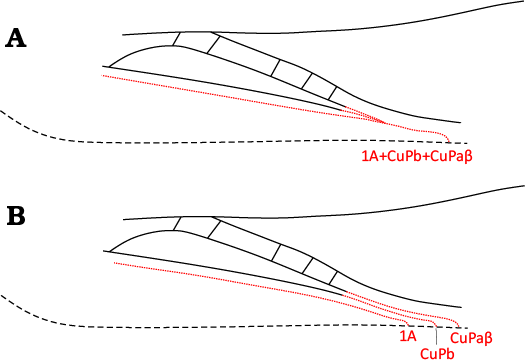
Fig. 3. Possible hypothetical venational configurations (in red) of ?Panorpidium polonicum Michalska sp. nov. as a species of (A) Elcaninae Handlirsch, 1906, with fused distal parts of CuPaβ, CuPb, and 1A (except for Eubaisselcana Gorochov, 1986, in which only CuPb and 1A are fused) or (B) Archelcaninae Gorochov et al., 2006, with free distal parts of CuPaβ, CuPb, and 1A.
The origin of the MA1 branch located before the basal part of RP implies more than two longitudinal branches between basal part of RP and CuA+CuPaα. Three or four such longitudinal branches are characteristic of the genus Panorpidium, and distinguish this genus from Probaisselcana and Minelcana (Gorochov et al. 2006). Moreover, based on the large size of the tegmen, six branches of ScP (Zhou et al. 2022), in their emended diagnosis of Panorpidium, state that the forewing has four to six branches of ScP ending on the costal margin), and narrow area between MP and posterior wing margin (i.e., between MP and CuA+CuPaα), the new tegmen could be assigned to Panorpidium.
Three longitudinal branches of M between basal part of RP and CuA+CuPaα are also present in some Elcaninae genera from the Burma Terrane, e.g., Pseudopanorpidium, and Elcanodentes, although these taxa have a relatively much longer anal margin of the forewing between MP and CuA+CuPaα than species from elsewhere or, at least, than their counterparts from other regions. Other Elcaninae genera from the Burma Terrane (Ellca, Adelphellca, Kolymbelcana, Pseudoprobaisselcana), which have two branches of M between basal part of RP and CuA+CuPaα, also share this feature. This is considered an important new character of Burmese amber Elcanidae and suggests a descent from Gondwanan predecessors, such as the Early Cretaceous Brazilian Cratoelcana with broad area between MP and posterior wing margin (Nel and Jouault 2022; Willmott et al. 2025; in contrast to species of Cratoelcana, ?Panorpidium polonicum Michalska sp. nov. has this area narrow).
In ?Panorpidium parvum Gorochov et al., 2006, in which the generic placement may be subject to change due to incomplete preservation of certain venational features, a situation analogous to that observed in ?Panorpidium polonicum Michalska sp. nov. is present, the structure of distal parts of CuPaβ, CuPb, and 1A is not preserved in the tegmen; however, the tegmen exhibits three longitudinal branches between basal part of RP and CuA+CuPaα. In the case of ?Panorpidium parvum, the open nomenclature results from unclear differences with species of Eubaisselcana. ?Panorpidium polonicum Michalska sp. nov. can be distinguished from Eubaisselcana in having CuPa much longer than CuPaα (versus slightly longer), CuPaα emerging obliquely from CuPa (versus almost straight), by its larger size and possibly colouration (hyaline or unpreserved versus patterned). Three longitudinal branches between the basal part of RP and CuA+CuPaα are also encountered in Archelcaninae Gorochov et al., 2006, although this condition is considerably less common there, e.g., in some species of Parelcana Handlirsch, 1906 (Gorochov and Coram 2022), and in Thagyaminana atawedeia Schall et al., 2026 (Schall et al. 2026). Following the principle of parsimony, ?Panorpidium polonicum Michalska sp. nov. is provisionally assigned to Panorpidium.
The new tegmen differs from the genus Longipectus in size as Longipectus can be distinguished from all other elcanid genera by its smallest body size, 2.95 mm in length.
Systematic background of Panorpidium Westwood, 1854.—Elcanidae (currently Elcaninae Handlirsch, 1906 + Archelcaninae Gorochov et al., 2006) was established in 1906 by Handlirsch, with Elcana Giebel, 1856, designated as the type genus. Zessin (1987) made a revision of 120 species of Elcana and reduced their number to 16 after resolving numerous synonymies. Subsequently, Jarzembowski (1996) synonymized the names Panorpidium with Elcana and Baisselcana Sharov, 1968. As a result, the species within Panorpidium remained inconsistent. As noted by Gorochov et al. (2006), the numerous species of Archelcaninae included in Elcana by earlier authors (Handlirsch 1906; Sharov 1968; Zessin 1987) are in need of generic revision. However, based on forewings, Gorochov et al. (2006) partially revised Panorpidium and assigned to this genus the following species: P. tessellatum Westwood, 1854, P. bimaculatum Gorochov et al., 2006, P. proximum Gorochov et al., 2006, P. sibiricum Sharov, 1968 (originally as Baisselcana sibirica, later Baisselcana was synonymized with Panorpidium by Jarzembowski 1996), and possibly P. parvum Gorochov et al., 2006. Subsequently, several more species were attributed to Panorpidium: P. longirostris Peñalver & Grimaldi, 2010 (nymph, originally described as Burmelcana longirostris, later Burmelcana Peñalver & Grimaldi, 2010, was synonymized with Panorpidium by Zhou et al. 2022); P. yixianensis Fang et al., 2015; P. spica Kim et al., 2021; P. acusicaudum Tian et al., 2022; P. validum Tian et al., 2022; and P. stenos Yu & Liu H. in Yu et al., 2025. Panorpidium maculosum Zhou et al., 2022 was revised and moved to Pseudopanorpidium maculosum, based on its much longer anal margin of the forewing between MP and CuA+CuPaα relative to Panorpidium (Willmott et al. 2025).
Remarks on the appearance of Panorpidium Westwood, 1854, in the fossil record and preliminary comparison with Elcanidae species from Solnhofen Limestone of Bavaria, Germany.—To date, species of Panorpidium have been reported from Europe in the UK (Gorochov et al. 2006) and from Asia in Transbaikalia (Sharov 1968), the Republic of Korea (Kim et al. 2021), Myanmar (Yu et al. 2025) and China (Fang et al. 2015; Tian et al. 2022). Thus, ?Panorpidium polonicum Michalska sp. nov. is one of only several Panorpidium species known from Europe and the first known from Poland. In general, the distribution of European elcanids extends beyond the UK to several regions of continental Europe, e.g., Germany, Spain, Luxembourg, and France (Handlirsch 1906–1908; Zessin 1987; Peñalver and Grimaldi 2010; Schubnel et al. 2020; Heads et al. 2022).
Within Panorpidum all current species are Early Cretaceous in age, with the exception of the Late Cretaceous (Cenomanian) P. stenos. Gorochov and Coram (2022) stated that the Jurassic specimens included by Zessin (1987) in the genus Elcana Giebel, 1856, should probably be transferred to the subfamily Archelcaninae Gorochov et al., 2006. Thus, ?Panorpidium polonicum Michalska sp. nov. would represent the oldest known species of this genus, shifting its earliest occurrence in the fossil record to the Late Jurassic. This result underscores the importance of a critical reassessment of previously described Jurassic species assigned to the genus Elcana (now a synonym of Panorpidium Westwood, 1854).
Among Jurassic sites, the lithographic limestones, Plattenkalk at Solnhofen, southern Germany, are nearly contemporaneous with limestone beds from Owadów-Brzezinki. The Solnhofen lithographic limestones are a famous source of Late Jurassic fossils, including Archaeopteryx, “death trails” of the horseshoe crab Mesolimulus, and huge insects (Wilkin 2020). At the early stage of research at Owadów-Brzezinki, over a decade ago, the locality was referred to as the “Polish Solnhofen” (Kin and Błażejowski 2012) due to the relatively short stratigraphic interval separating these two sites, amounting to approximately two million years. Their paleogeographic proximity, together with comparable paleoenvironmental conditions and faunal assemblages, further justified this comparison, although no true lithographic limestones are developed in Owadów-Brzezinki. In the early 19th century, the systematic collection of large assemblages of fossil insects from Solnhofen was initiated and subsequently investigated by scholars including Germar (1837, 1839, 1842), Hagen (1862), Weyenbergh (1869), Deichmüller (1886) and Oppenheim (1888); these studies were later comprehensively compiled and classified by Handlirsch (1906–1908). At that time, authors identified far more species than are actually valid, largely because species concept was different then, variability was not taken into account at all or only to a very limited extent, and new species were often described for each specimen preserved in a different position. Within Elcana Handlirsch (1908) recognized eight species from the lithographic limestones at Solnhofen, although he suggested that several might be synonymous. Carpenter (1932) reduced this number to four species, and later Zessin’s (1987) revision of Elcanidae followed Carpenter (1932), listing the same four species from Solnhofen: Elcana phyllophora Handlirsch, 1906; E. lithophila Germar, 1842; E. deichmuelleri Handlirsch, 1906; and E. longicornis Handlirsch, 1906. Additionally, Zessin (1987) suggested, that E. longicornis, whose scarce description is based mainly on parts other than the forewing, and E. deichmuelleri might be synonyms.
Given the limited figures and descriptions available, and the need for revision, herein we discuss only tentatively, based on the literature, the similarities between ?Panorpidium polonicum Michalska sp. nov. and Elcanidae species from Solnhofen, as these represent the closest relatives of the new fossil. Also, considering that only the forewing of ?Panorpidium polonicum Michalska sp. nov. is preserved, a detailed analysis is difficult to perform. Regardless, it appears to be most similar to E. deichmuelleri, based on similar size and, likely, the same number of RP branches. It differs from E. phyllophora in being larger and having fewer RP branches, and from E. lithophila in also being larger, but with more RP branches.
Further fossil discoveries from Owadów-Brzezinki, together with a comprehensive revision, may clarify whether the Solnhofen specimens should be assigned to the subfamily Archelcaninae Gorochov et al., 2006, and whether ?Panorpidium polonicum Michalska sp. nov. represents a junior synonym of one of the Solnhofen species. A full revision of the Solnhofen material, however, lies beyond the scope of this paper.
Paleaeoecology and taphonomy.—Among Orthoptera, the forewings of Elcanidae may have played an enhanced role in aerodynamic force production and flight manoeuvrability (e.g., Béthoux and Nel 2002; Kočárek 2020). Although the metatibial spurs are unknown in ?Panorpidium polonicum Michalska sp. nov., the presence of these structures is a characteristic feature of the family Elcanidae, although their function remains uncertain. For instance, Zessin (1987) proposed a specific migratory behaviour for the Central European Jurassic Elcanidae, interpreting their metatibial spurs as an adaptation to swimming after landing on the water surface during long distance travel overseas, i.e., during resting periods on the water (Ansorge 2003; Willmott et al. 2025). The almost complete preservation of the forewing of ?Panorpidium polonicum Michalska sp. nov. may suggest that the insect accidentally jumped into the lagoon of Owadów-Brzezinki (presumably from an island or during a long flight over the sea), followed by its drowning, at least partial disintegration and disarticulation, and subsequent settling to the bottom. The ragged wing could be indicative of various destructive external factors, e.g., predator activity, long transport prior to deposition or being left dead on land for a considerable time, which could have dried out the whole carcass and led to the partial destruction of fragile structures such as wings. The rest of an insect may also have decomposed at the bottom, as wings are more resistant to decay, and earlier decomposition (on land/water surface/in the water column) may have damaged the wing as well (Martı́nez-Delclòs et al. 2004). However, it cannot be ruled out that one of these factors predominated (e.g., the rest of the insect was consumed), leaving the wing as the only remaining structure. Moreover, considering the preservation state of all insects found in Owadów-Brzezinki, i.e., preserved exclusively as wings, elytra, and abdomens, this may be indicative of fluvial transport into the lagoon, or longer drifting time on the water surface.
Conclusions
?Panorpidium polonicum Michalska sp. nov. is currently retained in open nomenclature due to the incomplete preservation of certain critical venational features. An analogous situation occurs in ?Panorpidium parvum Gorochov et al., 2006; both species display three longitudinal branches between the basal part of RP and CuA+CuPaα (three or four such longitudinal branches are characteristic of the genus Panorpidium Westwood, 1854), while the structure of distal parts of CuPaβ, CuPb, and 1A is unpreserved. Within Elcaninae, the subfamily to which Panorpidium is currently assigned, these distal parts are typically fused (with the exception of Eubaisselcana Gorochov, 1986, where only CuPb and 1A are fused). In the case of ?P. parvum, the open nomenclature results from unclear differences with Eubaisselcana. ?Panorpidium polonicum Michalska sp. nov. can be distinguished from Eubaisselcana by having CuPa much longer than Cupaα (versus slightly longer), CuPaα emerging obliquely from CuPa (versus almost straight), by its larger size and possibly colouration (hyaline or unpreserved versus patterned).
Three longitudinal branches between the basal part of RP and CuA+CuPaα are also encountered in Archelcaninae Gorochov et al., 2006, a subfamily characterised mainly by the free distal parts of CuPaβ, CuPb, and 1A. Nevertheless, this condition is considerably less common there, e.g., in some species of Parelcana Handlirsch, 1906, and in Thagyaminana atawedeia Schall et al., 2026. Following the principle of parsimony, ?Panorpidium polonicum Michalska sp. nov. is provisionally assigned to Panorpidium.
As such, ?Panorpidium polonicum Michalska sp. nov. contributes to the ongoing broader discussion on species delimitation and venational variability within Elcanidae, emphasizing the importance of cautious taxonomic interpretation in palaeoecological studies and global biodiversity research. Furthermore, as the first fossil record of Elcanidae from Poland, this discovery expands the known palaeobiogeographic distribution of Late Jurassic orthopteran faunas.
Authors’ contributions
MM took the lead in writing the manuscript and was responsible for material preparation, photography and graphic illustrations; designed and wrote the entire manuscript, described the fossil, and prepared the figures showing the reconstructions. BB supervised the project, provided logistic support during fieldwork and read and approved the final version of the manuscript. The authors maintained continuous communication throughout the development of the manuscript.
Acknowledgements
We would like to thank Kamil Humański (ZPAL) for finding the fossil in the quarry, Dariusz Nast (PAS Museum of the Earth, Warsaw, Poland) for providing the photograph of tegmen, Aleksandra Hołda-Michalska (PAS Museum of the Earth, Warsaw, Poland) for help in preparing Fig. 1, Katarzyna Przestrzelska (ZPAL) for assistance with specimen preparation, and Adam T. Halamski (ZPAL) for insightful comments on earlier version of the manuscript and suggested improvements. The authors gratefully acknowledge the cooperation with the Sławno Commune and Nordkalk Company, which enabled the search for fossil material during ongoing operations at an active quarry. MM sincerely thanks Piotr Węgierek (University of Silesia, Katowice, Poland) and Robert Coram (University of Bristol, UK) for the valuable scientific discussions. Special thanks go to peer reviewers, Jörg Ansorge (University of Greifswald, Germany) and Ole-Kristian Odin Schall (University of Hamburg, Germany), whose helpful comments improved the manuscript. No additional external funding was received for this study.
Editor: Andrzej Kaim
References
Ansorge, J. 2003. Insects from the lower Toarcian of middle Europe and England. Acta Zoologica Cracoviensia 46: 291–310.
Bechly, G. and Kin, A. 2013. First record of the fossil dragonfly family Eumorbaeschnidae from the Upper Jurassic of Poland. Acta Palaeontologica Polonica 58: 121–124. Crossref
Bethoux, O. and Nel, A. 2002. Venation pattern and revision of Orthoptera sensu nov. and sister groups. Phylogeny of Palaeozoic and Mesozoic Orthoptera sensu nov. Zootaxa 96: 1–88. Crossref
Błażejowski, B., Gieszcz, P., and Tyborowski, D. 2016. New finds of well-preserved Tithonian (Late Jurassic) fossils from the Owadów-Brzezinki Quarry, Central Poland: a review and perspectives. Volumina Jurassica 14: 123–132.
Błażejowski, B., Gieszcz, P., Shinn, A.P., Feldmann, R.M., and Durska, E. 2019. Environment deterioration and related fungal infection of Upper Jurassic horseshoe crabs with remarks on their exceptional preservation. Palaeogeography, Palaeoclimatology, Palaeoecology 516: 336–341. Crossref
Błażejowski, B., Wierzbowski, H., and Feldmann, R.M. 2020. Reply to the comment on “No evidence for fungal infection of Upper Jurassic horseshoe crabs: A comment on Błażejowski et al. (2019)” by Zatoń 2020. Palaeogeography, Palaeoclimatology, Palaeoecology 554: 109733. Crossref
Błażejowski, B., Pszczółkowski, A., Grabowski, J., Wierzbowski, W., Deconinck, J.-F., Olempska, E., Teodorski, A., and Nawrocki, J. 2023a. Integrated stratigraphy and clay mineralogy of the Owadów-Brzezinki section (Lower–Upper Tithonian transition, Central Poland): implications for correlations between the Boreal and the Tethyan domains and palaeoclimate. Journal of the Geological Society 180 (2): jgs2022-073. Crossref
Błażejowski, B., Weryński, Ł., Wierzbowski A., Michalska, M., Hryniewicz, K., Uchman, A., Kugler, S., Bącal, P., and Hołda-Michalska, A. 2023b. Summary of a decade of research at the Owadów-Brzezinki Lagerstätte (Tithonian, central Poland): a review and perspectives for the future. Volumina Jurassica 21: 83–98. Crossref
Carpenter, F.M. 1932. Jurassic insects from Solenhofen in the Carnegie Museum and the Museum of Comparative Zoology. Annals of Carnegie Museum 21 (3): 97–129. Crossref
Chang, H., Qiu, Z., Yuan, H., Wang, X., Li, X., Sun, H., Guo, X., Lu, Y., Feng, X., Majid, M., and Huang, Y. 2020. Evolutionary rates of and selective constraints on the mitochondrial genomes of Orthoptera insects with different wing types. Molecular Phylogenetics and Evolution 145: 106734. Crossref
Chrząstowska, J., Dubicka, Z., Barski, M., Worobiec, E., Błażejowski, B., and Todes, J. 2025. A micropalaeontological record of the Early Cretaceous marine-terrestrial interface in central Europe. Lethaia 58 (3): 1–17. Crossref
Deichmüller, J.V. 1886. Die Insecten aus dem lithographischen Schiefer im Dresdener Museum. Mitteilungen aus dem Königlichen Mineralogisch-Geologischen und Prähistorischen Museum in Dresden 7: 1–88.
Dvořák, T., Pecharová, M., Krzemiński, W., and Prokop, J. 2019. New archaeorthopteran insects from the Carboniferous of Poland: Insights into tangled taxonomy. Acta Palaeontologica Polonica 64: 787–796. Crossref
Fang, Y., Muscente, A.D., Heads, S.W., Wang, B., and Xiao, S. 2018. The earliest Elcanidae (Insecta, Orthoptera) from the Upper Triassic of North America. Journal of Paleontology 92: 1028–1034. Crossref
Fang, Y., Wang, B., Zhang, H., Wang, H., Jarzembowski, E.A., Zheng, D., Zhang, Q., Li, S., and Liu, Q. 2015. New Cretaceous Elcanidae from China and Myanmar (Insecta, Orthoptera). Cretaceous Research 52: 323–328. Crossref
Germar, E.F. 1837. Über die versteinerten Insecten des Juraschiefers von Solenhofen aus der Sammlung des Grafen zu Münster. Isis 4: 421–424.
Germar, E.F. 1839. Die versteinerten Insecten Solenhofens. Nova Acta Leopoldina 19: 184–222.
Germar, E.F. 1842. Beschreibung einiger neuen fossilen Insecten. I. In den lithographischen Schiefern von Bayern. Beiträge zur Petrefactenkunde 5: 79–89.
Giebel, C.G. 1856. Fauna der Vorwelt mit steter Berücksichtigung der lebenden Thiere. 511 pp. F.A. Brockhaus, Leipzig.
Gorochov, A.V. 1986. Gryllida (= Orthoptera). In: A.P. Rasnitsyn (ed.), Insects in Early Cretaceous Ecosystems of West Mongolia [in Russian]. Proceedings of the Soviet-Mongolian Paleontological Expedition 28: 171–174.
Gorochov, A.V. 1989. New taxa of the orthopteran families Bintoniellidae, Xenopteridae, Permelcanidae and Vitimiidae [Vitimidae] (Orthoptera, Ensifera) from Mesozoic Asia [in Russian]. Vestnik Zoologii 4: 20–27.
Gorochov, A.V. and Coram, R.A. 2022. New and little known taxa of the suborder Ensifera (Insecta: Orthoptera) from the Lower Cretaceous of England. Cretaceous Research 134 (2): 105164. Crossref
Gorochov, A.V., Jarzembowski, E.A., and Coram, R.A. 2006. Grasshoppers and crickets (Insecta: Orthoptera) from the Lower Cretaceous of southern England. Cretaceous Research 27: 641–662. Crossref
Hagen, H.A. 1862. Über die Neuropteren aus dem lithographischen Schiefer in Bayern. Palaeontographica 10: 96–145.
Handlirsch, A. 1906–1908. Die Fossilen Insekten und die Phylogenie der Rezenten Formen, parts I–IV. 1430 pp. W. Engelmann, Leipzig.
Heads, S., Thuy, B., and Tamarri, J. 2022. Two new species of Archelcana Sharov (Orthoptera: Elcanidae) from the Lower Jurassic of Luxembourg. Kentiana 1: 1–13. Crossref
Jarzembowski, E.A. 1996. Towards a revision of Purbeck insects: Protogryllus, Panorpidium, Pleciomyia and Prohousea nom. nov. Proceedings of the Dorset Natural History and Archaeological Society 117 (for 1995): 155–157.
Kania-Kłosok, I., Szwedo, J., Jordan-Stasiło, W., Krzemiński, W., Draus, J., Krawczyk, K., Rakociński, A., Mazur, J., Zając, J., and Wegierek, P. 2025. A short review of fossil insects preserved in sedimentary rocks in Poland. Palaeoentomology 8: 630–650. Crossref
Kim, D.-Y., Lee, M., Nam, G.-S., and Park, T.-Y.S. 2021. The first orthopteran fossils from the Lower Cretaceous (Albian) Jinju Formation of Korea: Ethological implications for elcanids. Cretaceous Research 125: 104843. Crossref
Kin, A. and Błażejowski, B. 2012. Polskie Solnhofen. Przegląd Geologiczny 60: 375–379.
Kin, A., Gruszczyński, M., Martill, D., Marshall, J., and Błażejowski, B. 2013. Palaeoenvironment and taphonomy of a Late Jurassic (Late Tithonian) Lagerstätte from central Poland. Lethaia 46: 71–81. Crossref
Kočárek, P. 2020. A diminutive elcanid from mid-Cretaceous Burmese amber, Ellca nevelka gen. et sp. nov., and the function of metatibial spurs in Elcanidae (Orthoptera). Cretaceous Research 116: 104574. Crossref
Linnaeus, C. 1758. Systema naturæ per regna tria naturæ, secundum classes, ordines, genera, species, cum characteribus, differentiis, synonymis, locis. Tomus I. Editio decima, reformata. 824 pp. Laurentius Salvius, Stockholm. Crossref
Martı́nez-Delclòs, X., Briggs, D.E., and Peñalver, E. 2004. Taphonomy of insects in carbonates and amber. Palaeogeography, Palaeoclimatology, Palaeoecology 203: 19–64. Crossref
Martins-Neto, R.G. 1991. Sistemática dos Ensifera (Insecta, Orthopteroida) da Formação Santana, Cretáceo Inferior do nordeste do Brasil. Acta Geologica Leopoldensia 32: 5–160.
Matyja, B.A. and Wierzbowski, A. 2016. Ammonites and ammonite stratigraphy of the uppermost Jurassic (Tithonian) in the Owadów-Brzezinki quarry (central Poland). Volumina Jurassica 14: 65–122.
Michalska, M., Weryński, Ł., and Błażejowski, B. 2025. Podoba mi się ten głaz, to naprawdę ładny głaz – czyli o nowych skamieniałościach z Owadowa-Brzezinek. Przegląd Geologiczny 73: 590–595. Crossref
Nel, A. and Jouault, C. 2022. New grasshoppers (Orthoptera: Elcanidae, Locustopsidae) from the Lower Cretaceous Crato formation suggest a biome homogeneity in Central Gondwana. Historical Biology 34: 2070–2078. Crossref
Nel, A., Lian, X. N., Gao, J., and Huang, D. Y. 2024. The first Permian Chinese Elcanoidea (Insecta, Orthoptera). Historical Biology 37: 2268–2271. Crossref
Olivier, G.A. 1789. Encyclopedie methodique, dictionnaire des insectes, Vol. 4. 704 pp. Pankouke, Paris.
Oppenheim, P. 1888. Die Insectenwelt des lithographischen Schiefers in Bayern. Palaeontographica 34: 215–247.
Peñalver, E. and Grimaldi, D.A. 2010. Latest occurrences of the Mesozoic family Elcanidae (Insecta: Orthoptera), in Cretaceous amber from Myanmar and Spain. Annales de la Société Entomologique de France 46: 88–99. Crossref
Poschmann, M., Nel, A., and Raisch, M. 2023. A new archaeorthopteran insect from the Early Permian of the Saar-Nahe Basin, SW Germany, and the earliest record of Elcanoidea (Orthoptera). Neues Jahrbuch für Geologie und Paläontologie Abhandlungen 308: 181–187. Crossref
Schall, O.K.O., Kotthoff, U., and Husemann, M. 2025. Two new genera and species of Elcaninae (Orthoptera, Elcanidae) from mid-Cretaceous Burmese amber. Journal of Orthoptera Research 34: 63–68. Crossref
Schall, O.K.O., Kotthoff, U., and Husemann, M. 2026. Two new members of the Elcanidae (Insecta, Orthoptera) from mid-Cretaceous amber. Journal of Orthoptera Research 35: 63–68. Crossref
Schubnel, T., Desutter-Grandcolas, L., Garrouste, R., Hervet, S., and Nel, A. 2020. Paleocene of Menat Formation, France, reveals an extraordinary diversity of orthopterans and the last known survivor of a Mesozoic Elcanidae. Acta Palaeontologica Polonica 65: 371–385. Crossref
Sharov, A.G. 1962. A new Permian family of Orthoptera [in Russian]. Paleontologičeskij žurnal 1962: 112–116.
Sharov, A.G. 1968. Phylogeny of orthopteroid insects. Proceedings of the Paleontological Institute, Russian Academy of Sciences 118: 1–217.
Tian, H., Ren, D., and Gu, J.J. 2022. Two new species of Elcaninae (Orthoptera, Elcanidae) recorded from the Early Cretaceous China. Zootaxa 5128: 589–596. Crossref
Yu, H., Liu, Y.W., and Liu, H.Y. 2025. Two new species of Elcanidae (Orthoptera: Elcanoidea) from northern Myanmar amber during the late Mesozoic. Zootaxa 5723: 413–424. Crossref
Westwood, J.O. 1854. Contribution to fossil entomology. Quarterly Journal of the Geological Society of London 10: 378–396. Crossref
Węgierek, P. and Zherikhin, V.V. 1997. An Early Jurassic insect fauna in the Holy Cross Mountains. Acta Palaeontologica Polonica 42: 1997: 539–543.
Weyenbergh, H. 1869. Sur les insectes fossiles du calcaire lithographique de la Baviére qui se trouvent au Musée Teyler. Archive Museum Teyler 2: 247–294. Crossref
Wierzbowski, H., Błażejowski, B., Wierzbowski, A., Worobiec, E., and Kowalski, R. 2026. Multi-phase karst sinkhole deposits from the Owadów-Brzezinki quarry, central Poland: sedimentology, palynology and stratigraphy. Annales Societatis Geologorum Poloniae 96: 1–22. Crossref
Wilkin, J. 2020. The south German Plattenkalks. Geology Today 36: 27–32. Crossref
Willmott, L.A., Schall, O.K.O., Kotthoff, U., and Husemann, M. 2025. New species of Burmese amber Elcanidae (Insecta: Orthoptera) suggest Gondwanan origin and demonstrate ovipositor diversity. Paläontologische Zeitschrift 99: 35–51. Crossref
Zessin, W. 1987. Variabilität, Merkmalswandel und Phylogenie der Elcanidae im Jungpaläozoikum und Mesozoikum und die Phylogenie der Ensifera (Orthopteroida, Ensifera). Deutsche Entomologische Zeitschrift, Neue Folge 34: 1–76. Crossref
Zhou, Q., Xu, C.-P., Jarzembowski, E.A., and Xiao, C.-T. 2022. A new species of Elcanidae (Insecta: Orthoptera) from mid-Cretaceous Kachin amber. Cretaceous Research 136: 105226. Crossref
Acta Palaeontol. Pol. 71 (3): 475–483, 2026
https://doi.org/10.4202/app.01336.2026