
An enigmatic polyneopteran insect from the Cisuralian Shanxi Formation in Shuozhou, North China
DIYING HUANG, WANYUN ZHANG, YANZHE FU, WEI LI, and ANDRÉ NEL
The enigmatic early Permian polyneopteran insect Enigmapaolia shanxiensis Huang & Nel, gen. et sp. nov. is described on the basis of a forewing from North China. It is tentatively attributed to the Paoliida and Paoliidae rather than to the “Grylloblattodea”, on the basis of the cubital veins with a broad area between CuP and CuA and general pattern of venation. It shows a unique character among the Paleozoic insects in the short radius anterior distally ending into the subcostal posterior. This fossil increases our knowledge on the diversity of the Paoliidae and the early Permian entomofauna of the Shanxi Formation of North China.
Introduction
Chinese Permian insects are known mostly from the upper Guadalupian Yinping Formation (South China) and Cisuralian Shanxi Formation (North China). Several fossil insects are known from the Shanxi Formation, viz. the palaeodictyopteran Palaeoneura qiligouensis Hong, 1985; the megasecopteran Sunohymen xishanensis Hong, 1985; the odonatopteran Arctotypus? carbonicus Hong, 1985; a putative stem-orthopteran; plus near twenty stem-dictyopteran (Hong 1985; Wang et al. 2019; Santos et al. 2025).
Recently, some well-preserved early Permian insect wing fossils have been collected from a locality near the Zhiyu Village, Shuozhou City, Shanxi Province, North China. Two specimens have been described, viz. the lemmatophorid Shuozhougrylloblatta multifurcata Guo, Deng, Zhang, & Huang in Zhang et al., 2026 (in the order “Grylloblattodea”, a group that is potentially polyphyletic) and the diaphanopterodean Grandelmoa jingqii Xu et al., 2025 (Xu et al. 2025). Here we describe a very strange forewing of a polyneopteran, with unique characters in the venation also from the same locality. It is of uncertain affinities even though we provisionally attribute it to the Paoliidae.
Institutional abbreviation.—NIGP, Nanjing Institute of Geology and Palaeontology, Nanjing, China.
Other abbreviations.—CuA cubitus anterior; CuP cubitus posterior; MA media anterior; MP media posterior; PCu postcubital vein; RA radius anterior; RP radius posterior; ScP subcosta posterior.
Nomenclatural acts.—This published work and the nomenclatural acts it contains have been registered in ZooBank urn:lsid:zoobank.org:pub:7AE116CA-B8A2-4280-9CD6-715FDB86219B.
Material and methods
Only holotype has been collected, with part and counterpart, preserved in green-grayish mudstone from the lower Cisuralian Shanxi Formation at northern Shuozhou City, Shanxi Province. The specimens are carefully prepared using a steel awl. The specimen was photographed under a Zeiss AXIO Zoom V16 stereomicroscope. The holotype is housed in Nanjing Institute of Geology and Palaeontology. We follow the wing venation terminology of Schubnel et al. (2020).
Systematic palaeontology
Class Insecta Linnaeus, 1758
Order ?Paoliida Handlirsch, 1906
Family ?Paoliidae Handlirsch, 1906
Genus Enigmapaolia Huang & Nel nov.
ZooBank LSID: urn:lsid:zoobank.org:act:D3D9B9E8-ECBD-4D4B-81 A4-EB209A1AA23A.
Type species: Enigmapaolia shanxiensis Huang & Nel sp. nov.
Etymology: Named after the enigmatic venation of this taxon and its potential affinities with the Paoliidae. Gender feminine.
Diagnosis.—As for the monotypic type species.
Stratigraphic and geographic range.—Lower Permian, Zhiyu Village, Shuozhou City, Shanxi Province, North China.
Enigmapaolia shanxiensis Huang & Nel, sp. nov.
Fig. 1.
ZooBank LSID: urn:lsid:zoobank.org:act:99759D50-BB6A-49C7-A8 EE- 9DAD652C9C82.
Etymology: Named after the Shanxi Province in China.
Holotype: NIGP210221 (a nearly complete forewing with apex missing).
Type locality: Zhiyu Village, Shuozhou, Shanxi, North China.
Type horizon: Cisuralian Shanxi Formation, lower Permian.
Diagnosis.—Forewing characters only. RA short and ending into ScP; RP anteriorly pectinate, stem of RP short; anterior branch of CuA simply forked.
Material.—Type material only.
Description.—Forewing dark brown, with veins indicated by pale color, wing ca. 14.0 mm long, 4.9 mm wide; concave ScP simple, 9.3 mm long, reaching 66% of wing length, ScP apparently appressed to R in basal third, possibly due to a taphonomic deformation; area between C and ScP broad, 0.9 mm wide, crossed by a series of simple elongate veinlets; convex R separating into simple convex RA and concave RP 6.0 mm from wing base; a series of simple veinlets in area between R/RA and ScP; RA hardly visible, short and ending into ScP; stem of RP short, 1.0 mm long, RP with four simple anterior branches; M basally fused or appressed to R, separating from it 1.7 mm from wing base; first posterior branch of M (MP) simple, emerging 3.5 mm distal of point of separation between R and M; anterior branch of M (MA) forked with branches simple; area between R/RP and M with two rows of irregular cells; no m-cua crossvein (arculus); Cu basally separated from R+M, divided into convex CuA and concave CuP 1.1 mm from wing base; area between M/MP and CuA narrow; first fork of CuA 3.6 mm far from its base; anterior branch of CuA forked, posterior branch of CuA simple; area between CuA and CuP rather broad, 0.7 mm wide, broader than that between M and CuA; CuP nearly straight, ending into posterior margin of wing 7.8 mm from wing base; Convex PCu straight, closely parallel to CuP; two simple anal veins; area between CuP and posterior margin of wing 1.2 mm wide.
Stratigraphic and geographic range.—Type horizon and locality only.
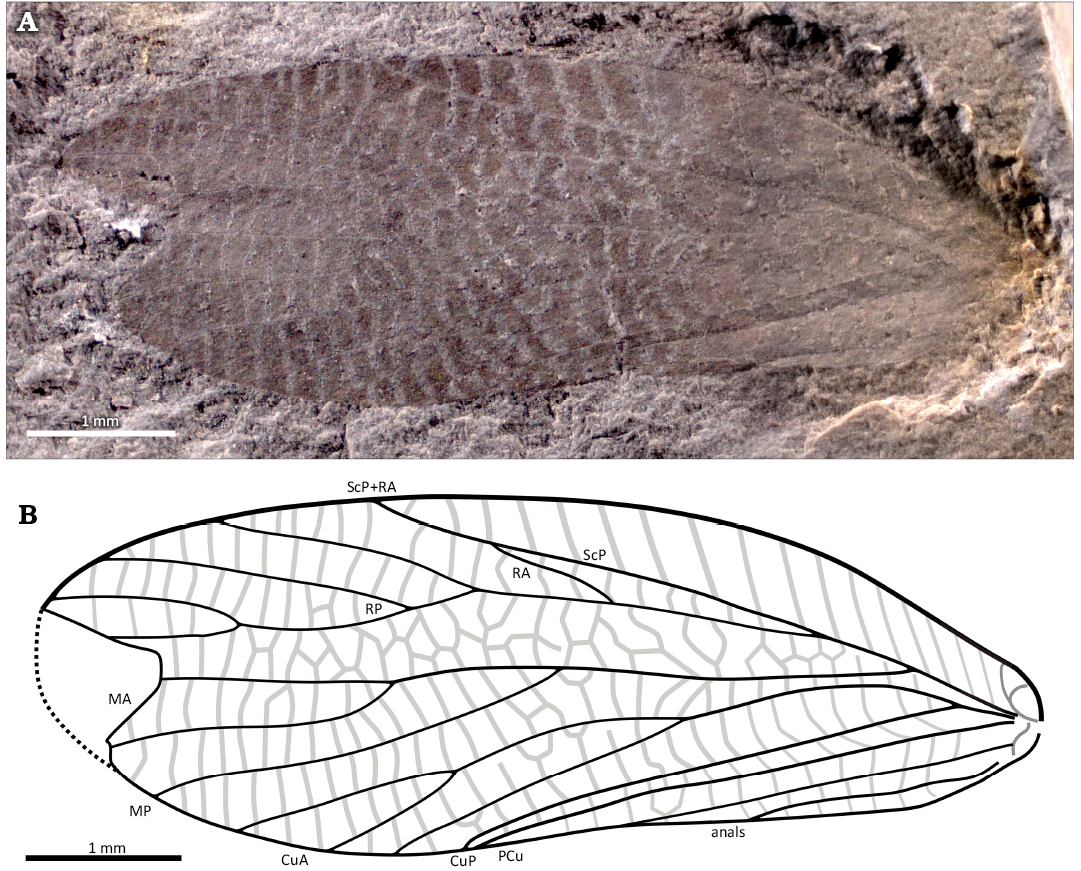
Fig. 1. ?Paoliid polyneopteran Enigmapaolia shanxiensis Nel & Huang gen. et sp. nov., holotype (NIGP210221) from Zhiyu Village, Shuozhou, Shanxi, North China; Cisuralian Shanxi Formation, lower Permian. A. Photography. B. Forewing reconstruction.
Discussion
We interpret this fossil is a forewing because of the narrow anal area posterior of PCu vein. This state is known in polyneopterans close to Paoliida and in “Grylloblattodea” because of the broad area between C and ScP, base of M fused to that of R at wing base, and CuA emerging from a common stem with CuP, separated from stem of R+M.
This forewing is quite remarkable in having the RA short and distally ending into ScP. The rather broad area between CuP and CuA and the distal division of CuA into a simple posterior branch and an anterior subdivided again distally advocate for an attribution to the Paoliida sensu Prokop et al. (2014) and Nel and Poschmann (2021). The “Grylloblattodea” have either no posterior branch of CuA or this branch is situated near to the base of CuA, in a much more basal position than in the new fossil (Storozhenko 1998). Nevertheless, the attribution of the new fossil to the Paoliida is only tentative because its RA is quite different from those of the Paoliida as it is distally fused to ScP; also there is no veinlet distally emerging from it. Also, ScP seems to be rather weakly concave and RA weakly convex, unlike in paoliids. But this could be due to taphonomic preservation. Another particular character of the new fossil is the anteriorly pectinate RP. But this situation also occurs in the paoliid Ideliopsina Storozhenko, 1997. The general pattern of crossveins strongly resembles that of the paoliid Permula lebachensis (Schlechtendal, 1913) (Nel and Poschmann 2021: fig. 1).
Conclusions
Enigmapaolia shanxiensis Huang & Nel gen. et sp. nov. is tentatively attributed to the Paoliidae. We refrain from erecting a new family that would be based on the autapomorphy of the fusion of RA with ScP because of the lack of phylogenetic analysis of the Paoliidae. Its description increases our knowledge on the diversity of these polyneopteran insects during the Permian.
Acknowledgements
We are grateful to Jakub Prokop (Charles University, Praha, Czech Republic) and Chenyang Cai (NIGP) who have provided constructive comments on the first version of this manuscript. We also thank En-Yuan Guo, Zhong-Shu Liu, Zhi-Liang Zhao (all NIGP) for field work helps. Financial support was provided by the National Natural Science Foundation of China (42288201).
Editor: Andrzej Kaim
References
Handlirsch, A. 1906–1908. Die fossilen Insekten und die Phylogenie der rezenten Formen. 1430 pp. Wilhelm Engelmann, Leipzig. Crossref
Hong, Y. 1985. New fossil genera and species of Shanxi Formation in Xishan of Taiyuan. Entomotaxonomia 7 (2): 83–91.
Linnaeus, C. 1758. Systema naturæ per regna tria naturæ, secundum classes, ordines, genera, species, cum characteribus, differentiis, synonymis, locis. Tomus I. Editio decima, reformata. 824 pp. Laurentius Salvius, Stockholm. Crossref
Nel, A. and Poschmann, M.J. 2021. Comparison of the recently described early Permian paoliid genus Permomertovia with the ‘eoblattid’ genera of the families Permulidae and Permotermopsidae. Palaeoentomology 4 (1): 39–43. Crossref
Prokop, J., Krzemiński, W., Krzemińska, E., Hörnschemeyer, T., Ilger, J.-M., Brauckmann, C., Grandcolas, P., and Nel, A. 2014. Late Palaeozoic Paoliida is the sister group of Dictyoptera (Insecta: Neoptera). Journal of Systematic Palaeontology 12: 601–622. Crossref
Santos, A.A., McLoughlin, S., and Nel, A. 2025. A new representative of the roachoid family Necymylacridae (stem group Dictyoptera) and associated vegetation with insect interactions from the Shanxi Formation (lower Permian), China. Palaeoworld 34: 200991. Crossref
Schlechtendal, D.H.R. von. 1913. Untersuchung über die karbonischen Insekten und Spinnen von Wettin unter Berucksichtigung berwandter Faunen (Revision der Originale von Germar, Giebel und Goldenberg). Nova Acta Akademia Leopoldina-Carolinae 98 (1): 1–186.
Schubnel, T., Desutter-Grandcolas, L., Legendre, F., Prokop, J., Mazurier, A., Garrouste, R., Grandcolas, P., and Nel, A. 2020. To be or not to be: postcubital vein in insects revealed by microtomography. Systematic Entomology 45: 327–336. Crossref
Storozhenko, S.Y. 1997. New Triassic grylloblattids of the family Ideliidae (Plecopteroidea, Grylloblattida). Russian Entomological Journal 5 (1–4): 13–19.
Storozhenko, S.Y. 1998. Sistematika, filogeniâ i evolûtsiâ grilloblattidovyh nasekomyh (Insecta: Grylloblattida). 207 pp. The Russian Academy of Sciences, Far Eastern Branch, Biological and Soil Institute, Dal’nauka, Vladivostok.
Wang, J., Béthoux, O., Ren, D., and Cui, Y. 2019. An insect wing discovered in the Early Permian Taiyuan Formation (Shanxi Province, China). Fossils Records 22: 73–76. Crossref
Xu, Z., Yang, N., Oyama, N., Xu, Y., Dong, L., Ren, D., and Béthoux, O. 2025. A new, large Permian Parelmoidae (Insecta, Megasecopteromorpha, Diaphanopterodea) found in Shanxi Province (China). Geodiversity 47 (18): 705–712. Crossref
Zhang, X., Deng, X., Zhang, L., Guo, S., and Huang, W. 2026. A new genus of the family Lemmatophoridae (Insecta: Grylloblattida) from the Lower Permian of Shanxi, China. Historical Biology 38 (2): 382–386 [published online in 2025]. Crossref
Diying Huang [dyhuang@nigpas.ac.cn; ORCID: https://orcid.org/0000-0002-5637-4867 ] (corresponding author) and Yanzhe Fu [yzfu@nigpas.ac.cn; ORCID: https://orcid.org/0000-0002-7819-1703 ], State Key Laboratory of Palaeobiology and Stratigraphy, Nanjing Institute of Geology and Palaeontology, Chinese Academy of Sciences, Nanjing 210008, China.
Wanyun Zhang [54884463@qq.com; ORCID: https://orcid.org/0009-0003-9696-4890 ], Shuozhou No.4 Middle School, Shuozhou 036006, Shanxi, China.
Wei Li [615509449@qq.com; ORCID: https://orcid.org/0009-0005-8887-7433 ], Jiadi Residential Community, Shanyin, Shuozhou 036900, Shanxi, China.
André Nel [anel@mnhn.fr; ORCID: https://orcid.org/0000-0002-4241-7651 ] (corresponding author), Institut de Systématique, Evolution, Biodiversité (ISYEB), Muséum national d’Histoire naturelle, CNRS, Sorbonne Université, EPHE, Université des Antilles, CP 50, 57 rue Cuvier, 75005 Paris, France.
Received 21 March 2026, accepted 29 May 2026, published online 26 August 2026.
Copyright © 2026 D. Huang et al. This is an open-access article distributed under the terms of the Creative Commons Attribution License (for details please see http://creativecommons.org/licenses/by/4.0/), which permits unrestricted use, distribution, and reproduction in any medium, provided the original author and source are credited.
Acta Palaeontol. Pol. 71 (3): 485–487, 2026
https://doi.org/10.4202/app.01355.2026