
An engaging introduction to palaeobotany
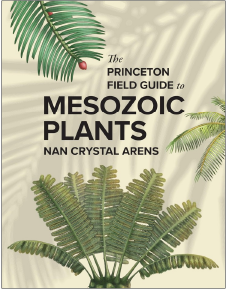
Arens, N.C. 2025. The Princeton Field Guide to Mesozoic Plants. Illustrated by Sante Mazzei. 208 pp. Princeton University Press, Princeton and Oxford. ISBN 9780691272436.
After several groups of vertebrates, a new palaeontological volume of the series Princeton Field Guides is devoted to Mesozoic plants. It consists of ten introductory chapters (pp. 9–87), followed by “Group and Species Descriptions” (pp. 88–202).
The author rightly points out that plants are so poorly known that “some people question whether they are life-forms at all” (p. 6), several aspects of plant biology are thus conveniently covered in concise sections. The introduction starts with a short report on the history of palaeobotany and continues discussing topics as diverse as methods of dating, palaeogeography, extinctions, life cycles of various plant groups, relation to environment, growth modalities, evolution, palaeoclimate, taphonomy, and notable palaeobotanical localities. There is a section on naming (organ nomenclature vs. whole-plant concept), which is praiseworthy for a popular science book; sadly, even some professional palaeontologists treat matters of nomenclature with disdain.
The main section consists of 130 entries, each of them corresponding either to a single species or a single whole-plant (several organ species). Entries are standardised, with location, age, description, petrographic characteristics of the plant-bearing rock, reconstructed habitat, and notes. Each entry is illustrated by at least one drawing, some of them are in colour, some in shades of greyscale. The focus of the book is clearly on the Mesophytic flora: 50 entries are on various gymnosperms, with subdivisions down to orders, and for conifers even to families. Angiosperms (40) are treated as a whole, with representatives of magnoliids, Chloranthaceae, and eudicots arranged alphabetically. The same is true for the stratigraphic diagram (p. 51): fern orders, conifer families, and a single line for the entire division of angiosperms.
“Plants” are understood in this book in the strictest sense, as synonymous with embryophytes. Such an approach can be found in the literature, but I would expect at least a mention of the equally justified, more traditional, and probably more frequent understanding of plants sensu lato, as including glaucophytes, red and green algae, and cormophytes. So, among the organisms discussed in the book there are no algae nor a single bryophyte.
A limited choice of taxa for a book which must stay within reasonable limits will probably never be entirely satisfactory for any single palaeobotanist, yet I would suggest, for example, dropping problematic foliage (like one of two species of Ficophyllum, or “Sterculia”) in favour of the incredibly well-preserved early eudicot, aptly named Leefructus mirus (Lat. mirus, admirable) and a representative of the Normapolles complex known through mesofossils.
It is evident that some simplifications are inevitable in a popular science book, yet I object to forcing form-taxa into the natural system. For example, Microphyllopteris are ferns that cannot be conclusively included in any family or order, and are not representatives of the Gleicheniaceae (p. 110). Likewise, Vitis stantonii is said to show a “superficial” resemblance to modern grape genus (p. 202); if so (and I’d say this is very likely), at least the genus name should be taken into quotation marks, “Vitis” stantonii. The same is true for Gleichenites, used for ferns in the text, whereas the type is not a fern. The extinction of the Caytoniales is dated to the Berriasian (p. 51), but Sagenopteris is known up to the Campanian. Pre-Cretaceous angiosperms may have existed, but describing their characteristics (p. 15) is too speculative for me.
In the systematic part, there is just a single photograph; all the other illustrations are drawings. I agree in many cases drawings say more. But a near-complete absence of photographs might give a disturbing impression of a discipline devoid of real objects of study. Providing photographs would also help to understand how painstaking preparing a reconstruction can be.
A glossary would be helpful in reading the descriptions. I am not sure every reader of this guide will know the definitions of twice-pinnate leaves, pinnae, pinnules, fronds, or ultimate lobes. A morphological introduction is absent from the book, and these terms are not in the index. There is a certain contrast between the introduction, in which the author deals with complex matters in impressively simple words, and the descriptions that in some cases might be too technical.
Despite some caveats, I would definitely recommend this nicely printed and profusely illustrated book. There are few, if any, books of similar scope.
I remember once coming across a bittersweet meme that depicted the different branches of palaeontology as three people in a pool: vertebrate palaeontology was having fun, invertebrate palaeontology was gasping for air, and palaeobotany was represented by a corpse tied to a wheelchair with a rusty chain at the bottom of the pool. Indeed, positions and financing for palaeobotanists have been decreasing for years. Producing well-written, aesthetically pleasing, and, on top of all that, inexpensive books that could awaken a more widespread interest in palaeobotany, like that by Nan Crystal Arens, is one of the best, if not the best, way to reverse this worrisome trend.
Adam T. Halamski [ath@twarda.pan.pl; ORCID: https://orcid.org/0000-0003-4179-9253 ], Institute of Paleobiology, Polish Academy of Sciences, ul. Twarda 51/55, 00-818 Warsaw, Poland.
Acta Palaeontol. Pol. 71 (2): 246, 2026
http://doi.org/10.4202/app.01360.2026